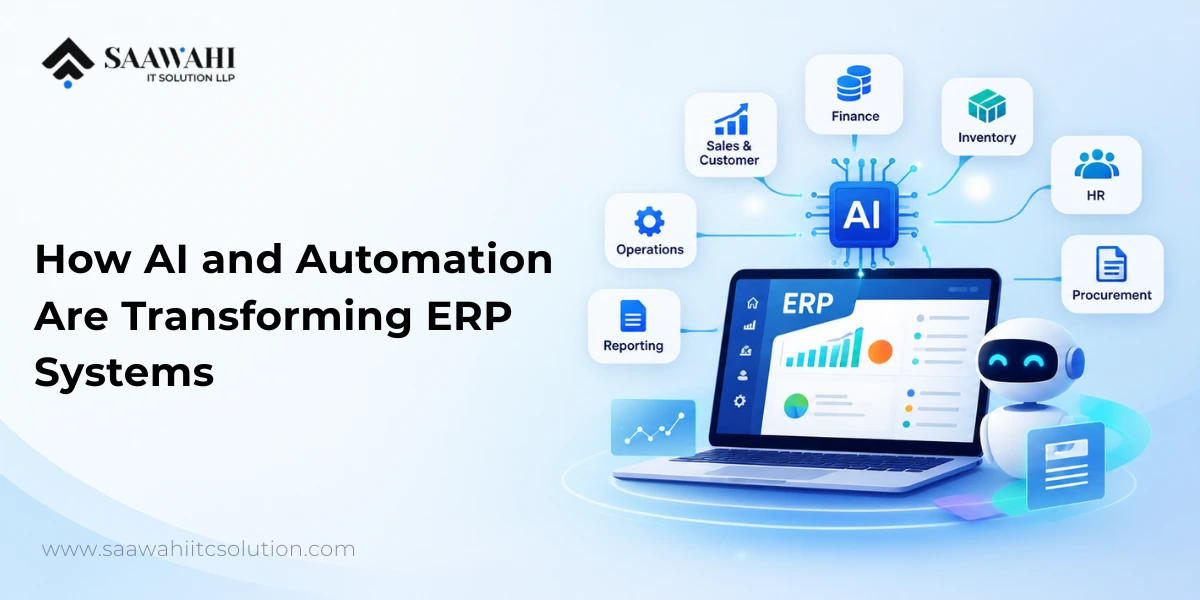
AI-Powered ERP Software: How AI and Automation Are Transforming ERP Systems
Date - 14/09/2026
AI | 21st August
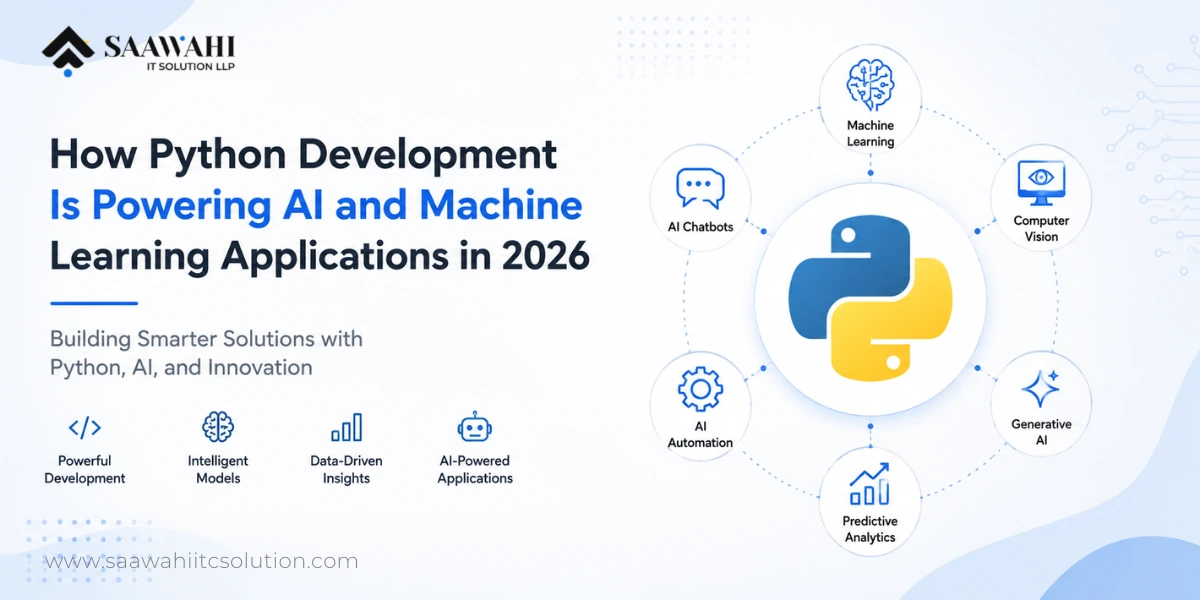
Python development has become a core technology behind modern artificial intelligence (AI) and machine learning (ML) applications. In 2026, businesses are using Python to build intelligent software for automation, predictive analytics, natural language processing, computer vision, recommendation systems, generative AI, and AI-powered business workflows.
Python is particularly effective for AI and ML because it combines a simple development experience with a mature ecosystem of frameworks, libraries, APIs, and data-processing tools. This allows development teams to move from experimentation to production more efficiently.
For businesses planning an AI initiative, Python development services can provide the technical foundation needed to build, integrate, and scale intelligent applications.
Python is widely used for AI and machine learning because it provides a strong combination of developer productivity, data-processing capabilities, frameworks, and community support.
Several characteristics make Python suitable for AI development:
This combination makes Python a practical choice for organizations moving from traditional software development toward AI-powered applications.
Python development is powering AI applications by providing the programming foundation for model development, data processing, AI integration, automation, and intelligent application logic.
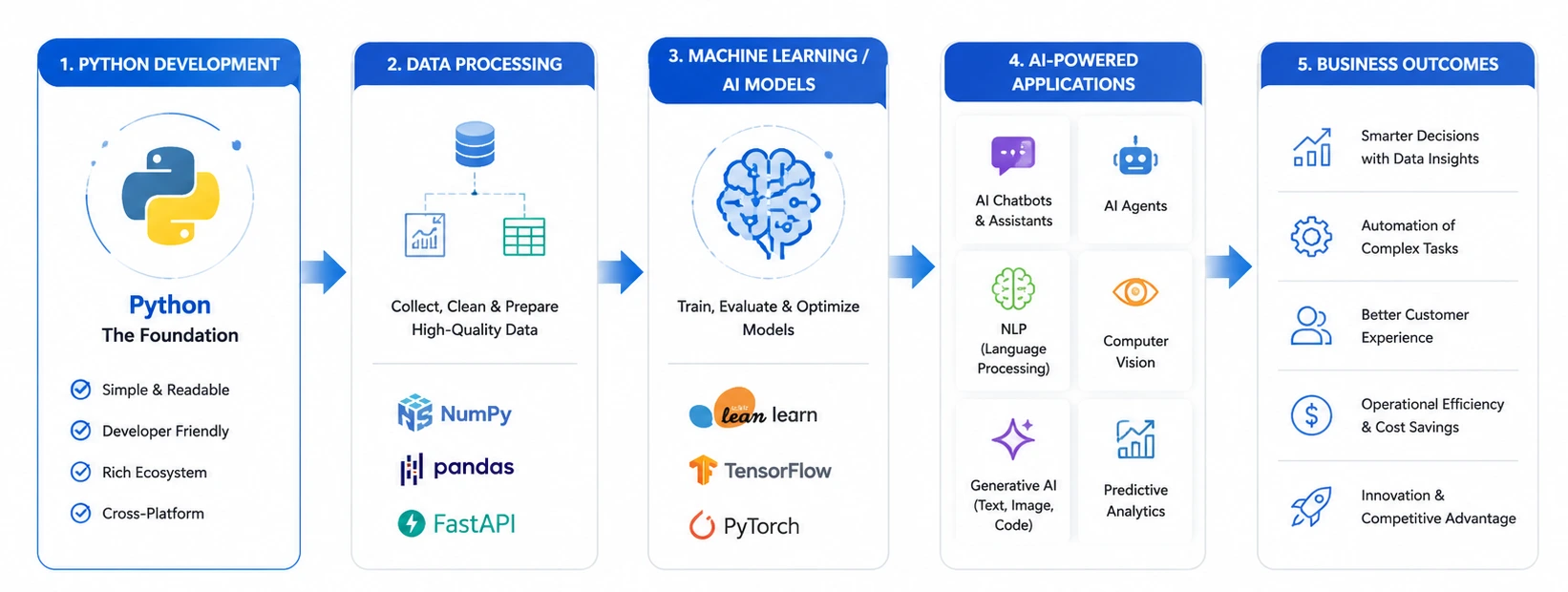 In 2026, Python is being used across the AI application lifecycle. Developers can use Python to prepare training data, develop machine learning models, connect applications to AI APIs, implement retrieval pipelines, integrate large language models, and deploy AI-powered workflows.
This makes Python useful for both traditional machine learning applications and newer generative AI development projects.
Python can support a wide range of AI applications, from predictive systems to conversational assistants and intelligent automation.
Python can be used to build AI chatbots that understand natural-language queries and provide automated responses. These systems can connect with company databases, CRM platforms, knowledge bases, websites, and communication channels.
Businesses can use AI chatbots for customer support, internal knowledge management, lead qualification, appointment assistance, and employee support.
Python is also widely used for generative AI development, where applications generate text, images, summaries, code, recommendations, or other content.
Python can connect AI models with application logic, databases, APIs, vector databases, and retrieval systems. This makes it possible to create business-specific AI applications instead of relying only on standalone AI tools.
Python machine learning applications can analyze historical data and identify patterns that help businesses make predictions.
Common applications include:
Python provides a strong ecosystem for natural language processing (NLP). Businesses can use NLP to analyze documents, classify text, extract information, summarize content, understand customer feedback, and build conversational interfaces.
Computer Vision
Python can also support computer vision development for applications that need to interpret images or video.
Examples include:
The Python ecosystem includes specialized tools for different AI and machine learning requirements.
| Technology | Common Application |
| TensorFlow | Machine learning and deep learning |
| PyTorch | Deep learning and AI research |
| Scikit-learn | Traditional machine learning |
| NumPy | Numerical computing |
| Pandas | Data analysis and preparation |
| OpenCV | Computer vision |
| Hugging Face Transformers | NLP and generative AI |
| FastAPI | Building high-performance AI APIs |
| LangChain | LLM and AI application development |
The right technology stack depends on the application, data requirements, model architecture, performance requirements, and deployment environment.
Python supports generative AI development by connecting large language models and other foundation models with the business logic surrounding them.
For example, a Python-based generative AI application can:
This architecture allows businesses to create AI solutions that are connected to their own data and operational processes.
Organizations exploring AI development services can therefore use Python as the application layer connecting AI models with real-world business systems.
Python is increasingly useful for AI agent development because AI agents need more than a language model. They require application logic, tools, APIs, memory, data retrieval, authentication, workflow orchestration, and system integrations.
A Python-based AI agent can be designed to:
For example, an AI sales agent could receive a lead, analyze the lead information, retrieve relevant customer data, prepare a response, update a CRM, and notify a sales representative.
This is where AI agent development services can help businesses move beyond basic chatbots toward task-oriented AI systems. For a deeper look at hiring for this shift, see why agentic AI requires specialized Python developers.
Python makes it possible to connect AI capabilities with automated business processes.
An AI-powered workflow can combine Python applications, APIs, databases, AI models, and workflow automation platforms to reduce repetitive manual tasks.
Examples include:
Businesses can also combine Python with AI automated workflows to create systems that make decisions or recommendations while keeping human approval where it is required.
Python is not the only language used for AI, but it has a major advantage in ecosystem maturity.
| Requirement | Python | Other Languages |
| AI/ML ecosystem | Excellent | Varies |
| Rapid prototyping | Excellent | Varies |
| Data science | Excellent | Varies |
| Deep learning | Excellent | Strong alternatives exist |
| AI API integration | Excellent | Widely supported |
| Developer availability | High | Depends on technology |
| Production application development | Strong | Strong alternatives exist |
The best programming language ultimately depends on the application’s requirements. Python is particularly attractive when AI, data processing, experimentation, and rapid development are central to the project.
Businesses should hire Python developers when they need custom software that involves Python-based backend development, AI integration, machine learning, data processing, automation, or API development.
Hiring Python developers can be particularly valuable when a project requires:
For an AI project, businesses should look beyond general Python knowledge and evaluate experience with AI frameworks, APIs, databases, cloud deployment, model integration, security, and production systems. And if you’re deciding between a freelancer and a dedicated hire, these 10 reasons break down the trade-offs.
The right Python development services provider should combine Python engineering expertise with an understanding of the business problem.
Consider these factors before selecting a development partner:
Check whether the development team has experience with relevant Python frameworks, APIs, databases, cloud environments, and application architectures.
If the project includes AI, the team should understand machine learning, generative AI, NLP, computer vision, or AI agent architectures relevant to the project.
Business applications rarely operate independently. Your development partner should be able to integrate Python applications with CRMs, payment systems, databases, cloud platforms, APIs, and third-party services.
AI applications often process sensitive business information. Development teams should consider authentication, authorization, data protection, API security, monitoring, and scalable infrastructure from the beginning.
A proof of concept is different from a production application. Look for developers who understand deployment, testing, monitoring, optimization, maintenance, and ongoing improvements.
Python is likely to remain an important technology for AI development because its ecosystem continues to evolve alongside machine learning and generative AI.
Future Python-based AI applications will increasingly focus on:
The key trend is shifting from standalone AI models toward AI-enabled software products. Python can play an important role in connecting models, data, APIs, workflows, and user-facing applications.
Businesses should start with a clearly defined business problem rather than choosing an AI technology first.
A practical approach is:
Define the process, customer problem, or operational challenge that AI needs to address.
Determine what data is available, where it is stored, and whether it is suitable for the intended application.
Decide whether the solution requires traditional machine learning, generative AI, an AI chatbot, computer vision, predictive analytics, or an AI agent.
Test the core functionality before investing in a larger production system.
Connect the Python application with databases, APIs, CRM platforms, internal tools, and other required systems.
Move the application into production with appropriate security, monitoring, performance optimization, and maintenance.
Saawahi IT Solution helps businesses build custom software and AI-powered applications using modern development technologies.
Our Python development services can support backend development, API development, data-intensive applications, AI integrations, automation, and custom software requirements.
For organizations looking to build intelligent products, our capabilities also extend to AI development services, generative AI development, AI chatbot development, and AI agent development.
The objective is not simply to add AI to an existing application. The focus is on building practical AI solutions that connect technology with measurable business outcomes.
Yes. Python remains a strong choice for AI development in 2026 because of its extensive machine learning, deep learning, data science, generative AI, and API ecosystem.
Yes. Python can connect generative AI models with databases, APIs, business applications, retrieval systems, and application logic to create customized generative AI solutions.
If an AI project requires custom backend development, data processing, API integration, automation, model integration, or production deployment, hiring experienced Python developers can be a practical option.
Python development refers to building software using Python, while AI development focuses on creating applications that use artificial intelligence techniques. Python is one of the most widely used technologies for building AI applications.
The cost depends on application complexity, required features, development time, integrations, AI models, infrastructure, and the experience of the development team. A simple Python application can require significantly less effort than an enterprise AI platform.
Yes. Python can be used to build AI agents that connect language models with APIs, databases, business applications, tools, retrieval systems, and automated workflows.
Python development is playing a significant role in the evolution of AI and machine learning applications in 2026. Its mature ecosystem, development flexibility, data-processing capabilities, and compatibility with modern AI technologies make Python a practical foundation for intelligent software.
From machine learning and predictive analytics to generative AI, AI chatbots, automation, and AI agents, Python can support multiple stages of an AI application’s lifecycle.
For businesses planning to build these solutions, choosing the right development expertise is as important as choosing the technology. Whether you need to hire Python developers for a custom application or want end-to-end Python development services, the right team can help transform an AI concept into a scalable production solution.

Wama Sompura is the CEO of Saawahi IT Solution, leading innovations in AI, automation, and digital solutions that help businesses drive efficiency and growth.
© Copyright 2025 All Rights Reserved. Saawahi IT Solution LLP.