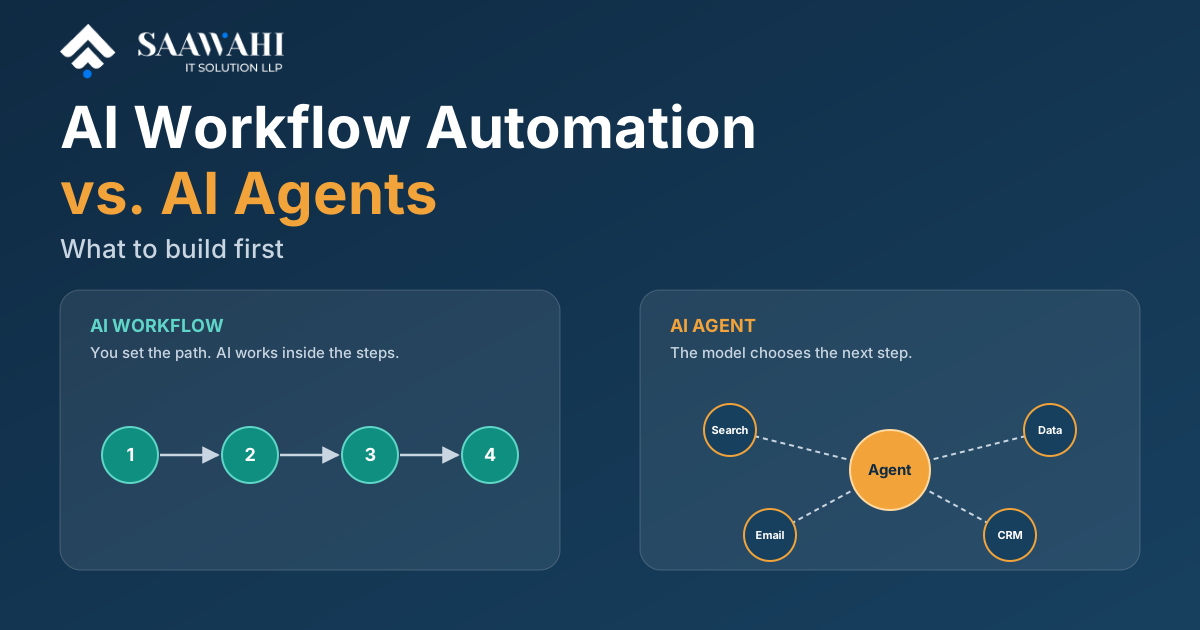
AI Workflow Automation vs. AI Agents: What to Build First
Date - 13/10/2026
AI | 26th October
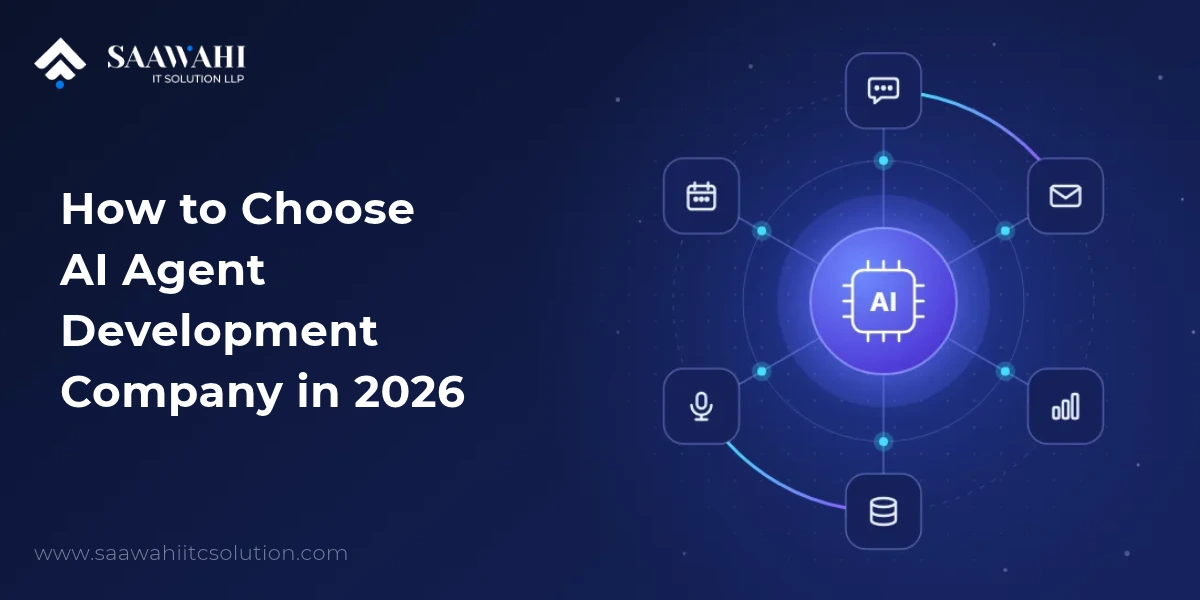
Businesses no longer want AI that only talks. They want AI that does the work. That shift is why more companies are hiring an AI agent development company in 2026: a partner that builds software which plans, uses your tools, and finishes tasks on its own.
The demand is real. expects 40% of enterprise apps to include task-specific AI agents by the end of 2026, up from less than 5% in 2025 (UC Today). By 2028, it predicts at least 15% of day-to-day work decisions will be made autonomously by agentic AI (Outlook Business).
There is a catch. predicts that more than 40% of agentic AI projects will be cancelled by the end of 2027, because of rising costs, unclear business value, or weak risk controls. The partner you choose decides which side of that number you land on.
This guide explains what an AI agent development company does, what it builds, what it costs, and how to pick the right one with a 10-point checklist.
An AI agent development company designs, builds, and maintains AI agents for businesses. An AI agent is software that is given a goal, decides the next step, and acts through your tools, such as your CRM, inbox, or database. The company brings together LLM engineering, software integration, and security in one team.
Every AI agent is built from four parts:
An AI agent loops through plan, act and observe until the goal is met
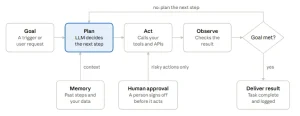
The agent repeats plan, act, and observe until the goal is met. It pulls context from memory and pauses for human approval before risky actions.
A good partner does far more than connect a model to an API. It decides where autonomy pays off, where a person must approve, and how to prove the agent works before it ever touches a real customer.
A chatbot answers, an RPA bot repeats, and an AI agent decides and acts. Knowing the difference stops you from paying agent prices for a rebranded chatbot.
| Rule-based chatbot | RPA bot | AI agent | |
|---|---|---|---|
| What it does | Answers questions from scripts or FAQs | Repeats fixed clicks and keystrokes | Plans and completes multi-step goals |
| Handles new situations | No | No, breaks when a screen changes | Yes, it reasons about the next step |
| Works inside your systems | Rarely | Yes, through the user interface | Yes, through APIs and tools |
| Uses context and memory | Limited | None | Yes, through memory and retrieval |
| Best for | Simple FAQs | Stable, high-volume back-office tasks | Variable work that needs judgement |
Gartner calls the rebranding problem “agent washing” and estimates only about 130 of the thousands of agentic AI vendors offer real agentic capabilities (Outlook Business). Always ask a vendor to show an agent completing a task end to end, not just chatting.
A full-service AI agent development company covers the whole journey, from picking the right use case to keeping the agent healthy after launch.
1. AI agent strategy and consulting
The team audits your workflows and ranks them by value and feasibility. You leave with one or two use cases worth building first, plus clear success metrics.
2. Custom AI agent development
Agents built for one job inside your business, such as handling refunds or qualifying leads. Custom agents follow your rules, your tone, and your approval steps.
3. Multi-agent systems
Several specialised agents work together, for example a researcher, a writer, and a reviewer. This suits complex workflows that are too big for one agent.
4. AI voice and chat agents
Agents that talk to customers by phone, web chat, WhatsApp, or email. Voice agents can answer calls, book appointments, and follow up with leads around the clock.
5. Knowledge and RAG agents
Retrieval-augmented generation (RAG) agents answer from your own documents, policies, and product data. That keeps answers accurate and grounded in your business.
6. Integration with your existing systems
Agents are only useful when they can act. Good partners connect them to CRMs, ERPs, help desks, calendars, and payment tools through secure APIs.
7. Testing, monitoring, and maintenance
After launch, the agent needs evaluation, cost tracking, and regular updates as models change. Ask for this as an ongoing service, not an afterthought.
The best first agent takes on a task that is frequent, rule-heavy, and still needs judgement. Here is where businesses are putting agents to work today.
| Industry | Example agent | What it handles |
|---|---|---|
| E-commerce | Customer support agent | Order tracking, returns, and refunds within policy |
| Healthcare | Patient scheduling agent | Bookings, reminders, and insurance pre-checks |
| Finance | Accounts payable agent | Reads invoices, matches purchase orders, flags exceptions |
| Real estate | Lead qualification voice agent | Calls new leads, qualifies them, books viewings |
| SaaS | Sales development agent | Researches accounts, drafts outreach, updates the CRM |
| HR | Recruiting agent | Screens CVs and schedules interviews |
| IT | Help desk agent | Password resets, access requests, ticket triage |
| Marketing | SEO and content agent | Keyword research, content briefs, on-page audits |
Notice the pattern: each agent owns one clear workflow. Starting narrow is the fastest way to prove ROI before you scale.
A reliable AI agent development company follows a staged process, so you see working results within weeks, not months. The durations below are typical for a single-workflow agent.
Steps 5 to 7 are where most failed projects cut corners. Ask every vendor to show you how they evaluate an agent before and after launch.
The right stack depends on your use case, budget, and data rules. A good partner stays model-agnostic and picks tools on merit, not habit.
| Layer | Common choices |
|---|---|
| Language models | OpenAI GPT, Anthropic Claude, Google Gemini, Meta Llama, Mistral |
| Agent frameworks | LangGraph, CrewAI, Microsoft AutoGen, OpenAI Agents SDK, Claude Agent SDK, LlamaIndex |
| Tool connections | Model Context Protocol (MCP), REST and GraphQL APIs, webhooks |
| Memory and retrieval | Pinecone, Weaviate, Qdrant, PostgreSQL with pgvector |
| Voice | Twilio, LiveKit, Deepgram, ElevenLabs |
| Monitoring and evaluation | LangSmith, Langfuse, Arize Phoenix |
| Cloud hosting | AWS, Microsoft Azure, Google Cloud |
Open-weight models such as Llama and Mistral can run on your own servers. That matters when your data cannot leave your environment.
Most custom AI agents cost between $10,000 and $150,000 to build, depending on scope. The ranges below are typical market estimates in USD, not fixed quotes.
| Agent type | Typical build cost (USD) | Typical timeline |
|---|---|---|
| Proof of concept (one task) | $10,000 to $25,000 | 3 to 6 weeks |
| Custom business agent with integrations | $25,000 to $75,000 | 6 to 12 weeks |
| AI voice agent | $20,000 to $60,000 | 4 to 10 weeks |
| Multi-agent enterprise system | $75,000 to $150,000+ | 3 to 6 months |
Budget for running costs too. Model API usage, hosting, and monitoring are ongoing, and annual maintenance often runs 15% to 20% of the build cost.
The right partner proves results on your data before asking for a big commitment. Use these 10 checks to compare vendors side by side.
Saawahi IT Solution builds custom AI agents that plug into the tools your team already uses. We start with one high-value workflow, prove it works on your data, and then scale
Ready to put an AI agent to work? Book a call with our team and we will show you which of your workflows an agent can take over first
It designs, builds, integrates, and maintains AI agents that complete business tasks on their own. That covers strategy, LLM selection, tool integration, testing, security, and post-launch support.
A simple proof of concept typically starts around $10,000 to $25,000. A custom agent with several integrations usually costs $25,000 to $75,000, and multi-agent enterprise systems can exceed $150,000.
A focused proof of concept takes 3 to 6 weeks. A production-ready agent with integrations usually takes 6 to 12 weeks.
A chatbot answers questions. An AI agent plans steps, uses tools such as your CRM or calendar, and completes tasks with little human input.
Yes. Agents connect to CRMs, ERPs, help desks, and databases through APIs or standards such as the Model Context Protocol (MCP).
They are secure when built with the right controls. Look for limited permissions, audit logs, data encryption, prompt-injection defences, and human approval for sensitive actions.
No. Most agents use a pre-trained LLM plus your existing documents, policies, and system data. Clean, well-organised data still improves results.
Track hours saved, cost per task, resolution rate, error rate, and revenue influenced. Compare them with the same workflow before the agent launched.
AI agents can take real work off your team’s plate, but only when they are scoped, tested, and secured properly. The right AI agent development company starts small, measures results, and scales what works.
Use the 10-point checklist above to shortlist vendors, and ask each one for a live demo on a workflow like yours. If you want a partner that builds agents around your business goals, talk to Saawahi IT Solution today.

Wama Sompura is the CEO of Saawahi IT Solution, leading innovations in AI, automation, and digital solutions that help businesses drive efficiency and growth.
© Copyright 2025 All Rights Reserved. Saawahi IT Solution LLP.