Most US companies have already tried generative AI. A chatbot drafts the email, a copilot summarizes the call, and then a person still has to do the work. Agentic AI development services close that gap by building software that plans toward a goal, uses your business tools, and completes multi-step work with the right level of human oversight.
The opportunity is real, and so is the risk. Gartner predicts that 33% of enterprise software applications will include agentic AI by 2028. It also expects over 40% of agentic AI projects to be canceled by the end of 2027, citing rising costs, unclear business value, and weak risk controls. This guide explains what these services include, where they pay off, what they cost, and how to choose a partner who ships production systems instead of demos.
What Are Agentic AI Development Services?
Agentic AI development services cover the strategy, design, engineering, and ongoing operation of AI systems that pursue goals with limited supervision. These systems reason through a task, choose which tools or APIs to call, act inside your software, check the result, and escalate to a person when confidence is low.
The terms get mixed up, so here is the practical difference:
| Generative AI | AI agent | Agentic AI system |
|---|
| What it does | Creates text, images, or code on request | Completes a defined task using tools | Pursues a goal across many steps, often with several coordinated agents |
| What starts it | A person’s prompt | A trigger or request | A goal plus a set of rules |
| Example | Drafts a reply to a support email | Looks up an order and updates the ticket | Resolves the issue end to end: checks policy, issues the refund, updates the CRM, flags exceptions |
Definitions vary by vendor, but agentic systems generally build on generative models rather than replace them. If you only need content generation, our generative AI development services are the better fit. For a single-purpose assistant, see AI chatbot development.
Benefits of Agentic AI for Your Business
- Faster cycle times: Agents work across systems around the clock, so cases keep moving instead of waiting for hand-offs.
- Lower cost per task: Routine work shifts to agents, and your team focuses on exceptions and judgment calls.
- Consistent execution: The same rules apply every time, and every step is logged.
- Easier scaling: Volume spikes no longer require a matching jump in headcount.
Gains depend on the workflow, so set a baseline before you build and measure against it afterward.
What’s Included in Agentic AI Development Services
A complete engagement usually covers six workstreams:
- Strategy and readiness assessment: Choose the first workflow worth automating, check data quality and system access, and define success metrics before any code is written.
- Agent design and architecture: Decide between single-agent and multi-agent patterns, then select models, memory, and planning logic.
- Tool and system integration: Connect agents to your CRM, ERP, ticketing tools, databases, and legacy APIs so they can act, not just advise.
- Multi-agent orchestration: Coordinate specialist agents (research, validation, action) with clear hand-offs.
- Guardrails and evaluation: Set permissions, approval steps, test suites, and red-team tests for failure modes.
- Deployment and AgentOps: Monitor accuracy, cost per task, override rates, and drift after launch.
Strong teams treat evaluation and monitoring as deliverables, not extras. If a proposal does not say how the agent’s performance will be measured, ask for that before you sign.
Agentic AI Use Cases for US Businesses
Start where work is repetitive, rule-bound, and spread across several systems:
- Customer support: Answer from an approved knowledge base, check order status, classify tickets, and hand complex cases to a human with full context.
- Sales and RevOps: Qualify inbound leads, enrich CRM records, schedule follow-ups, and draft outreach for rep review.
- Finance operations: Match invoices, check expenses, reconcile accounts, and route exceptions.
- HR and recruiting: Screen resumes, schedule interviews, run onboarding checklists, and answer policy questions. Our HRMS Pro case study shows how unified HR workflows can be automated from recruitment to offboarding.
- Healthcare administration: Prepare prior authorizations, check claim status, and support documentation, with HIPAA-grade access controls and human sign-off.
- IT and logistics: Triage tickets, enrich alerts, and handle shipment exceptions.
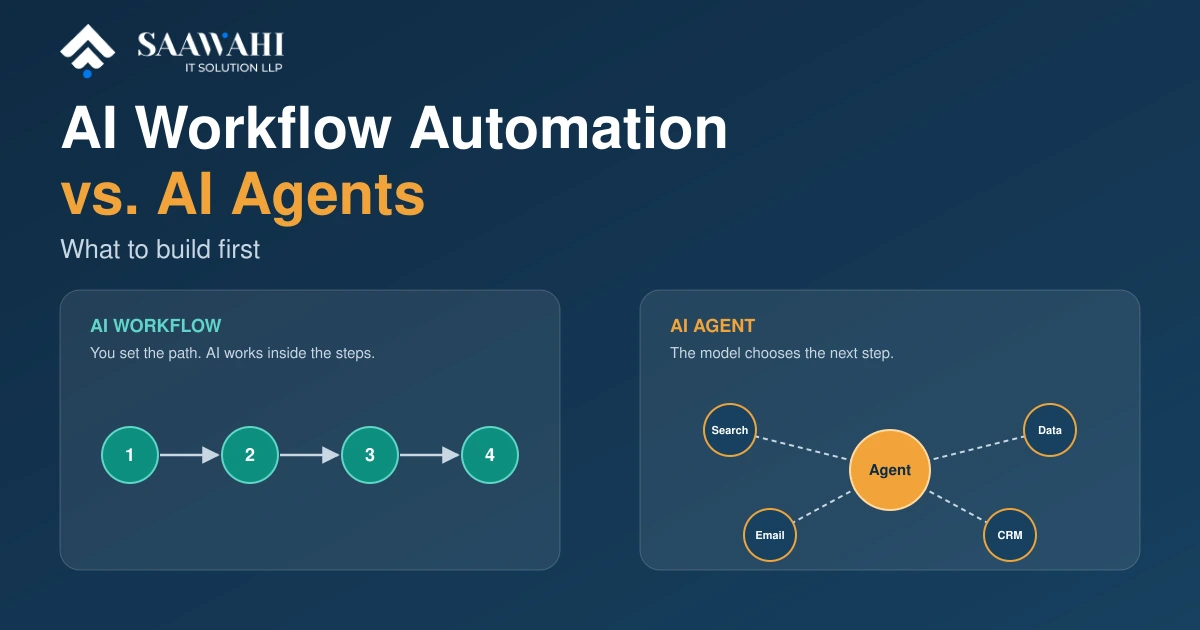
Not every task needs an agent. When rules are fixed and inputs are predictable, plain AI workflow automation is cheaper and more reliable. A good partner will tell you that up front.
Our Agentic AI Development Process
We use a six-step approach that keeps scope, risk, and results visible at every stage:
- Requirement analysis and feasibility: Map the workflow, data, systems, and risks, then confirm an agent is the right tool.
- Strategy and architecture design: Select models, orchestration, integrations, and the points where humans approve actions.
- Development and training: Build the agent logic, retrieval (RAG), prompts, and tool connections.
- Testing and optimization: Validate accuracy, security, performance, and edge cases against real examples before go-live.
- Deployment and integration: Roll out in stages, with monitoring, into your existing systems.
- Ongoing support and optimization: Track performance, cost, and drift, and improve over time.
We choose technology per project, not by default. Our stack includes OpenAI GPT models, LangChain, LlamaIndex, Hugging Face, Google Vertex AI, Azure AI, AWS SageMaker, and n8n.
Security, Compliance, and Guardrails
An agent that can act can also act wrongly. US buyers, especially in healthcare, finance, and the public sector, should expect these controls:
- Least-privilege access: OWASP’s LLM security project lists “excessive agency” as a core risk: agents given more functions, permissions, or autonomy than the task needs. Give each agent only the tools and data it requires.
- Human approval for high-impact actions: Refunds, contract changes, deletions, and external messages should be reviewed until the agent earns trust.
- Prompt-injection defenses: Treat every email, web page, and document an agent reads as untrusted input.
- Audit logs: Record every decision, tool call, and data access so you can explain what happened.
- Framework alignment: The voluntary NIST AI Risk Management Framework (govern, map, measure, manage) is the common US reference point. Many buyers also ask about SOC 2, HIPAA, and CCPA/CPRA. Ask any vendor which of these they have worked under, and which duties stay with you.
How Much Do Agentic AI Development Services Cost?
Cost depends on autonomy, number of integrations, data readiness, and compliance needs. Published industry estimates, mostly from agency blogs, put typical builds in these ballparks:
| System type | Ballpark build cost |
|---|
| Single-workflow agent, few tools | $15K–$50K |
| Agent with a knowledge base and 2–4 integrations | $45K–$100K |
| Advanced multi-step agent, 5+ integrations | $100K–$200K |
| Multi-agent enterprise system | $150K–$500K+ |
Treat these as rough benchmarks, not quotes. Three things commonly surprise buyers. Integration and data preparation often cost more than model fees. Ongoing monitoring and maintenance are commonly estimated at 15–20% of build cost per year. And delivery location and team structure move the total significantly.
The safest path is a focused pilot: one workflow, one measurable KPI, and a 4–10 week timeline, then expand only after it proves reliable. We scope every project after discovery, with agreed stages instead of open-ended estimates.
Why Agentic AI Projects Fail, and How to Avoid It
Gartner ties cancellations to cost, unclear value, and weak risk controls. It also warns about “agent washing,” where vendors relabel chatbots and RPA as agents, and estimates only about 130 of the thousands of vendors claiming agentic capabilities truly deliver them. To avoid the same fate:
- Pick one workflow with a measurable KPI, such as minutes per case, cost per ticket, or error rate.
- Fix data and access first: Agents cannot act on systems they cannot reach.
- Keep humans in the loop until production evidence supports more autonomy.
- Measure in production: task completion accuracy, override rate, and cost per task.
- Settle ownership early: who owns the code, prompts, and evaluation datasets.
Build, Buy, or Partner?
- Buy a platform when your need is standard, such as support triage or scheduling. It is the fastest route and gives you the least control.
- Build in-house when agents are core intellectual property and you already employ ML and platform engineers. It is the slowest route, and hiring is the main risk.
- Partner with a development company when agents must connect to your own systems and rules. A team that has shipped production agents shortens the learning curve, but insist on clear ownership and knowledge transfer.
How to Choose an Agentic AI Development Company
Ask every vendor these questions:
- Can you show agents running in production, and explain what went wrong and how you fixed it?
- How do you test and evaluate agents before and after launch?
- Which actions can the agent take alone, and which need human approval?
- Which models and frameworks do you use, and how hard is it to switch later?
- Who owns the code, prompts, and evaluation data when we finish?
- What post-launch support do you provide: monitoring, SLAs, retraining?
- How is our data stored, retained, and shared with model providers?
Why Work With Saawahi IT Solution
- Business-first approach. We start with your process and KPI, not the model.
- Integration-ready agents. We connect to CRMs, ERPs, internal APIs, and legacy systems.
- Human oversight built in. Approval steps and escalation paths are designed from day one.
- Proven delivery. Saawahi serves 350+ clients worldwide, with automation work such as Flikforge and RepShare. Projects are NDA protected.
- End-to-end support. We stay involved from feasibility through post-launch optimization.
Frequently Asked Questions
How much do agentic AI development services cost?
Industry estimates range from about $15K for a narrow single-workflow agent to $150K–$500K+ for multi-agent enterprise systems. Integrations, data readiness, and compliance requirements drive most of the difference.
How long does it take to build an AI agent?
A focused pilot often takes 4–10 weeks. Multi-agent systems with several integrations and security reviews usually take a few months.
How is agentic AI different from generative AI?
Generative AI creates content when prompted. Agentic AI uses generative models to plan, call tools, take actions, and complete multi-step goals with limited supervision.
Is agentic AI safe for regulated industries?
It can be, with least-privilege access, human approval for high-impact actions, audit logs, and testing against frameworks such as NIST AI RMF. Your compliance team should review any design that touches regulated data.
Can AI agents work with legacy systems?
Yes. Agents connect through APIs and supported integration methods to CRMs, ERPs, databases, and older internal systems. Integration effort is a major cost factor, so assess it early.
Ready to Build Your First AI Agent?
Tell us about the workflow you want to automate. We will assess feasibility, recommend a pilot scope, and show you what success should look like. Get a free consultation.