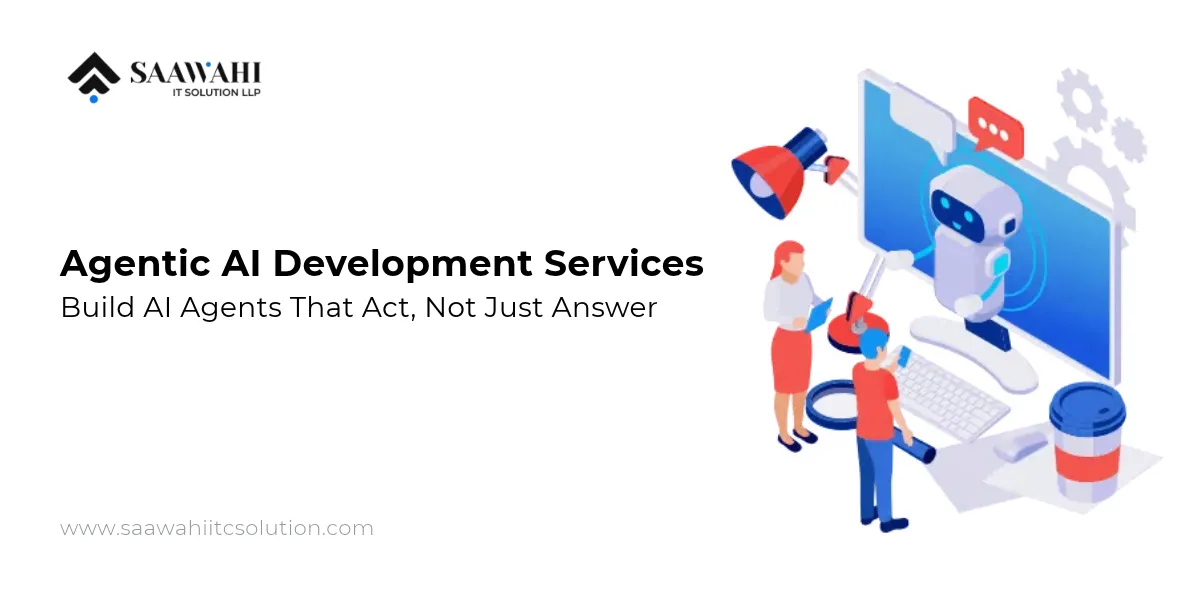
Agentic AI Development Services: Build AI Agents That Act, Not Just Answer
Date - 19/11/2026
AI | 27th November
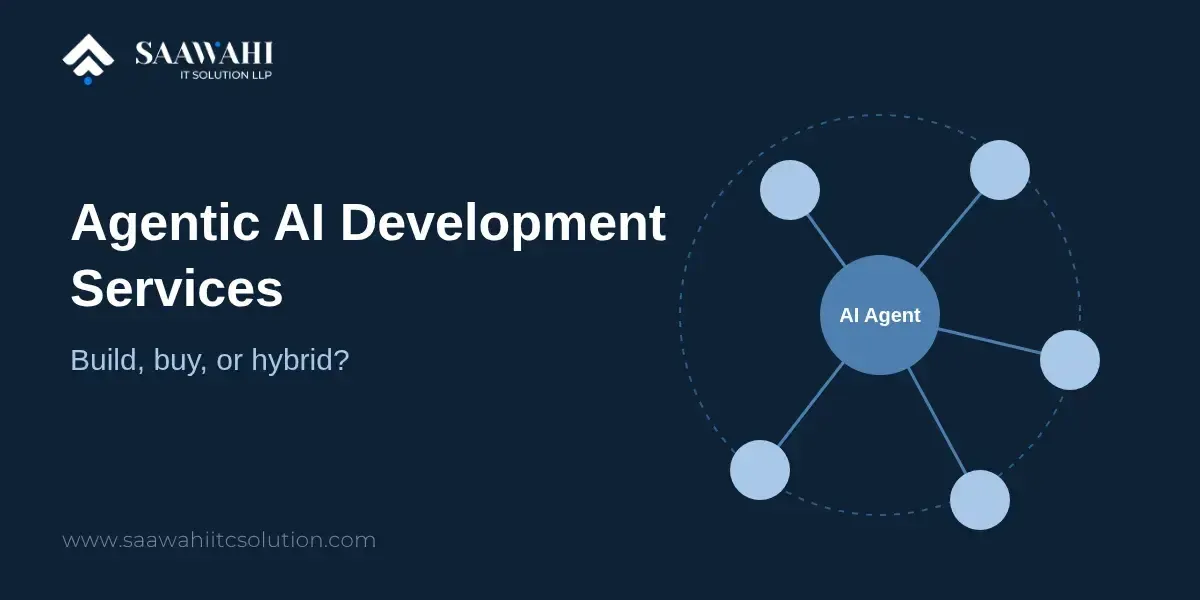
Agentic AI development services design, build, and deploy AI agents that plan steps and act on your systems, beyond answering questions. For most B2B SaaS companies, the real decision is how to source them: build in-house, buy from a development partner, or split the work between both. The right choice depends on how autonomous the agent needs to be, how much risk it carries, and how fast you need it live.
This guide gives you a decision framework you can use this week. We start with the autonomy level, because it drives cost and risk more than any other factor. Then we compare build, buy, and hybrid models for startups, scaling companies, and enterprises.
Agentic AI development services cover the design, build, and deployment of AI agents that complete multi-step tasks by calling tools, reading data, and making decisions within set limits. A typical engagement includes agent architecture, system integrations, guardrails, evaluation, and deployment support. Good providers also plan for monitoring after launch.
A chatbot answers a question and stops. An agent takes a goal, breaks it into steps, uses tools like your CRM or helpdesk, and checks its own output before it finishes. That gap is why agentic projects need more planning than a chatbot build.
A typical engagement covers:
Before you estimate any of those components, decide how much independence the agent should have.
Autonomy moves cost, risk, and timeline more than any other choice. Each action an agent takes without a human check adds integration work, testing, and oversight. Three levels cover most SaaS use cases.
A person approves every action while the agent drafts, recommends, or prepares work. A support team using an agent to draft replies is a typical example. Risk is low, and this is the fastest level to build.
The agent acts within set limits, such as issuing refunds under a fixed amount, and escalates anything outside them. Most SaaS products land here because it saves real labor without giving up control.
The agent completes multi-step workflows end to end, with audit logs, rollback paths, and continuous monitoring. The payoff can be large, but integration, testing, and governance requirements rise sharply.
| Level | Human role | Typical scope | Main risk | Main cost driver | Best fit |
|---|---|---|---|---|---|
| 1. Assisted | Approves every action | Drafting, summarizing, recommending | Low, mostly suggestion quality | Integration depth and prompt design | Teams testing AI value before a larger budget |
| 2. Supervised | Reviews escalations | Acting within limits, escalating edge cases | Medium, wrong action inside allowed limits | Permission logic, evaluation, escalation paths | Scaling SaaS products that need labor savings |
| 3. Autonomous | Monitors and audits | End-to-end workflows across several systems | High, errors compound across steps | Testing, governance, monitoring, rollback | Mature teams with strong engineering oversight |
Start with the lowest level that solves your problem. Teams that begin lower usually reach a working result sooner, then earn the budget to go further.
The autonomy level narrows the sourcing choice. Each path differs in speed, cost structure, and who owns the system after launch.
Building in-house keeps knowledge inside the company and gives you full control. The hidden costs are hiring time, a slower launch, and ongoing maintenance of prompts, integrations, and evaluation sets.
A partner brings proven patterns and an experienced team, so you start faster. The risk sits in the contract. Confirm who owns the code and prompts, how knowledge transfers, and what support looks like after launch.
In the hybrid model, a partner builds the first version and sets up evaluation and monitoring. An internal engineer then takes day-to-day ownership. You keep launch speed while building internal capability.
| Company stage | Recommended path | Why |
|---|---|---|
| Early-stage startup | Buy | You need results fast and can’t afford a long hiring cycle. |
| Scaling SaaS company | Hybrid | A partner handles the first build while you hire for ownership. |
| Enterprise | Build or hybrid, depending on compliance | Internal teams often need control and audit trails, so a partner usually supports rather than owns. |
Use the table as a starting point, then adjust for your compliance needs and hiring pipeline.
Once you have a sourcing model in mind, the budget question comes next.
Agentic AI development costs depend on four factors: autonomy level, the number of systems the agent connects to, data readiness, and compliance requirements. Assisted agents cost far less than autonomous workflows that touch billing or customer records. Expect the largest share of spend to go to integrations and testing, not the model itself.
Your first agent is usually the most expensive, because it sets up shared infrastructure that later agents reuse.
Most projects move through discovery, a limited pilot, testing, and production rollout. The pilot is where timelines often slip, because real data is messier than the sample data used to scope the project.
Once you have a cost range and timeline, the next question is which partner can deliver on them.
Choose an agentic AI development company by checking its integration experience, evaluation process, security practices, ownership terms, and post-launch support. Ask for a case study close to your use case, and request a demo of how the team tests agent behavior before launch.
Score each candidate on five criteria:
Treat a promise of full autonomy in the first proposal as a warning sign if the partner hasn’t asked about your data, permissions, or existing systems.
Good evaluation and clear contracts prevent most problems, but some failures only show up after the demo looks successful.
These pitfalls are easier to avoid with a short, concrete plan.
If you want a second opinion on the scoping step, Saawahi’s agentic AI development start with a free 30-minute scoping call. Bring your target workflow and the systems it touches, and you’ll leave with a recommended autonomy level and sourcing path. Start with the autonomy level, and the build-or-buy decision gets much easier.
Costs depend on the autonomy level, the systems the agent connects to, and your compliance needs. A limited assisted agent costs far less than an autonomous workflow across billing and customer records. Ask every vendor for a scoped estimate so their quotes are comparable.
Generative AI creates content, such as text, images, or code, in response to a prompt. Agentic AI uses generative models inside a system that plans steps, calls tools, and works toward a goal. A generative tool drafts an email, while an agent checks your CRM, drafts the email, and sends it after approval.
Check their integration experience, evaluation process, security practices, ownership terms, and post-launch support. Ask for a case study close to your use case, and confirm in the contract who owns the code and prompts.
Timelines depend on how many systems the agent touches and how clean your data is. Pilots can be tested quickly, but production rollout takes longer because of testing and governance.
Agentic AI development services work best when you match the autonomy level to a real business problem, then choose a sourcing model your team can sustain. Start with the lowest level that solves the problem, score build, buy, and hybrid against your timeline and hiring capacity, and shortlist partners who show their evaluation process and ownership terms. The right decision is rarely the most ambitious one, since a small, supervised agent that ships quickly teaches more than a plan that never leaves the whiteboard. If you’re still weighing these options, we can review your use case with you and suggest a starting autonomy level.

Wama Sompura is the CEO of Saawahi IT Solution, leading innovations in AI, automation, and digital solutions that help businesses drive efficiency and growth.
© Copyright 2025 All Rights Reserved. Saawahi IT Solution LLP.