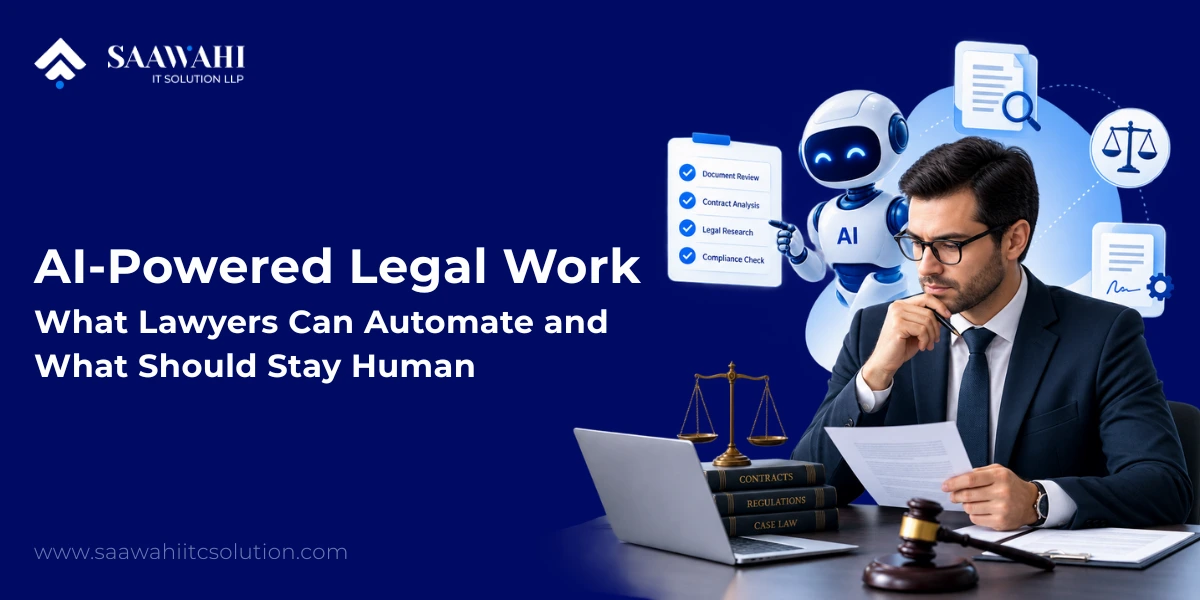
AI-Powered Legal Work: What Lawyers Can Automate and What Should Stay Human
Date - 25/08/2026
AI | 14th September
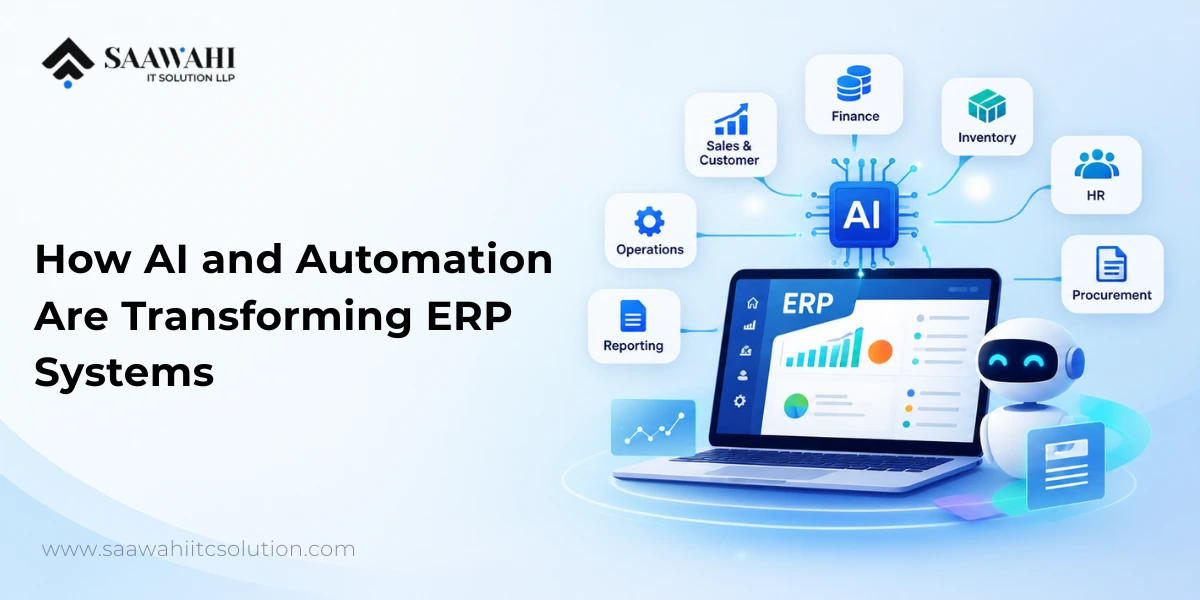
Enterprise Resource Planning (ERP) software has traditionally been the central system businesses use to manage finance, procurement, inventory, human resources, sales, operations, and other core functions.
But modern businesses need more than a system that records transactions and stores information. They need software that can identify patterns, predict what may happen next, automate repetitive work, surface important information, and help teams make faster decisions.
This is where AI-powered ERP software is changing the role of ERP systems.
By combining ERP data with artificial intelligence, automation, analytics, natural-language interfaces, and intelligent workflows, businesses can move from simply managing processes to making those processes more responsive and proactive.
| Question | Answer |
|---|---|
| What is AI-powered ERP? | An ERP system enhanced with AI for analysis, prediction, decision support, and automation. |
| What can it automate? | Finance, procurement, inventory, HR, reporting, document processing, approvals, and other workflows. |
| What does AI add to ERP? | Predictive insights, anomaly detection, recommendations, natural-language interaction, and intelligent workflows. |
| What are AI agents in ERP? | AI systems that can perform defined multi-step tasks across ERP and connected business applications. |
| Does AI replace ERP? | In most cases, AI extends ERP capabilities rather than replacing the ERP’s core transactional and control functions. |
ERP software is a centralized business management system that connects different organizational functions through a shared technology platform and data environment.
Instead of keeping finance, inventory, purchasing, HR, sales, and operational information in disconnected applications or spreadsheets, an enterprise resource planning system brings these processes together.
A typical ERP system may include:
The main value of ERP is integration. When departments work from connected business data, organizations can reduce duplicate data entry, improve visibility, standardize processes, and make business information easier to access.
However, traditional ERP software primarily depends on predefined processes, business rules, reports, and user actions.
AI changes what can happen on top of that foundation.
An AI-powered ERP system combines traditional ERP capabilities with artificial intelligence to analyze business information, identify patterns, generate predictions, support decisions, and automate selected processes.
Traditional ERP generally answers questions such as:
AI-enabled ERP can go further:
The distinction is important.
ERP provides the operational foundation and business data. AI adds intelligence that can help interpret that data and support or automate decisions.
This makes an intelligent ERP system more useful for organizations dealing with large volumes of data, complex workflows, and rapidly changing business conditions.
AI does not need to replace every ERP function to create significant value. Its impact can come from improving specific activities across the ERP environment.
Traditional ERP reporting generally focuses on historical and current information.
AI can use historical business data and relevant operational signals to identify patterns and generate forecasts.
For example, AI-powered ERP software can support:
Instead of waiting for a problem to appear in a report, organizations can use predictive insights to prepare for possible outcomes.
Forecasting is particularly useful when businesses deal with seasonal demand, fluctuating inventory requirements, changing purchasing patterns, or large volumes of historical data.
Managers often have access to large amounts of ERP data but still spend significant time interpreting it.
AI can help convert business information into more useful recommendations.
For example, an AI system could identify that:
Inventory for a particular product is declining faster than expected while supplier lead times are increasing.
Instead of simply displaying two separate reports, an AI-enabled system could highlight the relationship and recommend reviewing procurement requirements.
This does not necessarily mean that AI should make every business decision automatically.
In many cases, the better approach is AI-assisted decision-making, where the system identifies relevant information and recommendations while a responsible employee retains control over important decisions.
Businesses process large quantities of documents, including:
Traditional processing can involve manual data entry and verification.
AI can help classify documents, extract relevant information, identify inconsistencies, and route documents into appropriate workflows.
For example, an invoice received by an organization could be automatically processed, matched against purchase information, checked for anomalies, and routed for approval.
This is an important area where ERP automation and AI can work together.
AI can identify patterns that may be difficult for people to notice manually.
In ERP environments, anomaly detection can help identify:
The goal is not to assume that every unusual event is fraudulent or incorrect.
Instead, AI can prioritize exceptions so employees can investigate the cases that deserve attention.
One of the most visible changes brought by AI is the ability to interact with business systems using natural language.
Instead of navigating multiple ERP reports, a user could ask:
“What were our highest operating expenses last quarter?”
Or:
“Which products have experienced the largest decline in sales?”
A properly integrated AI interface can interpret the question, retrieve relevant information, and present the result in a more accessible format.
This makes ERP information easier to use for people who may not be familiar with complex reporting interfaces.
ERP automation and AI automation are related, but they are not identical.
Traditional ERP automation generally follows predefined rules.
For example:
If an invoice is below a certain amount, automatically send it for standard approval.
This works well when the process is predictable.
AI automation can handle situations that require classification, prediction, pattern recognition, or interpretation.
For example:
Analyze an invoice, compare it with historical purchasing patterns, identify unusual differences, and route it for appropriate review.
A simple way to understand the difference is:
| Traditional Automation | AI Automation |
| Rule-based | Data-driven |
| Follows predefined conditions | Can interpret patterns |
| Best for predictable processes | Useful for variable processes |
| “If X, do Y” | “Analyze X and determine the appropriate next step” |
| Limited exceptions | Can identify and prioritize exceptions |
The two approaches are not competitors. Modern ERP environments can use both.
The best opportunities for AI-powered business automation usually involve repetitive, data-intensive, or decision-heavy processes.
AI can support:
For example, AI can help identify transactions that require manual review instead of requiring finance teams to examine every transaction equally.
AI can support procurement teams by helping analyze:
AI can also assist with purchase workflows by identifying requests that meet predefined criteria and routing them appropriately.
Inventory management is another strong use case.
AI-powered ERP systems can support:
The objective is not simply to automate purchasing. It is to make inventory decisions more informed.
AI can assist with selected HR workflows such as:
Sensitive HR decisions still require appropriate human oversight, governance, and access controls.
AI can analyze customer and sales information to support:
When ERP and CRM systems are connected, AI can work across both operational and customer-related information.
AI can reduce the time required to turn raw ERP data into useful business information.
Instead of manually reviewing multiple dashboards, managers can receive summaries of:
This turns reporting from a purely historical activity into a more decision-oriented process.
ERP systems contain many processes that cross departmental boundaries.
Consider a procurement workflow:
Traditional automation can connect these steps through predefined rules.
AI workflow automation can add intelligence to the workflow.
For example, AI could:
This creates a workflow that is not only automated but also more responsive to the information being processed.
For businesses looking to implement this approach, AI Workflow Automation can be used alongside ERP systems and connected enterprise applications to automate more complex business processes.
AI agents introduce another layer of automation.
A conventional workflow may perform a predefined sequence of actions.
An AI agent can be designed to work toward a defined goal by deciding which steps are needed within a controlled environment.
For example, imagine a business goal:
“Identify low-stock products that are likely to experience increased demand and prepare the required procurement actions.”
An AI agent could potentially:
The important point is that AI agents should operate within defined permissions, business rules, security controls, and approval boundaries.
This makes AI agents in ERP particularly interesting for multi-step processes involving ERP systems, CRM platforms, document systems, communication tools, and other enterprise applications.
Businesses exploring this model can use AI Agent Development Services to build agents around specific operational workflows rather than attempting to automate everything at once.
Generative AI adds another capability to ERP software: generating useful business content from enterprise information.
Potential applications include:
For example, instead of presenting a manager with a complex financial report, generative AI could produce a concise explanation of the major changes and highlight areas requiring attention.
However, generative AI should not be treated as an unrestricted source of business truth.
ERP systems contain sensitive and financially important information. AI implementations therefore need appropriate data access controls, validation, auditability, and governance.
Generative AI Development Services can be used to build controlled AI capabilities around enterprise data and applications.
Another practical application is the integration of AI chatbots with ERP systems.
A conversational ERP interface can allow employees to ask questions such as:
Depending on permissions, the system may also support actions rather than simply answering questions.
For example, an employee might ask the system to prepare a purchase request or create a draft report.
The key requirement is controlled access. A conversational interface should respect the user’s role and should not expose information or perform actions beyond the permissions assigned to that user.
AI does not make traditional ERP obsolete. Instead, it can extend the capabilities of an existing ERP foundation.
| Area | Traditional ERP | AI-Powered ERP |
| Data management | Centralized business data | Centralized data plus intelligent analysis |
| Reporting | Historical and current reports | Reports plus predictions and summaries |
| Automation | Rule-based workflows | Rule-based + AI-driven workflows |
| Forecasting | Traditional models/manual analysis | AI-assisted predictive analysis |
| Anomaly detection | Rule-based alerts | Pattern-based detection |
| User interaction | Dashboards and forms | Dashboards, natural language, and AI assistants |
| Decision support | Reports and predefined KPIs | Recommendations and contextual insights |
| Complex workflows | Predefined sequences | Intelligent workflow orchestration |
| AI agents | Usually absent | Can execute defined multi-step tasks |
The most effective strategy for many organizations is therefore not “replace ERP with AI.”
It is:
ERP + AI + automation + connected enterprise systems.
When implemented appropriately, AI-enabled ERP can provide several business benefits.
AI can help decision-makers identify patterns and exceptions faster.
Automating repetitive tasks can allow employees to focus on higher-value activities.
Intelligent workflows can reduce unnecessary manual handoffs and processing delays.
AI can analyze historical and current data to support more informed forecasts.
AI can bring attention to important changes instead of requiring employees to manually examine every data point.
Businesses can gradually automate additional workflows as their processes and AI capabilities mature.
Natural-language interfaces can make enterprise information easier for employees to access.
AI-powered ERP also introduces challenges that businesses should consider before implementation.
AI is heavily dependent on the quality and consistency of the data it uses.
Poorly structured, incomplete, duplicated, or inconsistent ERP data can reduce the reliability of AI outputs.
Many businesses operate multiple systems, including ERP, CRM, HRMS, payment platforms, e-commerce systems, and custom applications.
AI needs reliable connections to these systems to provide useful automation.
ERP data can include sensitive financial, employee, supplier, and customer information.
AI solutions therefore need role-based access, authentication, data protection, logging, and appropriate governance.
Not every business decision should be fully automated.
Financial approvals, employment decisions, high-value procurement, compliance processes, and other sensitive activities may require human review.
Employees need to understand how AI-enabled workflows work and where human responsibility remains.
Technology adoption is not only a technical challenge. It is also an operational one.
Businesses do not need to transform their entire ERP environment immediately.
A practical implementation approach can start with specific, measurable opportunities.
Look for workflows that involve significant manual effort, repeated data entry, frequent approvals, or large volumes of documents.
Review whether the ERP data is complete, consistent, accessible, and suitable for the intended AI use case.
Start with processes where automation can produce measurable improvements.
Examples include:
Many AI use cases require information from more than the ERP.
ERP integration may involve:
API integration and enterprise system integration become important at this stage.
Define exactly what AI can:
High-impact actions should generally have appropriate approval and monitoring mechanisms.
Track measurable outcomes such as:
AI implementation should be evaluated based on business outcomes, not simply the number of AI features deployed.
Organizations can think about ERP modernization as a gradual progression.
The organization centralizes business transactions and data.
Focus: Record and manage information.
Rule-based workflows automate predictable tasks.
Focus: Reduce repetitive manual work.
AI provides predictions, recommendations, summaries, and anomaly detection.
Focus: Improve decision-making.
AI coordinates workflows across ERP and connected enterprise applications.
Focus: Automate multi-step business processes.
AI agents perform defined goal-oriented tasks within controlled permissions.
Focus: Move from workflow automation toward autonomous execution with appropriate human oversight.
Not every organization needs to reach the fifth level immediately. The right maturity level depends on business processes, data quality, risk tolerance, technology infrastructure, and organizational readiness.
ERP is increasingly becoming more than a system of record.
The next generation of ERP environments is likely to combine:
This does not mean every ERP function will become autonomous.
Instead, ERP systems are likely to become more intelligent around the core transactional foundation they already provide.
The direction can be summarized as:
Record → Analyze → Predict → Recommend → Automate → Orchestrate → Act
This progression is important because businesses increasingly want software that can help them respond to operational events instead of simply recording them after they occur.
AI-powered ERP software is an ERP system enhanced with artificial intelligence to analyze business data, generate predictions, identify anomalies, support decisions, and automate selected business processes.
Traditional ERP automation generally follows predefined rules and workflows. AI automation can analyze data, identify patterns, classify information, make predictions, and support decisions before triggering appropriate actions.
Yes. AI agents can be integrated with ERP systems to perform defined multi-step tasks, such as retrieving information, analyzing data, preparing documents, initiating workflows, or coordinating actions across connected applications.
Common opportunities include invoice processing, procurement workflows, inventory forecasting, reporting, document processing, anomaly detection, employee onboarding, and other repetitive or data-intensive processes.
Generally, AI is better viewed as an extension of ERP rather than a replacement for it. ERP remains responsible for core business transactions, records, controls, and processes, while AI adds intelligence, analysis, recommendations, and automation.
It can be. Smaller businesses do not necessarily need to implement advanced AI across the entire ERP environment. Starting with a focused use case, such as document processing, forecasting, reporting, or workflow automation, can be a more practical approach.
Successful implementation usually requires suitable business data, ERP integration, clearly defined use cases, appropriate security controls, AI capabilities, workflow design, and human oversight.
ERP software remains an important foundation for managing business operations, but the expectations placed on enterprise systems are changing.
Businesses increasingly want their software to do more than store transactions and generate reports. They want systems that can identify patterns, predict outcomes, recommend actions, automate workflows, and help employees work more efficiently.
That is where AI-powered ERP software becomes valuable.
By combining ERP systems with artificial intelligence, automation, AI workflows, generative AI, conversational interfaces, and AI agents, organizations can gradually move from static business processes toward more intelligent and responsive operations.
The strongest approach is not to add AI simply because it is available. Businesses should identify specific operational problems, select appropriate use cases, connect the necessary systems, establish clear controls, and measure the resulting business impact.
For organizations planning long-term ERP modernization, the opportunity is therefore not simply to build a smarter ERP.
It is to create an intelligent business environment where data, software, automation, and AI work together to support better decisions and more efficient operations.

Wama Sompura is the CEO of Saawahi IT Solution, leading innovations in AI, automation, and digital solutions that help businesses drive efficiency and growth.
© Copyright 2025 All Rights Reserved. Saawahi IT Solution LLP.