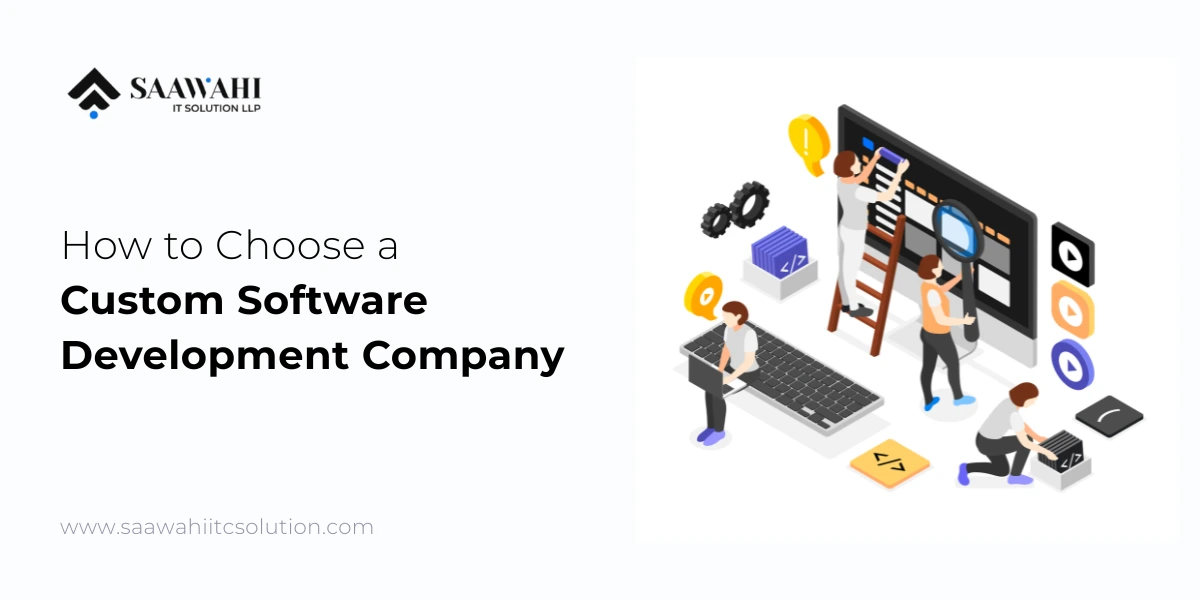
How to Choose a Custom Software Development Company
Date - 17/09/2026
Software development | 12th March
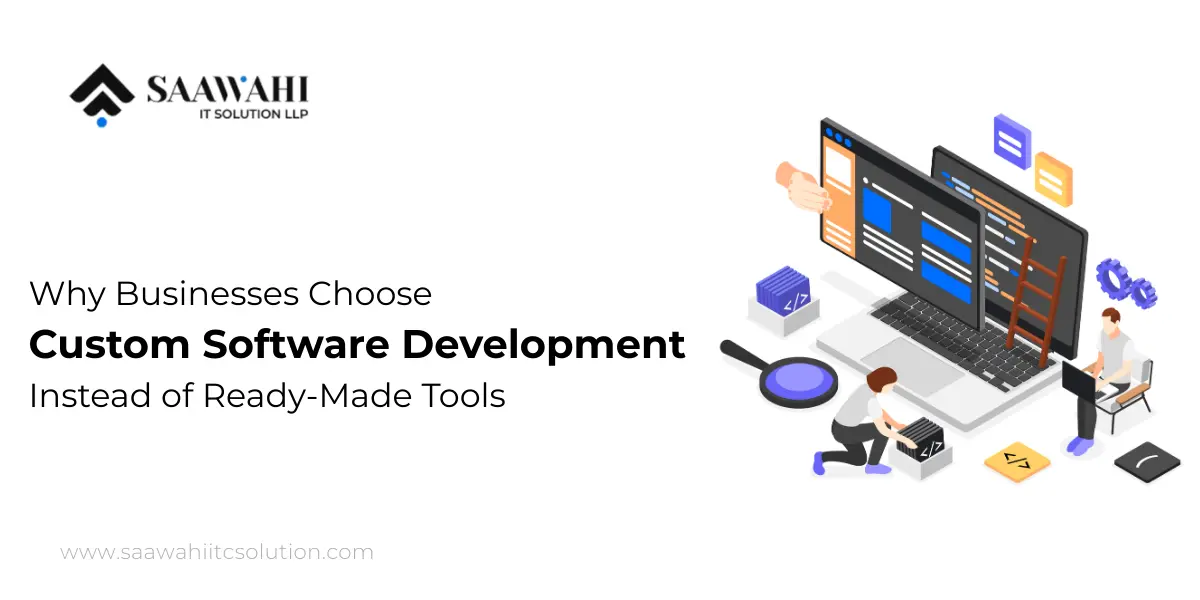
Businesses don’t always need custom software. For many common business functions, ready-made software is faster to deploy, easier to budget for, and already includes the features a company needs.
The decision becomes more difficult when standard software no longer fits the way a business operates.
If employees rely on spreadsheets to fill gaps, teams repeatedly enter the same information into different systems, critical integrations are unavailable, or business processes require constant workarounds, custom software development may provide a better long-term solution.
The key question isn’t whether custom software is better than ready-made software. It’s whether the software fits the business well enough to justify its cost, implementation effort, and long-term ownership.
This guide explains the differences between custom and ready-made software, when each approach makes sense, the costs involved, and how businesses can make a practical build-vs-buy decision.
Custom software is designed and developed around the specific requirements of an organization. Its features, workflows, integrations, user roles, and architecture can be planned according to how the business operates.
Ready-made software, also called off-the-shelf software, is developed for a broad market. It provides standardized functionality that can usually be configured to meet common business requirements.
| Factor | Custom Software | Ready-Made Software |
|---|---|---|
| Business fit | Built around specific workflows | Designed for broad requirements |
| Customization | Highly customizable | Usually limited to available options |
| Initial investment | Generally higher | Generally lower |
| Implementation | Usually takes longer | Usually faster |
| Scalability | Designed around business requirements | Depends on the product and vendor |
| Integrations | Can be developed for specific systems | Depends on available integrations |
| Ownership | Greater control over the solution | Product remains controlled by vendor |
| Updates | Business controls development roadmap | Vendor controls product roadmap |
| Differentiation | Can support unique processes | Usually standardized |
| Best suited for | Specialized or complex requirements | Standard business processes |
Neither option is automatically better. The right choice depends on the complexity of the business, available budget, implementation timeline, operational requirements, and strategic importance of the software.
Custom software development involves creating an application specifically for a business, industry, workflow, or operational requirement.
Instead of asking the business to adapt its processes to an existing product, developers design the software around the business’s requirements.
A custom solution may include:
Custom software can be developed as a web application, mobile application, desktop application, cloud platform, internal business system, or a combination of technologies.
Ready-made software is developed for a large number of businesses with similar requirements.
Examples include:
The main advantage is speed. A business can typically subscribe to or purchase an existing product and start using it without funding an entire development project.
For businesses with standard requirements, this can be the most practical option.
The challenge appears when the organization’s processes don’t match the product closely enough.
Businesses typically consider custom development when software has become an important part of their operations rather than simply a supporting tool.
Every organization has its own processes.
A ready-made platform may require employees to change those processes to fit the software. Custom development takes the opposite approach: the software is designed around the workflow.
For example, a company may have a specific process for:
Lead → Qualification → Proposal → Approval → Project → Delivery → Billing
If existing software cannot support that workflow without multiple manual steps, a custom system can bring the process into a single platform.
This can reduce unnecessary handoffs and make the system easier for employees to use.
Ready-made products generally provide features that serve a broad customer base.
Custom software can include only the functionality the business actually needs.
This means a company can define:
Customization is particularly valuable when the business has processes that are difficult to represent using standard software.
Business requirements change as companies grow.
A small organization may initially need a simple system. Later, it may need:
Custom software can be architected with those future requirements in mind.
However, scalability is not automatic. A poorly designed custom application can also create technical limitations. Architecture, infrastructure, database design, security, and development practices all influence how well software scales.
Many businesses don’t use a single software platform.
They may have separate systems for:
When those systems don’t communicate effectively, employees may have to move information manually between platforms.
Custom software can act as an integration layer that connects important systems through APIs and automated workflows.
The goal isn’t necessarily to replace every existing tool. In many cases, the better approach is to connect the systems that already work well.
Custom software can automate processes that are unique to an organization.
For example:
Order received → Inventory checked → Approval requested → Customer notified → Invoice generated → Delivery scheduled
Instead of requiring employees to perform every step manually, the system can execute predefined actions based on business rules.
Automation can reduce repetitive work, minimize manual data entry, and improve process consistency.
When business data is spread across several systems, obtaining a complete view can be difficult.
Custom software can bring information together into centralized dashboards and reports.
Different users can receive different views based on their roles.
For example:
This can make reporting more efficient and reduce dependence on manually prepared spreadsheets.
With ready-made software, the vendor determines:
Custom software provides greater control over the application’s development roadmap.
The business can prioritize functionality according to its own requirements rather than waiting for a third-party vendor to introduce a feature.
Some businesses have processes that are too specialized for generic software.
Examples include:
When these requirements directly affect how the business operates, custom development can become more valuable.
Software can sometimes become part of a company’s competitive advantage.
A business may use technology to deliver a service faster, provide a better customer experience, automate a complex process, or offer functionality competitors don’t have.
In these situations, relying entirely on standardized software may limit differentiation.
Custom software allows technology to support the specific way a business creates value.
Businesses rarely remain unchanged.
New markets, customers, regulations, integrations, business models, and automation requirements can change software needs.
A custom application can be extended as those requirements evolve, provided it has been built with maintainability and future development in mind.
Ready-made software is useful, but it can create challenges when business requirements become more specialized.
Common limitations include:
The software may allow configuration but not the deeper changes the business requires.
Employees may create spreadsheets, manual processes, or separate tools to compensate for missing functionality.
An application may not provide the APIs or connectors needed to communicate with other systems.
A business may have to wait for a vendor to introduce a required feature.
Costs can increase as the number of users, features, storage, or integrations grows.
Information may remain distributed across several platforms, making reporting and process management more difficult.
These limitations don’t mean ready-made software is a bad choice. They indicate that a business should periodically evaluate whether its current tools still match its operational requirements.
A business may want to evaluate custom development when several of these situations occur.
If spreadsheets are being used to compensate for missing functionality in the primary software, the organization may have outgrown the existing platform.
Duplicate data entry increases workload and creates opportunities for errors.
If approvals depend heavily on email, messages, or manual tracking, automation may improve the workflow.
If employees constantly transfer information between disconnected platforms, integration may be a strong reason to consider custom development.
When teams must export information from multiple systems before preparing a report, centralized data may provide significant operational value.
Frequent workarounds are often a sign that the software doesn’t fully support the business process.
If new users, locations, workflows, integrations, or business requirements are constrained by the existing product, it’s worth evaluating alternatives.
Custom software isn’t always the right answer.
Ready-made software can be the better option when:
For example, there is usually little reason to develop a completely custom email platform when an established solution already meets the business’s requirements.
The goal should be to build custom software where customization creates meaningful business value—not simply because custom development is possible.
Custom development becomes more compelling when:
A useful rule is:
Buy when a standard product solves a standard problem. Consider building when the software needs to support a business process that is unique, strategic, or difficult to automate with existing products.
The initial purchase price shouldn’t be the only factor in the decision.
Ready-made software may have:
Custom software may involve:
The important comparison is total cost of ownership, not simply the initial development or subscription price.
A ready-made product can be more economical when it meets the business’s needs with minimal customization.
A custom solution can make more sense when operational inefficiencies, disconnected systems, recurring workarounds, or vendor limitations create substantial long-term costs.
Businesses don’t always need to choose one approach for everything.
A hybrid model can combine ready-made software for standard functions with custom applications for specialized processes.
For example:
CRM → Ready-made
Accounting → Ready-made
Communication → Ready-made
Business-specific workflow → Custom
AI automation → Custom/integrated
Executive dashboard → Custom
This approach allows businesses to use established platforms where they provide strong value while investing in custom development where differentiation or operational efficiency matters.
For many growing organizations, this can be a more practical technology strategy than replacing every existing platform.
A logistics company may need to connect orders, inventory, dispatch, driver information, delivery status, customer notifications, and billing.
Rather than managing each activity separately, a custom platform can connect these processes into one workflow.
A healthcare organization may require appointment scheduling, patient information, billing, notifications, staff access, and reporting.
Custom development can provide a workflow designed around the organization’s specific operational requirements while supporting appropriate security and access controls.
A manufacturer may need software that connects production planning, inventory, quality checks, machine data, purchasing, and reporting.
A custom platform can be designed around its production workflow instead of forcing operations into a generic process.
A service company may need to manage leads, proposals, projects, approvals, team assignments, deliverables, invoices, and client communication.
Custom workflow software can connect these stages and automate repetitive handoffs.
The value of custom software shouldn’t be measured only by the number of features it contains.
The more useful question is:
What business problem does the software solve?
Potential benefits include:
The actual return depends on the business case, implementation quality, adoption, and ongoing maintenance.
A custom application should therefore begin with clearly defined business objectives rather than a list of technical features.
A well-planned custom software project generally includes several stages.
The development team identifies business objectives, users, workflows, technical requirements, integrations, and constraints.
The technology architecture, database structure, integrations, security approach, and scalability requirements are defined.
User journeys, interfaces, dashboards, and application flows are designed around the intended users.
The application is developed in planned iterations, allowing functionality to be tested and reviewed progressively.
The system is tested for functionality, usability, performance, security, and integration reliability.
The application is deployed to the appropriate production infrastructure.
After launch, the system may require monitoring, security updates, bug fixes, performance improvements, and new functionality.
A strong development process treats the software as a long-term product rather than a one-time coding project.
Before making a decision, evaluate these questions:
Does an existing product meet at least most of our requirements?
If yes, ready-made software may be sufficient.
Are our workflows significantly different from standard industry processes?
If yes, custom development may deserve consideration.
Do we need integrations that existing products don’t support?
If yes, custom or hybrid development may be appropriate.
Are employees creating workarounds around the current software?
If yes, calculate the operational cost of those workarounds.
Is this software strategically important to our business?
If yes, greater control and customization may justify the investment.
Will our requirements change significantly as we grow?
If yes, evaluate scalability and extensibility before selecting a platform.
Can we clearly measure the business value of custom development?
If the answer is no, more discovery and cost-benefit analysis may be needed before development begins.
Not necessarily. Ready-made software is often better for standard business requirements and faster implementation. Custom software is more suitable when an organization has unique workflows, specialized requirements, complex integrations, or strategic reasons to control its software.
Businesses choose custom software when existing products cannot efficiently support their workflows, integrations, automation requirements, scalability needs, or specialized functionality.
Custom software usually requires a higher initial investment than subscribing to a ready-made product. However, the right comparison is total cost of ownership, including subscriptions, integrations, workarounds, operational inefficiencies, maintenance, and future requirements.
A company should consider custom software when its processes are unique, existing tools require significant workarounds, important integrations are unavailable, or software has become strategically important to the business.
Custom software generally requires more upfront planning, development time, investment, maintenance, and technical management than ready-made software.
Ready-made software typically offers faster implementation, predictable subscription or licensing models, established functionality, vendor support, and lower initial investment.
Yes. Custom applications can be designed to integrate with existing systems through APIs, databases, webhooks, middleware, and other integration technologies, depending on the capabilities and security requirements of the systems involved.
Usually, no. A business can use ready-made products for standard functions and custom software for specialized workflows. A hybrid approach can often provide a better balance between cost, flexibility, and functionality.
between custom software and ready-made software is ultimately a business decision, not simply a technology decision.
Ready-made software is often the right choice when requirements are standard, implementation speed matters, and an established product already solves the problem effectively.
Custom software becomes more valuable when a business needs technology to support unique workflows, integrate disconnected systems, automate specialized processes, scale with growth, or provide greater control over a strategically important operation.
The best approach is not to build everything from scratch. It is to identify where software creates meaningful business value and choose the solution that supports those requirements most effectively.
For businesses evaluating custom software, the first step should be understanding the current workflow, identifying limitations in existing tools, defining measurable objectives, and comparing the long-term cost and value of available options.
If your existing software is creating more work than it removes, it may be time to evaluate whether a custom or hybrid software solution is a better fit for your business.

Wama Sompura is the CEO of Saawahi IT Solution, leading innovations in AI, automation, and digital solutions that help businesses drive efficiency and growth.
© Copyright 2025 All Rights Reserved. Saawahi IT Solution LLP.