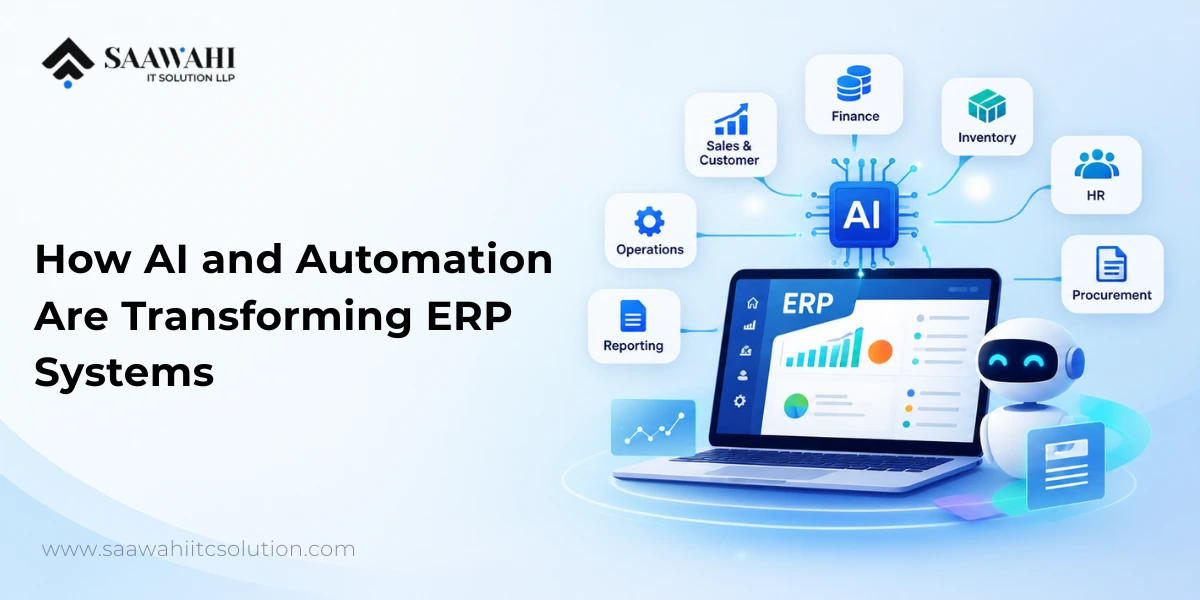
AI-Powered ERP Software: How AI and Automation Are Transforming ERP Systems
Date - 14/09/2026
AI | 30th January
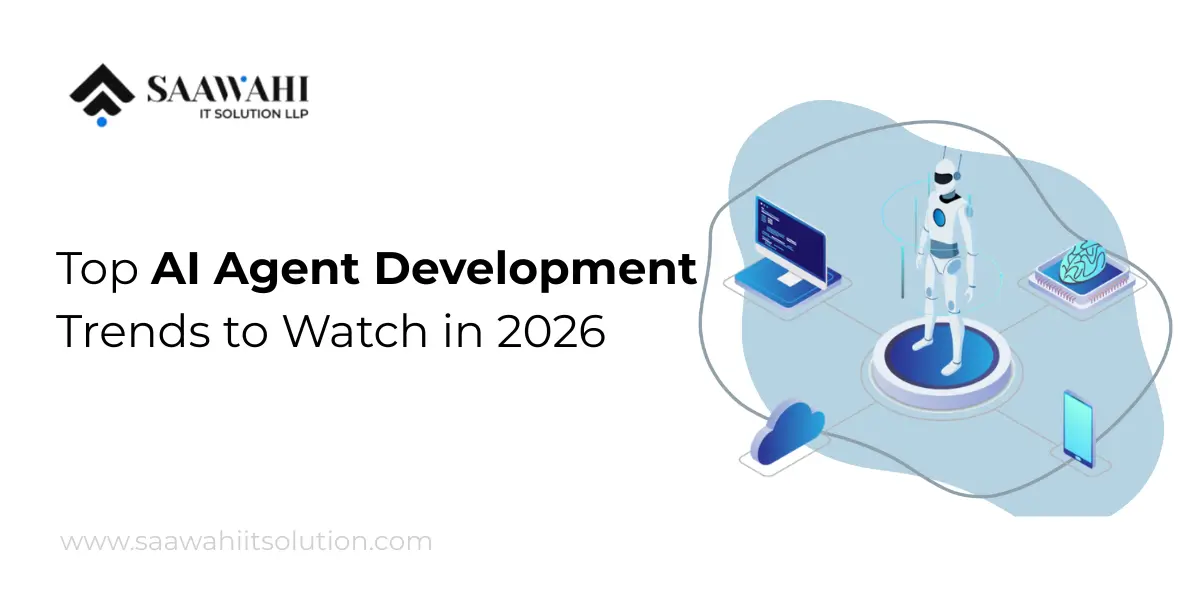
AI agents are moving beyond experimental chat interfaces and isolated proof-of-concepts. In 2026, the focus is increasingly on how agents can operate reliably inside real business workflows, connect with enterprise tools, manage context, and complete multi-step tasks with appropriate controls.
This shift is changing what matters in AI agent development. Building an agent is no longer only about selecting a capable AI model. Development teams also need to consider memory, tool integration, interoperability, orchestration, security, evaluation, observability, human oversight, and operational cost.
The growing emphasis on these areas is reflected in current agent-engineering practices. For example, LangChain’s 2026 State of Agent Engineering research reports that 89% of surveyed organizations have implemented some form of observability for agents, while teams with agents already in production report even higher adoption of observability and tracing.
At the same time, interoperability is becoming an important part of the agent technology stack. Protocols such as the Model Context Protocol (MCP) are being used to standardize how AI systems discover and interact with external tools and resources, while enterprise discussions increasingly connect this interoperability layer with authorization and governance.
So, the important AI agent development trends in 2026 are not simply about making agents more autonomous. They are about making them more connected, context-aware, controllable, observable, and useful in production environments.
This article examines the major trends shaping AI agent development in 2026 and explains what each trend means for businesses and teams building AI-powered applications and workflows.
AI agents are software systems that can use AI models to interpret a goal, determine the steps required, interact with tools or external systems, and work toward completing a task.
Unlike a conventional chatbot that primarily generates a response to a user’s message, an AI agent can operate through a broader execution loop:
Goal → Context → Reasoning → Tool Selection → Action → Result → Next Step
A production AI agent may combine several technical components, including:
This architecture becomes particularly important as AI agents move from demonstrations into business-critical workflows. Current AI engineering discussions increasingly emphasize evaluation, observability, governance, and deployment alongside the underlying model because an agent’s usefulness depends on how reliably it performs across the complete workflow—not simply how well the model responds to an individual prompt.
With that foundation, let’s examine the top AI agent development trends shaping 2026.
As AI agents move into more complex business processes, a single agent is not always the most practical architecture. Multi-agent systems divide a larger objective into specialized tasks, allowing different agents to handle areas such as research, planning, data analysis, validation, or execution.
Instead of asking one agent to manage every step, a multi-agent architecture can assign specific responsibilities to specialized agents and coordinate their work through an orchestration layer. This approach can be useful when a workflow involves multiple domains, tools, decision points, or validation stages.
For example, an enterprise research workflow could use separate agents for:
However, multi-agent architecture is not automatically better than a single-agent design. Each additional agent introduces communication, orchestration, state-management, latency, and monitoring requirements. For simpler tasks, a well-designed single agent may be easier to operate and maintain.
In 2026, AI agent development increasingly requires an architectural decision between single-agent and multi-agent approaches based on the workflow itself.
Development teams need to define agent responsibilities, communication patterns, shared context, tool access, failure handling, and escalation paths before adding multiple agents. The orchestration layer also needs visibility into individual agent runs so that failures can be traced to a specific step rather than treated as one overall system error.
The practical trend, therefore, is not simply “more agents.” It is the development of better-coordinated agent architectures for workflows where specialization and orchestration provide a clear benefit.
An AI agent can complete a task effectively in a single interaction, but longer-running workflows require more than the information available in one conversation. Agents increasingly need to retain relevant information, retrieve the right context when needed, and maintain state across multiple steps or sessions.
This is where AI agent memory and context engineering become important.
Agent memory can include information such as previous interactions, user preferences, business rules, workflows, instructions, past decisions, or learned patterns. Short-term memory supports the current task, while long-term memory allows relevant information to persist across future interactions.
However, storing more information does not automatically make an agent more effective. The agent also needs the right context at the right time. Context engineering focuses on deciding what information should enter the model’s context, how it should be structured, and when it should be retrieved during an agent’s execution.
For example, an enterprise agent may need to combine:
Rather than continuously passing all available information to the model, a well-designed agent can retrieve or construct only the context required for the current step. This becomes increasingly important as agents handle longer and more complex workflows. IBM’s 2026 discussion of context engineering similarly highlights the need to manage relevant information rather than simply increasing the amount of context provided to an agent.
In 2026, developing a context-aware AI agent involves more than adding a memory database. Development teams need to define what should be remembered, how memories are updated, how relevant information is retrieved, and when that information should influence an agent’s decisions.
Memory architecture should also consider data ownership, access permissions, retention, accuracy, and the possibility of outdated information. For business applications, these controls are particularly important when an agent works with customer records, internal documentation, operational data, or other sensitive information.
The practical trend is therefore moving from simply giving AI agents a longer conversation history toward structured memory and context management that helps agents maintain continuity without overwhelming the reasoning process.
AI agents become significantly more useful when they can do more than generate text. By connecting to tools, APIs, databases, business applications, and external services, an agent can retrieve information and perform actions as part of a larger workflow.
This makes tool use and agent interoperability an important area of AI agent development in 2026.
A tool-enabled agent can, for example:
The challenge is that every integration can introduce its own interface, authentication method, data format, and operational requirements. Building and maintaining individual integrations can become increasingly complex as the number of tools connected to an agent grows.
This is one reason Model Context Protocol (MCP) has become an important development topic. MCP provides an open standard for connecting AI applications with the systems where data and tools reside. Its 2026 specification has continued to evolve around scalability, routing, authorization, extensions, and production deployment.
Rather than treating every tool connection as an isolated integration, an MCP-based architecture can provide a more standardized way for an AI application to discover and interact with available tools and resources.
For development teams, the trend is not simply to give an AI agent access to more tools. The focus is increasingly on structured, controlled, and interoperable tool access.
A production-oriented implementation should define:
This becomes particularly important for enterprise agents that interact with multiple applications or perform actions that affect business data.
MCP’s recent specification work also illustrates this shift toward production requirements. The July 2026 release introduced a stateless protocol core, header-based routing, cacheable list results, and authorization hardening, showing that interoperability is increasingly being considered alongside scalability and operational control.
The practical trend, therefore, is moving from AI agents that can call individual tools toward AI agent architectures that can interact with multiple systems through more standardized, governed, and maintainable interfaces.
AI agents are increasingly being considered as part of broader business workflows rather than as standalone assistants. Instead of only answering questions or generating content, an agent can interpret information, make decisions within defined boundaries, use connected tools, and move a process from one step to the next.
This creates a significant difference between traditional workflow automation and agentic workflow automation.
Traditional automation generally follows predefined rules:
Trigger → Rule → Action → Result
An agentic workflow can handle situations where the next step depends on information discovered during execution:
Goal → Understand Context → Decide Next Step → Use Tool → Evaluate Result → Continue or Escalate
For example, an automated customer-support workflow may route a ticket according to predefined categories. An AI-agent workflow could interpret the customer’s request, retrieve relevant account information, check available knowledge sources, determine the appropriate resolution path, update the support system, and escalate the case when a defined condition requires human involvement.
This does not mean that traditional automation becomes unnecessary. In many enterprise environments, AI agents can work alongside existing automation, APIs, databases, and business-process systems. UiPath’s 2026 guidance, for example, describes extending existing enterprise automation foundations with AI agents rather than treating agentic automation as an entirely separate layer.
Building an AI agent for workflow automation requires more than connecting a language model to an API. Developers need to understand the complete business process and determine where an agent should reason, where deterministic automation should execute, and where human approval should remain part of the workflow.
A production-oriented architecture may include:
This hybrid approach can be particularly useful for processes that combine structured rules with unstructured information, exceptions, or decisions that cannot be fully predefined.
The trend in 2026 is therefore not simply about replacing existing automation with AI agents. It is about combining agentic reasoning with workflow orchestration and existing enterprise systems to handle more complex, context-dependent processes. As these systems move closer to production, reliability, governance, and measurable workflow outcomes become just as important as the agent’s ability to reason and act.
As AI agents become capable of handling longer and more complex tasks, giving them complete independence is not always appropriate. At the same time, requiring a person to approve every individual action can limit the efficiency that makes agentic systems useful.
This is driving a shift toward controlled autonomy, where an AI agent can operate independently within clearly defined boundaries while escalating specific decisions or situations to a human.
The level of human involvement can vary depending on the workflow:
For example, an AI agent managing customer support could classify requests and prepare responses automatically. It may be allowed to update routine records without approval, while refunds above a defined amount or unusual account changes require human review.
This approach recognizes that autonomy should depend on risk, reversibility, permissions, and business context, rather than being treated as an all-or-nothing capability.
Research into real-world agent usage also suggests that effective oversight is not necessarily about reviewing every action. Anthropic’s 2026 analysis found that experienced users increasingly allow agents to operate autonomously while intervening when necessary, highlighting the importance of designing systems where humans can effectively monitor and redirect agents.
Developers need to define an agent’s authority boundaries as carefully as its capabilities.
A controlled-autonomy architecture may include:
These controls should be designed into the workflow rather than added after deployment. Modern agent platforms are increasingly providing mechanisms for scoped permissions, approval flows, and tool-level controls because agents can otherwise take actions across connected systems with more authority than intended.
The practical trend in 2026 is therefore not simply toward more autonomous AI agents. It is toward agents that can determine when to act independently, when to request human input, and what actions they are permitted to perform at each stage of a workflow.
As AI agents move into production environments, businesses are increasingly looking beyond general-purpose agents for tasks that require deeper knowledge of a particular industry, function, or workflow.
A domain-specific AI agent is designed around a defined business context. It can be connected to relevant data, processes, tools, terminology, policies, and decision rules instead of relying only on general-purpose model knowledge.
For example, an agent designed for a financial operations workflow may need to understand financial records, internal policies, approval requirements, and compliance processes. A healthcare-related workflow may require different data boundaries, terminology, permissions, and escalation procedures. A software-development agent may instead need access to repositories, issue trackers, testing environments, and deployment tools.
The value of specialization comes from how these components work together.
A domain-specific agent can be designed around:
Gartner’s 2026 analysis of agentic AI deployments emphasizes specialization around specific business processes rather than relying only on broad, general-purpose agents. Its research also identifies data and context, algorithmic choices, and workflows as important pillars for developing domain-specific agents.
Developing a domain-specific AI agent requires more than providing an existing model with a collection of documents. The development process needs to connect the agent’s reasoning capabilities with the actual environment in which the work takes place.
Teams should define:
This approach also makes evaluation more meaningful. Instead of asking whether an agent gives a generally good response, development teams can measure whether it completes the specific business task accurately, consistently, securely, and within acceptable cost and time limits.
The trend in 2026 is therefore moving toward specialized AI agents built around defined business processes and operational contexts, rather than treating every agent as a general-purpose AI assistant. For businesses, this means agent development increasingly starts with the workflow and domain requirements before selecting the model, tools, and architecture needed to support them.
Many business processes depend on information that changes continuously. Customer activity, inventory levels, transactions, system alerts, application events, and operational data can all change faster than a scheduled workflow can respond.
This is creating greater interest in real-time and event-driven AI agents.
Instead of repeatedly checking whether something has changed, an event-driven architecture allows an agent workflow to respond when a relevant event occurs.
A simplified flow can look like:
Event → Context Retrieval → Agent Reasoning → Tool Selection → Action → Result → Next Event
For example, when an ecommerce order is cancelled, an event could trigger an agent workflow that retrieves the relevant order and customer information, determines the appropriate next steps, updates connected systems, and escalates the case if it falls outside predefined rules.
Similarly, an operational monitoring system could trigger an agent when a significant anomaly is detected. The agent could investigate the available data, determine which tools or systems need to be queried, summarize the situation, and recommend or execute an approved response.
Event-driven architectures are particularly relevant to AI agents because they allow system state to be propagated through events and enable continuous reactions rather than relying only on batch processing or predefined request-response cycles. Current 2026 architecture work is exploring these patterns for autonomous systems and long-running agent workflows.
Building a real-time AI agent requires more than connecting an AI model to a live data source. Developers need to design how events are generated, processed, routed, and converted into agent actions.
Important considerations include:
This architecture can be useful for applications such as customer operations, fraud monitoring, IT operations, supply-chain workflows, intelligent notifications, and other processes where conditions can change continuously.
However, real-time execution should be introduced where the business process actually requires it. Running every agent continuously can increase infrastructure usage, processing volume, and operational complexity.
The practical trend in 2026 is therefore moving beyond agents that simply retrieve current information toward agents that can respond to meaningful changes in their operating environment as those changes occur.
As AI agents gain access to business systems, sensitive data, and tools that can perform real actions, security becomes a fundamental part of AI agent development.
A conventional AI application may primarily generate information for a user to review. An AI agent can potentially retrieve private data, call external services, modify records, execute workflows, or delegate tasks to other agents. This expands the security considerations from model output to the agent’s entire execution environment.
One important risk is prompt injection, where untrusted content attempts to influence an agent’s instructions or actions. For tool-enabled agents, the consequences can extend beyond an incorrect response if the compromised agent has access to sensitive information or powerful tools. Current security guidance therefore emphasizes controlling data access, untrusted inputs, and external actions rather than relying on the model alone to prevent unsafe behavior.
This makes several controls increasingly important:
Microsoft’s 2026 guidance similarly treats governance and security as organizational requirements for AI agents, covering areas such as identity, access, monitoring, and policy controls.
Security should be designed into the agent architecture rather than added after the agent is already connected to production systems.
Development teams should define the agent’s identity, permissions, accessible data, available tools, action boundaries, approval requirements, and logging strategy before deployment.
For example, an agent may be permitted to read customer information but not export it. It may be allowed to create a draft transaction but require approval before submitting it. Another agent may access an internal knowledge base but have no permission to modify the underlying records.
This separation is important because a model’s ability to reason should not automatically determine what the system allows it to do. Recent research into multi-agent security has highlighted the importance of authorization architecture, delegated permissions, and limiting the authority available to a compromised or manipulated agent.
Governance also needs to continue after deployment. Teams need visibility into which agents exist, what systems they can access, how their permissions change, and whether their behavior remains within defined policies. As agent deployments scale, this operational layer becomes increasingly important for maintaining accountability and controlling risk.
As AI agents become more complex, simply checking whether the final answer is correct is no longer enough to determine whether an agent is working reliably.
An agent may produce the correct result while taking an inefficient path, selecting the wrong tool and recovering later, retrieving irrelevant information, making unnecessary model calls, or approaching a task in a way that could fail under slightly different conditions.
This is why agent observability and evaluation are becoming core parts of AI agent development in 2026.
Observability provides visibility into what happened during an agent run. Depending on the architecture, this can include:
Evaluation answers a different question: Did the agent perform the task correctly and according to the required criteria?
For agentic systems, evaluation needs to consider more than the final response. A useful evaluation can examine the agent’s task completion, tool usage, context selection, policy adherence, output quality, and execution path.
Anthropic’s 2026 guidance on agent evaluations emphasizes this difference, noting that agents operate across multiple steps, use tools, modify state, and can fail in ways that single-turn evaluations do not capture.
The distinction is becoming visible in industry adoption as well. LangChain’s 2026 State of Agent Engineering survey found that nearly 89% of respondents had implemented agent observability, compared with 52.4% running offline evaluations and 37.3% running online evaluations.
Observability and evaluation should be designed into the development lifecycle rather than added after an agent reaches production.
A practical agent-development cycle can look like:
Build → Test → Deploy → Observe → Evaluate → Improve → Retest
Production traces can help development teams identify real failure patterns and convert those failures into repeatable evaluation cases. This creates a feedback loop where real-world agent behavior informs future testing and improvements.
Development teams should establish evaluation criteria based on the actual purpose of the agent. Depending on the workflow, these may include:
For example, an AI support agent should not be evaluated only on whether its final response sounds appropriate. The evaluation may also need to determine whether it retrieved the correct customer information, selected the appropriate support tool, followed business rules, and escalated cases that required human intervention.
This makes observability and evaluation complementary rather than interchangeable. Observability shows how the agent behaved; evaluation determines whether that behavior met the required standard.
The practical trend in 2026 is therefore toward measurable AI agent engineering, where production traces, structured evaluations, monitoring, and human review work together to identify failures and continuously improve agent performance.
As AI agents become more complex and handle larger workloads, using the same AI model for every task can create unnecessary cost, latency, or performance constraints.
Different steps in an agent workflow can have very different requirements. A simple classification or extraction task may not need the same model used for complex planning or reasoning. This is driving greater interest in multi-model AI agent architectures, where different models can be selected according to the task being performed.
For example, an agent workflow could use:
This approach is often referred to as model routing. Instead of automatically sending every request to the most capable or expensive model, the system determines which model is appropriate for a particular task.
Recent 2026 analysis from Splunk describes model routing as a way to match individual agent steps with models based on their capability and cost requirements, while McKinsey’s 2026 analysis similarly identifies model routing and rightsizing as important levers for managing agentic-workflow economics.
But model selection is only one part of the economics.
An AI agent can have a low cost per model call and still be expensive to operate if it requires many calls, repeats failed actions, retrieves excessive context, or frequently escalates tasks to humans.
For that reason, evaluating an agent only through token cost or API cost can provide an incomplete picture.
More useful operational metrics can include:
McKinsey’s 2026 analysis specifically argues that the economics of agentic workflows should be evaluated around completed work rather than simply the cost of individual model calls.
For development teams, model architecture and business measurement increasingly need to be considered together.
A production AI agent should be evaluated not only on whether it can complete a task, but also how reliably, quickly, and economically it completes that task.
This creates a practical optimization loop:
Choose Model → Run Workflow → Measure Quality and Cost → Identify Bottlenecks → Optimize → Re-evaluate
Optimization may involve routing certain tasks to different models, reducing unnecessary context, improving prompts or tool calls, caching reusable information, restructuring workflows, or changing when human intervention occurs.
The right architecture will depend on the workflow. A simple, low-volume application may benefit from using one capable model rather than introducing the additional complexity of model routing. A larger workflow with varied task requirements may have stronger reasons to use multiple models.
The broader trend in 2026 is therefore toward AI agent systems that are optimized around both capability and measurable business outcomes. As agents move into production, successful development increasingly means understanding not only what an agent can do, but how reliably and efficiently it can deliver completed work.
Building a proof-of-concept AI agent can be relatively straightforward. Building an agent that can operate reliably within a real business environment is a much broader engineering task.
Production AI agents may need to work with existing applications, business data, APIs, databases, internal knowledge, authentication systems, and workflow platforms. They also need defined permissions, error handling, evaluation, monitoring, and human escalation mechanisms.
This is where professional AI agent development services can become valuable. Experienced AI Agent Developers can help businesses move from an individual AI capability to an application architecture designed around a specific business process.
Key areas include:
The need for this engineering discipline becomes clearer as agents move into production. LangChain’s 2026 survey of more than 1,300 professionals found that 57% of respondents had agents in production, while quality remained a leading barrier to deployment.
Professional development is therefore not simply about connecting a business to an AI model. It is about designing the architecture, integrations, controls, evaluation process, and operational framework required for an agent to perform a defined business function reliably.
For businesses considering an AI agent project, the right starting point is usually the workflow and its measurable objective—not the model or framework alone.
Choosing an AI development company should involve more than reviewing a portfolio, technology list, or product demonstration. An agent that works in a controlled demo may still require significant engineering before it can reliably operate within a real business workflow.
A useful evaluation should therefore focus on how the development company approaches architecture, integration, security, testing, deployment, and ongoing operation.
Ask whether the company has built and deployed AI agents for real workflows rather than only prototypes or demonstrations.
Look for evidence of how those systems handle real-world conditions such as tool failures, changing data, unexpected inputs, latency, retries, and production monitoring.
The development team should be able to explain why a particular architecture is appropriate for your workflow.
Depending on the use case, this could involve a single agent, multiple specialized agents, workflow orchestration, retrieval systems, or a combination of deterministic automation and agentic reasoning.
The important question is not which framework is being used, but why the architecture fits the business process.
An enterprise AI agent often needs to interact with existing applications, APIs, databases, knowledge systems, and business tools.
Ask how the company handles authentication, tool permissions, integration failures, and interoperability. If MCP is part of the proposed architecture, the team should also be able to explain how MCP-based connectivity is secured and governed in the actual deployment rather than treating MCP simply as another integration keyword. MCP provides a standardized connectivity layer, but production systems still require appropriate identity, authorization, error handling, and operational controls.
Ask how the agent’s permissions are defined and how sensitive actions are controlled.
A serious development process should address:
Security should be part of the architecture rather than something introduced after development is complete.
A development company should be able to explain how it will determine whether the agent is actually working.
Look for task-specific evaluation criteria, representative test cases, failure scenarios, regression testing, and measurable acceptance criteria.
For an operational agent, evaluation might measure task completion, output accuracy, correct tool usage, policy compliance, escalation behavior, latency, or cost.
Production agents need visibility into what happens during execution.
Ask whether the proposed system can trace agent runs, model calls, tool usage, errors, retries, latency, human interventions, and costs.
This matters because an agent failure is not always visible from the final response. Production-oriented AI platforms are increasingly treating observability, evaluation, safety, and governance as core components of the deployment lifecycle.
AI agent costs can depend on more than the price of an individual model call. Multiple reasoning steps, tool calls, retries, large context windows, and human escalation can all affect operating costs.
The development company should therefore be able to explain:
AI agent development does not necessarily end when the first production version is deployed.
Models, APIs, tools, business processes, security requirements, and evaluation results can change over time. Ask how the development company handles monitoring, updates, regression testing, model changes, integration maintenance, and ongoing optimization.
The strongest evaluation is therefore not simply “Can this company build an AI agent?”
It is:
“Can this company design, secure, evaluate, deploy, monitor, and continuously improve an AI agent for the specific business workflow we need to operate?”
That broader evaluation helps distinguish a working demonstration from an AI agent system designed for sustained production use.
AI agent development in 2026 is moving beyond experiments focused only on model capabilities. As agents become part of real business workflows, development priorities are expanding to include architecture, context management, interoperability, security, evaluation, observability, reliability, and cost.
The trends covered in this article point toward a common direction: production-ready AI agents need to be designed as complete systems, not simply connected to an AI model. Multi-agent architectures, memory, MCP-based tool connectivity, workflow automation, controlled autonomy, specialized agents, real-time execution, governance, evaluation, observability, and model optimization all address different parts of that system.
For businesses planning an AI agent project, the practical starting point is therefore not simply choosing the latest model or framework. It is identifying the workflow to improve, defining what the agent should and should not do, determining how success will be measured, and designing the technical controls required to operate it reliably.
As agent adoption continues to move into production environments, the competitive focus is likely to remain on reliability, measurable outcomes, interoperability, and operational control alongside AI capability. LangChain’s 2026 survey reflects this production-oriented shift: 57% of respondents reported having agents in production, while quality remained a leading challenge and observability had become widespread among surveyed teams.
The most useful AI agent development strategy in 2026 is therefore not about adding more autonomy for its own sake. It is about building agents that can understand context, use the right tools, operate within defined boundaries, and deliver measurable value within the workflows they are designed to support.

Wama Sompura is the CEO of Saawahi IT Solution, leading innovations in AI, automation, and digital solutions that help businesses drive efficiency and growth.
© Copyright 2025 All Rights Reserved. Saawahi IT Solution LLP.