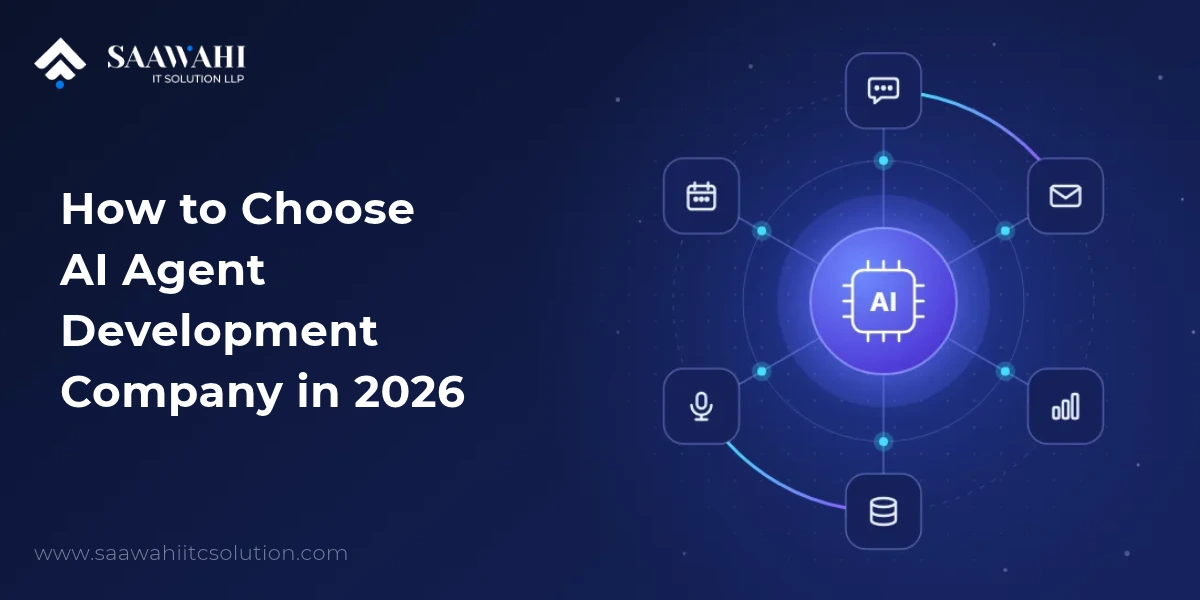
How to Choose an AI Agent Development Company in 2026
Date - 26/10/2026
AI | 3rd November
Choosing a generative AI development company is harder than choosing most software vendors. Nearly every firm now uses the words “AI,” “LLM,” and “agents,” and many demos look impressive. The real question is whether a partner can understand your business problem, build a system that works reliably with your data, protect that data, and hand it over in a state your team can maintain. This guide explains how to tell the difference, what to check before you sign, and what to avoid.
A generative AI development company in USA designs, builds, and deploys software that creates content or makes decisions using large language models and related models. In practice, that work usually includes:
If a company can only describe the first step, or only the model it plans to use, it is probably not yet a full development partner.
Many US companies have strong engineering teams but limited experience with production AI. Generative AI behaves differently from traditional software. The same question can produce different answers, outputs can be confidently wrong, and performance depends heavily on the quality of your data and the way the system retrieves it. A specialized partner can shorten the learning curve and avoid expensive mistakes, such as building a chatbot that no one uses or sending confidential information to a service without the right controls.
The right partner also helps with US-specific constraints. These include state privacy laws such as the California Consumer Privacy Act (CCPA), sector rules such as HIPAA for healthcare data, and customer contracts that require SOC 2 reporting or specific data-residency commitments.
Before you compare companies, write down the problem in one or two sentences. For example: “Our support team spends 40% of its time searching product manuals to answer tickets” is far more useful than “We want to use generative AI.”
A good problem statement includes:
Vendors who respond to a clear problem statement with specific questions are usually more trustworthy than vendors who respond with a generic pitch.
Ask each company to explain, in plain terms, how they would build your solution. You are looking for clear answers to these questions:
Demos are easy to build. Production systems are harder. Ask for evidence that the company has shipped generative AI into real workflows, and look for:
Be cautious of firms that cite large percentage gains without explaining how they were measured. Ask what the baseline was, who measured it, and over what period.
Generative AI projects often touch sensitive data, including customer records, employee information, financial documents, and proprietary designs. A capable partner should cover these areas before you ask:
Get these commitments in the contract, not only in a sales conversation.
Find out who will actually do the work. Ask for names and roles, and confirm whether the senior people in the pitch will stay on the project. Then check how they will work with your team:
A partner that builds a system you cannot maintain has not delivered value. Make handover part of the scope.
Price is only one part of the decision. Compare proposals on the following:
Be wary of a very low quote that leaves out evaluation, security, integration, or support. Those items usually come back later as change requests. Ask each vendor to list their assumptions, and compare those assumptions side by side.
Some warning signs appear again and again in weak AI vendor relationships:
Any one of these is worth a follow-up question. Several together are a reason to walk away.
Use these questions to shortlist vendors quickly:
You have three broad options:
Many organizations combine these options. They buy a standard tool for general productivity and partner for the custom system that supports a core process.
Costs vary widely with scope, data complexity, integrations, security requirements, and ongoing usage. A focused proof of concept costs far less than a production system connected to several internal tools. Ask for a phased estimate with clear assumptions.
A narrow proof of concept can often be tested in weeks. A production system with integrations, evaluation, security review, and training usually takes longer. Timelines depend heavily on how ready your data is.
Not always, but you do need a clear internal owner who understands the business process and can make decisions. Technical knowledge transfer should be part of the project so your team can maintain the system after launch.
Define success metrics before the build starts. Typical measures include task completion time, answer accuracy on a test set, user adoption, escalation rate, and cost per interaction. Review these regularly after launch.
It can be, when the system is designed with access controls, clear data-use terms, appropriate hosting, and monitoring. The safety depends on the architecture and the vendor’s practices, so verify them directly rather than assuming.
The best generative AI development company for your business is the one that understands your problem, explains its approach in plain language, proves it has delivered similar work, protects your data, and leaves your team able to run the result. Use the steps above to narrow your shortlist, then test each finalist with the same questions and the same scope.
If you are evaluating partners now, start with a short discovery session. Bring your problem statement, your data sources, and your compliance requirements. A clear conversation at this stage will show you quickly whether a partner is the right fit.
Saawahi IT Solution helps US businesses plan, build, and deploy generative AI development services that fit their data, security needs, and goals. Share your use case with our team and get a clear view of scope, timeline, and next steps.
© Copyright 2025 All Rights Reserved. Saawahi IT Solution LLP.