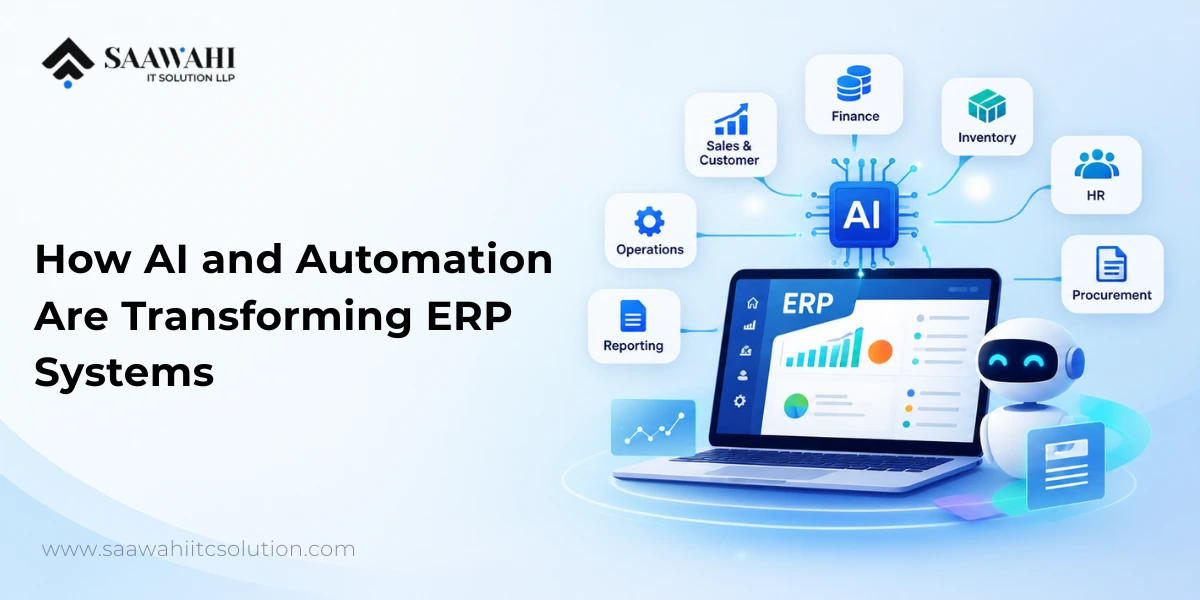
AI-Powered ERP Software: How AI and Automation Are Transforming ERP Systems
Date - 14/09/2026
AI | 10th August
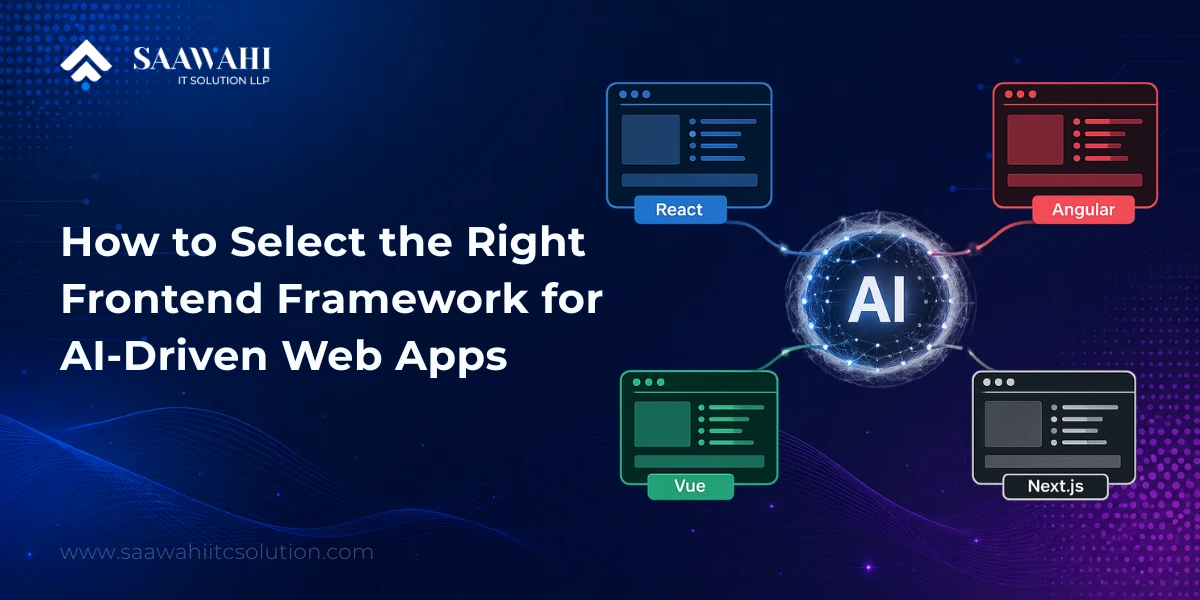
AI-driven products put different demands on a frontend than a standard CRUD app ever did. Streaming responses, real-time data updates, and UI that has to stay responsive while a model is “thinking” none of that was really a design concern five years ago. It is now.
If you’re building (or rebuilding) a product with AI features baked in chat interfaces, recommendation engines, live dashboards fed by ML pipelines the frontend framework you pick shapes how smooth that experience feels, and how much engineering effort it takes to keep it that way. This guide breaks down what actually matters when choosing, and how React, Angular, Vue.js, and Next.js stack up for AI-driven web apps specifically.
Not every framework strength matters equally here. For AI-driven apps, a handful of things matter more than they would for a typical web app:
AI responses often stream in token-by-token or update continuously (think live chat, live dashboards). The framework needs to handle frequent, incremental UI updates without janky re-renders.
AI calls are asynchronous by nature, often long-running, sometimes unpredictable in timing. Clean state handling here prevents a tangle of loading spinners and race conditions.
Most AI features talk to a backend model or agent over REST, WebSockets, or server-sent events. The framework’s ecosystem support for this matters.
UI needs to reflect model output changes instantly — partial answers, confidence scores, suggested actions — without manual DOM wrangling.
Rendering efficiency becomes more visible when your UI updates dozens of times a second during a streaming response, not just on user click.
With that lens, here’s how the major frontend frameworks compare.
React remains the most common choice for AI-driven interfaces, and it’s not just popularity — its component model and hook-based state management (useState, useReducer, useEffect) map naturally onto streaming and async patterns. Libraries built specifically for AI UX — chat components, streaming text renderers, vector search UIs — tend to land on React first, simply because that’s where the largest developer community and tooling ecosystem already sits.
React also pairs well with edge and serverless architectures, which matters if your AI backend needs low-latency inference calls. For teams building AI agents, copilots, or chat-first products, React is usually the safest ecosystem bet.
If you’re evaluating React for an AI-driven build, our team can help – see our ReactJS development services for project-specific guidance.
Angular’s structure – TypeScript by default, RxJS for reactive/async data streams, a built-in dependency injection system – makes it a strong fit for larger, enterprise-scale AI products where multiple teams are working across a big codebase. RxJS in particular is a genuine advantage for AI apps: it was built for exactly the kind of asynchronous, multi-event data streams that AI features generate.
Angular tends to make more sense when the AI feature is one part of a much larger enterprise application a fintech platform with an AI-assisted underwriting module, for example rather than the product’s entire premise.
For enterprise AI builds, explore our hire Angular developers.
Vue sits between React and Angular in complexity – simpler to onboard a team onto than Angular, with a reactivity system that’s genuinely well-suited to live-updating interfaces. For startups building an AI MVP fast, or teams that want less boilerplate than Angular without giving up structure entirely, Vue is a reasonable middle path.
It doesn’t have React’s sheer volume of AI-specific component libraries, so teams sometimes end up building more custom tooling around streaming UI patterns than they would with React.
Learn more about our Vue.js development services
Next.js (built on React) adds server-side rendering, streaming SSR, and edge runtime support – all genuinely useful for AI products where you want fast initial load and the ability to stream AI-generated content server-side before it even reaches the client. For AI SaaS products where SEO, performance, and streaming responses all matter simultaneously, Next.js is often the practical default.
It also plays well with serverless AI inference setups, since API routes can sit right alongside the frontend in the same deployment.
For AI-driven SaaS builds, see our hire Next.js developers
| Framework | Best fit for AI apps | Streaming/async handling | Learning curve | Ecosystem for AI UI |
| React | Chat interfaces, AI agents, copilots | Strong (hooks-based) | Moderate | Largest – most AI component libraries |
| Angular | Enterprise apps with an AI module | Strong (RxJS built-in) | Steeper | Smaller, but solid for enterprise integration |
| Vue.js | Fast AI MVPs, lean teams | Good (native reactivity) | Gentler | Smaller than React’s |
| Next.js | AI SaaS products, streaming SSR | Strong (streaming SSR + edge) | Moderate (React-based) | Same as React, plus SSR-specific tooling |
The framework is one piece of the decision — these usually matter just as much:
There’s no universal right answer — the right framework is the one that matches your team, your timeline, and how your AI backend actually delivers data to the frontend.
Framework choice is only the starting point — the harder part is architecting the frontend to handle real-time AI output cleanly, without race conditions, janky renders, or a tangle of loading states. Our team builds AI-driven web applications end-to-end, from framework selection through to production deployment, working across React, Angular, Vue.js, and Next.js depending on what the project actually needs.
If your product involves AI agents, copilots, or automated workflows, our AI Agent Development services cover both the frontend experience and the underlying agent architecture.
For most AI-driven, chat-first, or agent-based products, React (or Next.js, if SSR and streaming matter) is the safer default given the ecosystem support. Angular earns its place in larger enterprise builds where an AI feature is embedded in a bigger application. Vue is worth considering when speed of development and a lean learning curve matter more than ecosystem breadth.
The right call depends less on which framework is “best” in the abstract, and more on your team, your timeline, and how your AI backend delivers data to the screen.
React is generally the strongest choice for AI chatbots, given the depth of chat-UI and streaming-text component libraries already built for it. Next.js is a close second when you also need fast page loads and SSR.
Yes, Angular’s built-in RxJS support makes it well-suited to asynchronous, real-time data streams, which is exactly what most AI features generate. It’s a solid choice for enterprise AI applications, in particular.
Vue works well for AI MVPs and smaller teams, thanks to its gentler learning curve and native reactivity system. It has a smaller AI-specific component ecosystem than React, though, so more custom UI work may be needed.
Next.js adds server-side rendering and streaming SSR on top of React, which helps AI apps load faster and stream AI-generated content before it fully reaches the client — useful for AI SaaS products where performance and SEO both matter.
Not necessarily a different framework, but different priorities — real-time state handling, async data management, and streaming UI support matter more for AI agents than they do for typical CRUD-based web apps.
Weigh your team’s existing expertise, your project timeline, how your AI backend delivers data (REST vs. streaming), and your scalability needs. There’s no single best framework only the best fit for your specific constraints.

Wama Sompura is the CEO of Saawahi IT Solution, leading innovations in AI, automation, and digital solutions that help businesses drive efficiency and growth.
© Copyright 2025 All Rights Reserved. Saawahi IT Solution LLP.