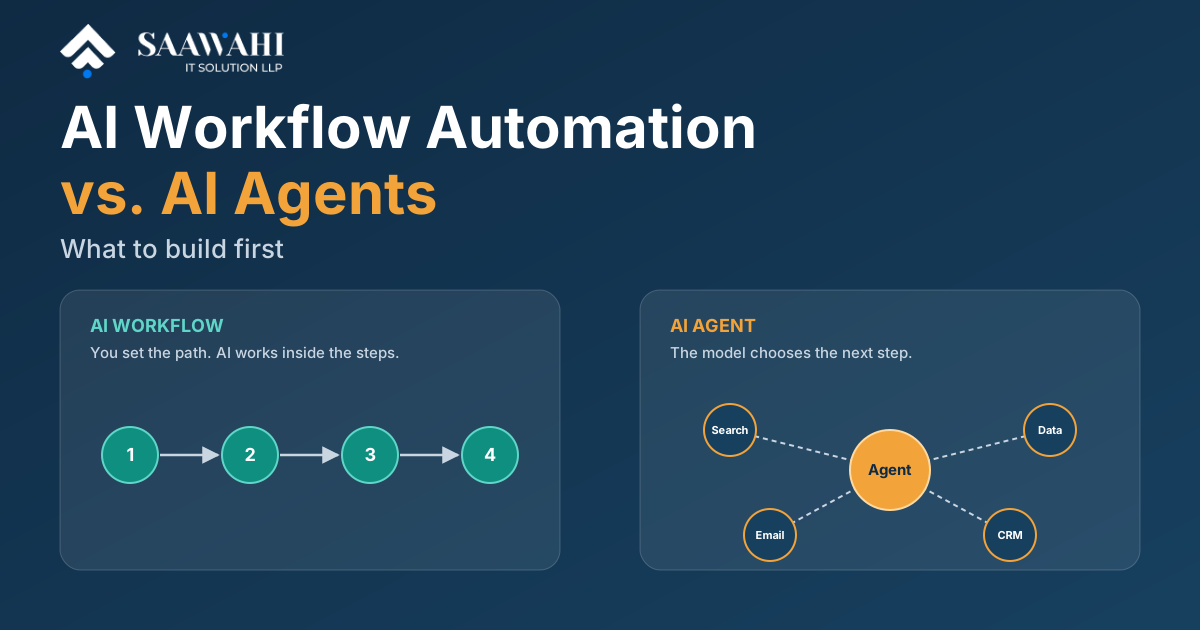
AI Workflow Automation vs. AI Agents: What to Build First
Date - 13/10/2026
AI | 29th June
Due to increased labor costs, constantly increasing customer demands and the need to make decisions faster, all businesses have been forced to be under even more pressure than ever before. The increase in these three areas has caused all businesses regardless of industry, to make operational efficiency a top priority. Although automation has allowed organizations to streamline tasks that are repetitive for many years, there is now a new generation of intelligent technology that will take business efficiency to another level – autonomous AI agents.
Unlike traditional automation tools that only follow rules that were already established, autonomous AI agents will be able to assess the information available to them, determine a course of action, learn to adapt as information changes and manage complex workflows with little or no human input. This level of capability will allow businesses to not only automate individual tasks, but automate entire business processes.
According to industry research from organizations such as McKinsey and Deloitte, organizations that integrate advanced AI-based automation have reported substantial increases in productivity and lower operational costs. While the exact dollar amounts of savings vary by industry and implementation, many organizations are now realizing 20% to 40% in reduced costs by automating back-office and front-office workflows that are repetitive, volume driven, and decision based.
In this article we will discuss how autonomous AI agents operate, how they perform better than traditional automation and the ways in which they can assist organizations with decreasing operational costs through enhanced accuracy, speed and scalability.
Autonomous AI agents are intelligent software systems that can perform tasks independently. They do this in several ways.
While traditional software programs require a continuous human presence to manage their behavior, AI agents can carry out multi-step processes that allow them to adapt to changing circumstances.
For example, instead of simply providing responses to customers via a chatbot, an autonomous AI agent would be able to do the following:
Due to their reasoning, planning and execution capabilities, autonomous AIs have the potential to provide value in multiple industries, including: customer support, finance, healthcare, logistics, manufacturing, and overall business-to-business enterprise operations.
Businesses implementing these advanced AI technologies generally start their efforts by developing custom AI Agents through AI Agent Development Services, creating an AI agent specifically designed to support the (business’s) unique workflows instead of using off-the-shelf robotic automation solutions.
Although conventional automation has been an effective means of increasing efficiency, its limitations are becoming increasingly obvious as business processes evolve into a more dynamic environment.
The use of rules-based automation tools means that when a process changes or an unplanned event occurs, a human being will frequently have to get involved; therefore, this type of automation creates operational bottlenecks and hinders scalability.
As an example, if a rules-based invoice automation tool processes invoices from a particular vendor according to the predetermined invoice format, there are likely to be more problems than solutions when that same vendor’s invoice format is altered or when a vendor submits an invoice but does not include all of the required information. As a result, the invoice should probably undergo further processing by a human being.
In contrast, autonomous artificial intelligence (AI) agents are capable of interpreting context, recognizing patterns, and identifying missing elements and then determining the best course of action based upon facts and circumstances that don’t conform to rigid rules
| Traditional Automation | Autonomous AI Agents |
| Rule-based workflows | Goal-driven decision making |
| Limited adaptability | Learns from interactions |
| Handles repetitive tasks | Manages complex workflows |
| Requires frequent updates | Continuously improves performance |
| High human supervision | Minimal human intervention |
This adaptability enables organizations to automate increasingly complex business operations while reducing manual effort and operational costs.
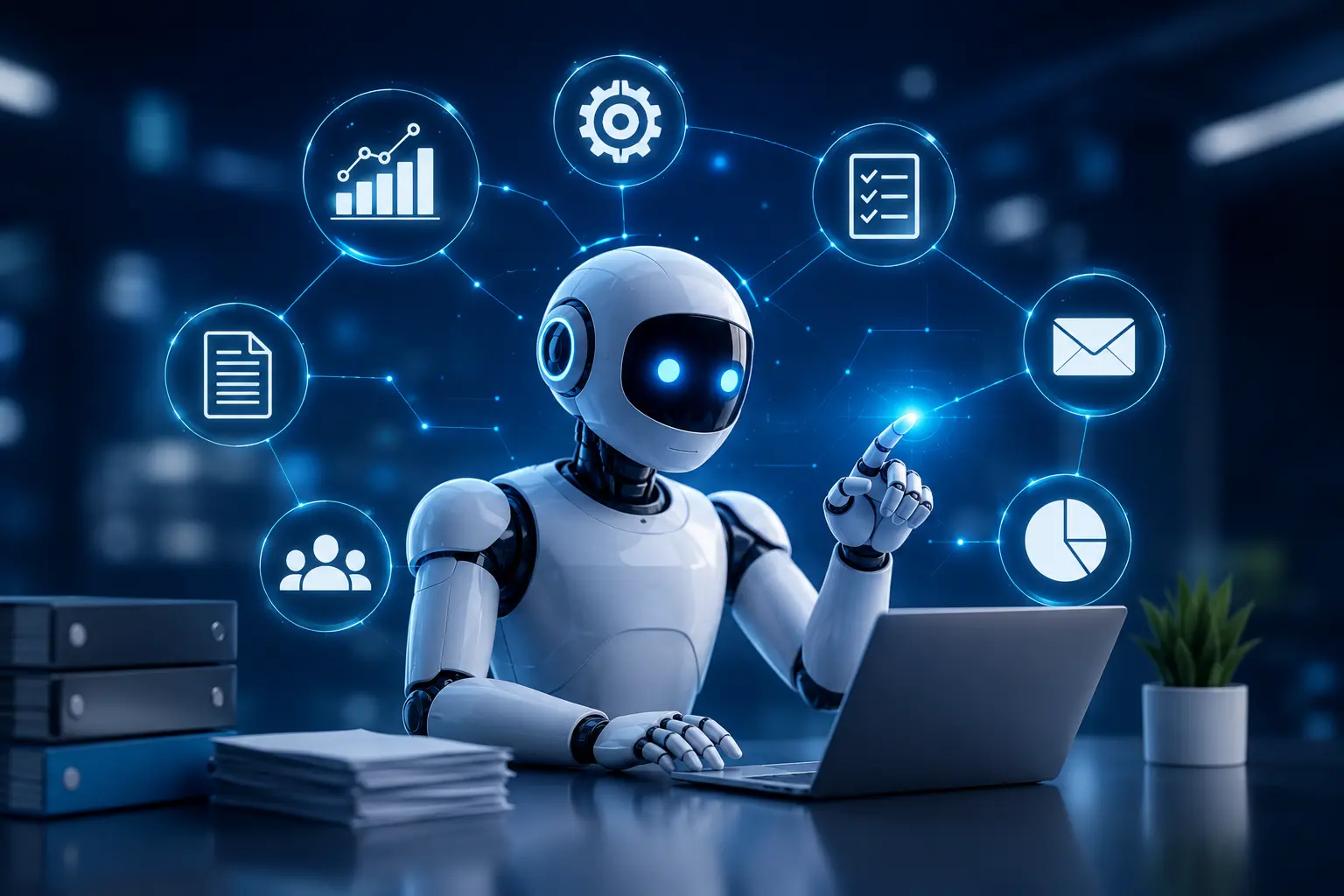
Many organizations still spend thousands of employee hours every month performing repetitive administrative tasks.
These include:
These are relatively small tasks but when combined together consume a lot of operational resources.
By automating these jobs with an autonomous AI agent, companies are able to assign their employees to more important tasks, such as strategy and innovation, and to focus on customers and growing the business.
Using an AI agent to take care of the following example of invoice processing eliminates the need for manual labour: The AI agent extracts data from invoices, validates purchase orders, updates accounting systems, and indicates to the financial team that there are exceptions through notifications, all without any human touch.
This form of automation not only decreases the amount of money that can be spent on the labour, but it also decreases the amount of time that the organization has to wait before processing invoices, improves the compliance with accounting standards, and dramatically reduces the amount of errors in processing invoices.
For companies that are developing an overall automated enterprise through enterprise automation, integrating of AI agents with their ERP, CRM, and business application systems through the use of AI Integration Services, can further enhance the efficiency of their operations and result in rapid returns for their investments.
One of the greatest operational expenses for many companies is customer support. To maintain 24/7 customer support, businesses can put in place additional staff and extend hours of operation or require businesses to hire an outside vendor to provide customer service.
AI autonomous agents are a viable solution to handle a significant percentage of the customer interactions without needing to hire additional employees.
Unlike traditional chatbots that only answer predefined questions, the use of AI agents is much different because they can interpret meaning in context, pull data from multiple systems, and complete the entire service request.
In some cases, a customer service AI agent can:
For these reasons, organizations can reduce their support costs, improve their response times and improve customer satisfaction by using AI agents to resolve standard requests without human involvement.
Also, human support teams will have more time available to concentrate on higher value customer interactions that require empathy, negotiation or areas of specialization.
It takes a lot of departments, approvals, and software programs to complete business processes. For instance, when a company hires a new employee, they will have to collect documents for HR, provision accounts for IT, set up payroll for finance, and approve access for management. Creating these manual processes adds time and unnecessary admin costs.
The use of autonomous AI agents greatly reduces the amount of time spent coordinating the various tasks in a process by providing a single intelligent coordinator. Instead of automating individual tasks within a process, an AI agent will manage an entire process from start to finish. An AI agent can automatically gather the required documentation; trigger approvals for the various departments; send reminder notices; update the business systems; and notify the various stakeholders throughout the entire process.
The use of this type of workflow automation greatly reduces the processing time, limits bottlenecks and provides assurance that the tasks are still progressing without constant human supervision.
Companies that are using AI agents combined with Custom AI Development Services can create workflow solutions that are specific to their unique operations and increase both productivity and efficiency for all employees.
Manual processes can lead to mistakes. Wrong pieces of data being entered, creating duplicate records, failing to approve something or making an arithmetic mistake are all things that can cause a business to lose money or not follow the rules and make customers unhappy.
AI (artificial intelligence) agents can help to alleviate these risks because they follow set rules when making actions and can check and ensure that things are correct before acting on them.
For example, an AI agent that processes purchase orders will:
AI agents act like a helper to employees; they will not replace them. However, they provide employees with help in order to be more accurate and responsible in their jobs.
Businesses such as finance, healthcare, and manufacturing where being correct is critical will likely save a considerable amount of money over time with the use of AI.
Workers often have to waste hours getting information from several different systems in order to make a decision, which can cause operational delays.
Autonomous AI agents can help reduce that time by gathering, analyzing and presenting all relevant data in real-time.
Think of a sales manager who needs to rank the leads he/she is working on based on their potential for sale. Instead of having to manually read through the CRM records, review web site traffic and activity and search the e-mail records on those leads, an AI agent could automatically evaluate the quality of the leads through the scoring system, rank them with a score, and create recommendations for the best next step to take.
The same is true in finance, where AI agents can help finance functions “keep an eye on” cash flow, identify non-typical spending behavior, and make recommendations for action before an issue becomes critical.
The faster accurate insights are obtained by businesses, the better they can react to changes in the marketplace, improve their operational capabilities and cut back on the expense of slow decision making.
Inefficient resource use is one of the highest hidden costs of business. Employees can waste time on unproductive tasks, inventory can remain on shelves with no movement, or manufacturing orders can be misaligned with customers’ needs.
To optimize resource use, autonomous artificial intelligence (AI) agents continuously review operational analytic data. These technologies provide recommendations for better resource utilization.
Examples include:
AI-based agents utilize historical data to improve their understanding of resource needs over traditional static scheduling systems and therefore can provide better-informed recommendations.
Results are increased utilization of both labor and capital via improved productivity and lower operational waste.
One of the largest operational costs in manufacturing, logistics, energy, and healthcare is the accidental failure of equipment.
Presently used maintenance schedules are typically based on a fixed interval, which can lead to excess parts, and last-minute breakdowns.
Autonomous artificial intelligence (AI) agents take a more proactive approach to this issue.
By continuously monitoring the sensor data being received from a piece of equipment, as well as its previous operating history, they can identify possible warning signs of a failure before it happens.
For example, an AI agent that is monitoring equipment on a production line may identify abnormal vibration patterns, increasing temperature, or decreasing performance; and will automatically schedule maintenance and notify the technician and order any replacement parts, before there is any disruption to the production process.
By using this predictive method, organizations can:
Predictive maintenance often provides one of the quickest returns on investment for companies in asset-intensive industries using artificial intelligence for their predictive maintenance programs.
Sales and marketing professionals handle millions of customer contacts every month. This activity includes qualifying leads, maintaining CRM records, sending follow-up emails, and measuring the results of campaigns — all activities that take time away from building relationships with customers.
AI (Artificial Intelligence) allows sales agents and marketers to automate many of the routine tasks that they do, while also providing teams with the data necessary to make better decisions.
An AI sales agent can do things like:
Marketing teams can also benefit from an AI agent’s ability to monitor the effectiveness of a campaign, segment audiences, recommend content strategies, and optimize ad spend based on real-time data.
By using AI agents instead of eliminating jobs, marketing professionals can free themselves from mundane administrative tasks and devote their time and energy to creative solutions, strategic planning, and innovative customer experiences.
| Industry | Common AI Agent Applications | Primary Business Benefits |
|---|---|---|
| Healthcare | Patient scheduling, claims processing, virtual assistants | Lower administrative costs and faster patient service |
| Banking & Finance | Fraud detection, compliance monitoring, customer support | Improved accuracy and reduced operational risk |
| Manufacturing | Predictive maintenance, quality control, production scheduling | Reduced downtime and higher productivity |
| Retail & E-commerce | Inventory management, customer service, demand forecasting | Better customer experience and optimized inventory |
| Logistics & Supply Chain | Route planning, shipment tracking, warehouse automation | Lower transportation costs and faster deliveries |
| Real Estate | Lead qualification, property recommendations, document processing | Faster sales cycles and improved client engagement |
| SaaS & Technology | Customer onboarding, technical support, workflow automation | Increased efficiency and scalable customer service |
| Feature | Traditional Automation | Autonomous AI Agents |
|---|---|---|
| Decision-making | Rule-based | Context-aware and adaptive |
| Learning capability | None | Continuously improves from data |
| Workflow management | Individual tasks | End-to-end business processes |
| Human involvement | Frequent | Minimal for routine operations |
| Scalability | Moderate | High |
| Flexibility | Limited | Handles dynamic scenarios |
| Business value | Efficiency gains | Efficiency, intelligence, and strategic insights |
While traditional automation remains valuable for simple, repetitive tasks, autonomous AI agents enable organizations to automate complex decision-driven processes that were previously difficult to streamline.
Adopting autonomous AI agents is not simply about deploying new technology—it requires a strategic approach that aligns with your business goals, existing workflows, and organizational readiness. Businesses that start with a clear roadmap are more likely to achieve measurable cost savings and long-term success.
You will need to employee to assess how repetitive, time-consuming, or error-prone your current process is by reviewing the following areas where you may find; customer support, invoice processing, employee onboarding, data entry, lead qualification, and document management.
These areas generally provide the quickest return since they occur frequently and typically involve well-defined workflows.
AI agents require accurate and well-organized data in order to make informed decisions. Therefore, prior to implementing you’re going to want to examine your business’s current data quality in addition to any inconsistencies or gaps.
Integrating data from CRM systems, ERP systems, internal databases, and business software will provide context that your AI agent will need so they can perform their duties effectively.
Not every business will benefit from the same type of AI agent. One company may find value in having an AI agent focused on customer support, an additional company may benefit from workflow automation, a different company would benefit from predictive analytics, and yet another would find value via intelligent document processing.
You will want to partner with an experienced AI development provider who can ensure the AI agent solution you implement is aligned with your operations goals versus requiring your business to change how it operates in order to accommodate a generic software solution.
In order to gain absolute Efficiency when Using Existing Tools that are already in place for Your Teams, AI Agents should be Integrated into Products / Services Which You Are Currently Using.
Integration of CRM and ERP Software, as well as Cloud Applications, will allow Your AI agent tools to Access Information, Automated Processes and Maintain the same Flow of Work as the Initially Established Workflows thus Reducing Any Disruptions while Increasing the Acceptance of the Use of Artificial Intelligence via Increased User Acceptance by All Divisions.
The Success of Implementing AI Does Not Stop After A System is Deployed. You Will Need to Track KPI’s, Which Include; How Long it Takes to Process an Order? How Much Money Do You Spend on Operations? How Satisfied Are Your Customers? How Long Does it Take to Respond to an Inquiry, Error Rate, Etc.?
By Tracking Performance Regularly, You Will Identify Opportunities to Refine Workflow Processes, Increase Their Accuracy and Ultimately Achieve Maximum ROI With Artificial Intelligence Implementations.
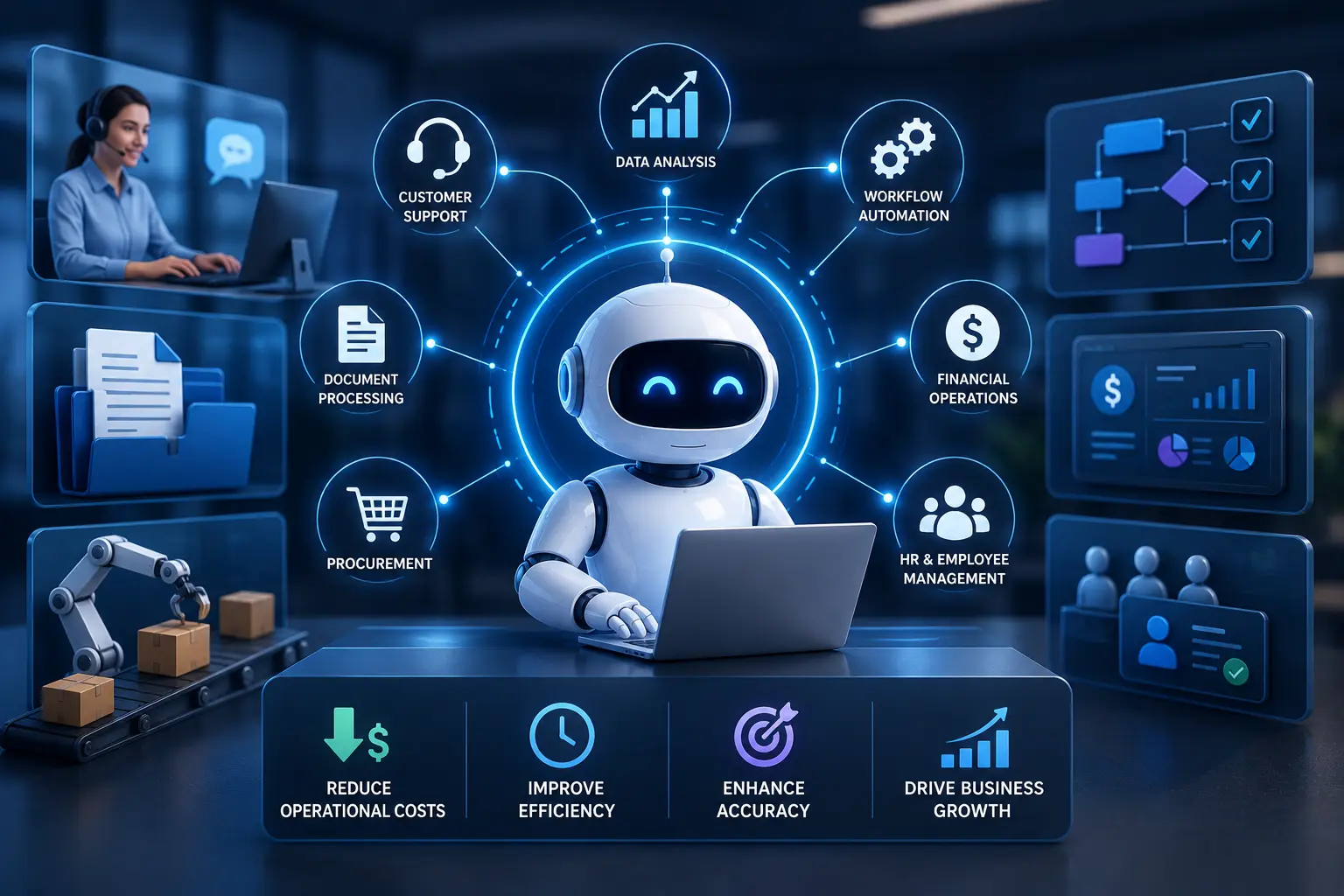
Even though autonomous Artificial Intelligence offers great benefits to organizations, they will face issues implementing it. Identifying those issues early is critical to minimize implementation risk and achieve better results.
If data is incomplete, outdated, or inaccurate, it will impact the performance of the AI system that uses it. Developing strong data governance policies and implementing processes for routinely validating data will help ensure reliable results.
Most organizations today run multiple distinct legacy systems, which often were not built with an AI integration strategy in mind. By using an AI platform with flexible, well-defined APIs, the deployment of an AI agent will be faster than using any other kind of platform.
Many employees will be concerned that AI will take their jobs. Evidence suggests that the most successful AI agents are those that provide assistance to human productivity, as opposed to replacing it; AI can automate routine tasks so that employees can spend more time on higher value added tasks.
Companies need to educate their employees about how to adopt AI into their daily tasks and how AI will help employees perform their jobs better.
Any business that processes or stores confidential business or consumer data needs to ensure that the AI systems they use meet applicable regulations and security standards. Businesses should implement role-based access controls, encryption, audit logs, and develop a system for real-time monitoring of their AI applications to ensure compliance with applicable regulations and to maintain user trust.
Organizations that have realized the most significant benefits from autonomous AI agents often implement some or all of the following best practices:
By treating AI as a continuous business practice and not just a single technology project, organizations can maximize the value created through their investment in autonomous AI agents.
Maturing AI systems are evolving from being a limited number of task-oriented assistants to full-fledged intelligent systems that can run ever-more complex business processes on their own without human intervention.
For example, multi-agent systems will come into play as organizations will continue to move towards multiple agents working together to provide the needed assistants, as well as provide customers an end-to-end experience. A customer’s request can activate multiple agents to perform all the activities required by each agent to finish an end-to-end request, including those required for sales, finance, logistics, or customer service.
Generative AI advances, large language models, and systems with reasoning capability will provide the AI agents with the ability to make better contextualized decisions, enhance customers with customized interactions, and identify opportunities for improvement in processes.
Investing in AI is critical for businesses today to drive operational efficiency, gain a competitive advantage, and respond to changes in the digital economy.
Autonomous AI agents are reshaping the landscape of how businesses today redefine their approach to Operational Efficiency by providing intelligence, adaptability, and decision-making capabilities into all aspects of a business’s daily operations, in addition to automating repetitive tasks.
Specifically, Autonomous AI Agents are enabling organizations to streamline their workflows, reduce errors, optimize their resources, and Improve their responsiveness to meet the dynamic business environment of today. By making these types of performance improvements possible, businesses can achieve significant Operational cost savings, while giving their employees the ability to innovate and build more effective relationships with customers and focus on the successful growth of the business in the long term.
As Artificial Intelligence technology continues to evolve, organizations that invest in Autonomous AI Agents now, will be better positioned to efficiently scale their organization in the years ahead, improve their business’s resiliency to market changes, and provide their organization with a sustainable competitive edge.
If you are an organization that is interested in exploring how to automate complex workflows or build custom AI solutions for your organization’s needs, working with an experienced AI development team can help you discover the best opportunities to use Automation to create and implement scalable solutions, and maximize the value of your business over the long-term.

Wama Sompura is the CEO of Saawahi IT Solution, leading innovations in AI, automation, and digital solutions that help businesses drive efficiency and growth.
© Copyright 2025 All Rights Reserved. Saawahi IT Solution LLP.