AI Agents in Back-Office Automation: Real ROI, Real Use Cases
Date - 27/07/2026
AI | 23rd April
AI agent development services bridge the gap between traditional static software engineering and autonomous system execution. Unlike legacy automation tools that rely on rigid, deterministic rules—such as hardcoded if/then conditions—modern AI agents use Large Language Models (LLMs) as central reasoning engines. This fundamental architecture shift allows agentic systems to interpret unstructured data, formulate execution strategies dynamically, and interact with external applications to complete multi-step operations without requiring explicit step-by-step programming.
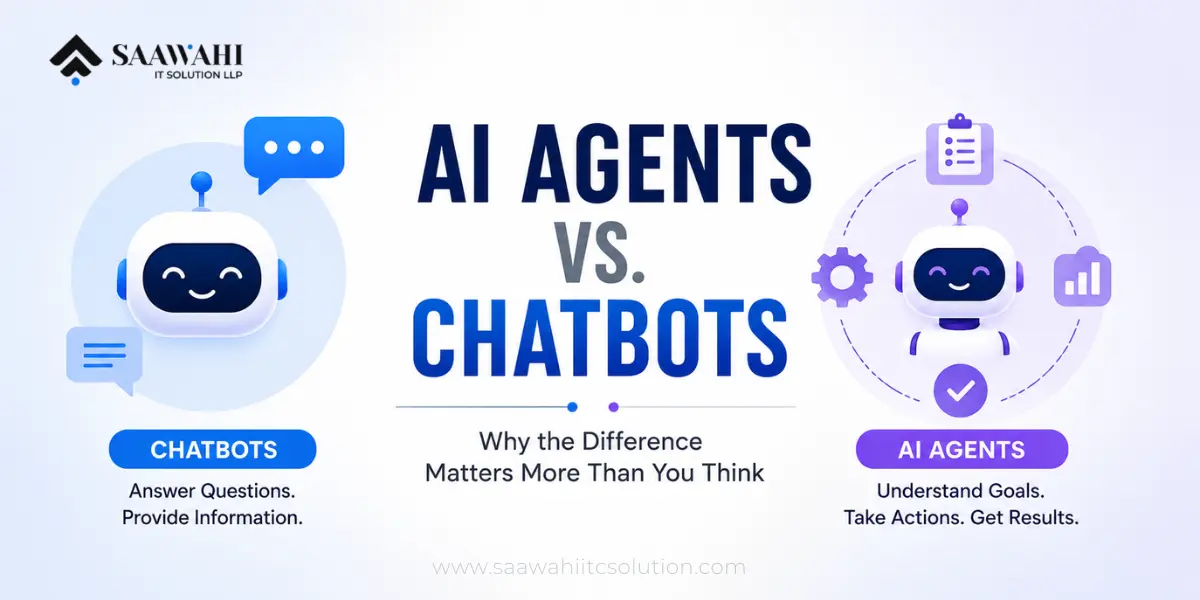
In an enterprise environment, these services focus on moving beyond basic informational chatbots. Instead, they deliver complex, goal-oriented systems capable of evaluating context, managing state across long execution cycles, and autonomously utilizing software tools to achieve specific business outcomes.
Building a production-ready AI agent requires integrating several sophisticated software layers. To move past simple prompt-and-response interactions and ensure enterprise-grade stability, an agentic framework must be built upon four foundational pillars:
The core of any AI agent is its reasoning framework, which dictates how the underlying LLM processes tasks. Rather than executing a single linear request, advanced agent architecture implements iterative reasoning loops, such as the ReAct (Reason + Act) or Chain-of-Thought (CoT) frameworks. This allows the agent to break down a broad, high-level objective into sequential sub-tasks, evaluate its own intermediate outputs, correct course when a software tool returns an error, and logically progress toward the final goal.
To be useful in a business setting, agents require both short-term operational memory and long-term factual recall.
An agent cannot create real-world business value if it is confined to a text box. Agents must be equipped with “tools”—which are technically structured API abstractions, database connectors, or microservices. The development process involves engineering strict tool-calling interfaces. When the agent’s reasoning engine determines it needs to read a client file, check inventory levels, or update an internal record, it autonomously outputs a structured command (such as JSON) to execute that specific function across your CRM, ERP, or legacy software ecosystem.
Deploying autonomous agents into enterprise workflows introduces critical security, data privacy, and compliance requirements. A robust architecture implements deterministic validation layers that wrap around the agent’s inputs and outputs. These safety guardrails act as a protective firewall: filtering out prompt injection vulnerabilities, preventing data leakage, enforcing strict access control boundaries, and programmatically triggering “human-in-the-loop” approval requests whenever a high-stakes action (such as a financial transaction or a customer-facing communication) is required.
Building an AI agent involves more than integrating a language model. Successful AI agents require strategic planning, data integration, workflow design, and continuous optimization.
A typical AI agent development process includes:
Identify automation opportunities, business goals, workflows, and expected outcomes.
Define the agent’s capabilities, decision-making logic, data sources, and integrations.
Choose the appropriate AI models such as GPT, Claude, Gemini, Llama, or custom-trained models.
Connect the AI agent with CRMs, ERPs, databases, APIs, communication platforms, and internal systems.
Validate accuracy, response quality, security, and performance under real-world conditions.
Deploy the agent, monitor results, collect feedback, and continuously improve performance.
Organizations implementing intelligent agents through professional development services experience dramatic efficiency improvements. Agents handle repetitive tasks, process information at scale, and eliminate manual bottlenecks. A customer service agent, for example, can handle thousands of inquiries simultaneously, providing instant responses and escalating complex issues to human agents.
Automating routine processes significantly reduces operational costs. AI agent development services enable businesses to redeploy human resources from mundane tasks to strategic initiatives. The ROI becomes apparent within months as labor costs decrease and throughput increases.
Intelligent agents analyze vast datasets, identify patterns invisible to humans, and provide data-driven recommendations. In finance, agents detect fraudulent transactions; in healthcare, they assist with diagnostics; in manufacturing, they predict equipment failures.
Unlike human teams, agents scale effortlessly. Whether processing ten requests or ten million, properly developed agents maintain performance. This 24/7 availability ensures businesses never miss opportunities or leave customers waiting.
Different business objectives require different AI agent architectures.
| AI Agent Type | Primary Use Case |
|---|---|
| Customer Support Agents | Automate inquiries and ticket resolution |
| Sales AI Agents | Lead qualification and follow-up automation |
| Research Agents | Data gathering and competitive analysis |
| Workflow Automation Agents | Automate repetitive business processes |
| Document Processing Agents | Extract and analyze information from documents |
| Personal Productivity Agents | Scheduling, reminders, and task management |
| Multi-Agent Systems | Complex enterprise automation involving multiple AI agents |
Selecting the right type of AI agent depends on business goals, workflows, and operational complexity.
Before development begins, stakeholders must articulate clear, measurable objectives. What should the agent accomplish? What success looks like? Vague objectives lead to misaligned development and disappointing results.
Comprehensive testing is non-negotiable. Professional AI agent development services implement rigorous testing protocols including unit tests, integration tests, simulation-based testing, and real-world validation. Edge cases and failure scenarios require special attention.
Deployment isn’t the endpoint. Mature development services establish monitoring systems tracking agent performance, user satisfaction, and business metrics. This data informs continuous optimization cycles.
Responsible AI agent development incorporates ethical guidelines, bias detection, and safety mechanisms. Agents must operate transparently, respect privacy, and avoid harmful decisions. Especially in sensitive domains like healthcare or criminal justice, ethical development is paramount.
Clear documentation ensures agents remain maintainable and understandable. As team members change and requirements evolve, comprehensive documentation preserves institutional knowledge and facilitates updates.
Intelligent chatbots and support agents handle inquiries, troubleshoot issues, and provide personalized assistance. Natural language capabilities enable human-like interactions while reducing support costs by 30-40%.
Agents analyze market data, detect fraud, manage portfolios, and execute trades. The speed and precision of intelligent agents provide competitive advantages in fast-moving financial markets.
Medical agents assist with patient triage, symptom analysis, and diagnostic recommendations. They process medical records, identify relevant research, and support clinical decision-making.
Agents optimize routes, predict demand, manage inventory, and coordinate suppliers. In complex supply chains, agent-based optimization reduces delays and costs significantly.
Predictive maintenance agents monitor equipment, predict failures, and schedule maintenance proactively. This prevents costly downtime and extends equipment lifespan.
Evaluate providers’ expertise across relevant domains: machine learning, NLP, system architecture, and your specific industry. Look for teams with proven track records and certifications.
Generic solutions rarely address specific business needs. Seek providers offering customized development rather than one-size-fits-all platforms.
Ensure providers can scale solutions alongside your growth. Cloud infrastructure, distributed systems expertise, and performance optimization capabilities matter.
Development doesn’t end at deployment. Providers should offer maintenance, monitoring, optimization, and enhancement services post-launch.
Understand pricing models and what’s included. Hidden costs and unexpected fees indicate unreliable partners.
Next-generation agents will learn autonomously from environmental interactions, reducing reliance on pre-trained models and enabling true adaptation.
As agents make critical decisions, explainability becomes crucial. Development services increasingly focus on creating agents whose decision logic is transparent and auditable.
Agents processing data locally rather than in cloud services offer reduced latency and improved privacy. Edge-based AI agent development will accelerate.
Future agents will collaborate more seamlessly with humans and other agents, creating hybrid intelligent systems that combine human judgment with machine efficiency.
AI agent development services represent more than a technology trend—they’re fundamental to organizational transformation. As businesses navigate increasingly complex environments and data volumes, intelligent agents become essential tools for maintaining competitiveness and operational excellence.
Whether you’re exploring initial agent implementation or scaling existing systems, partnering with experienced AI agent development professionals ensures success. The right development partner brings technical expertise, industry knowledge, and commitment to delivering solutions that drive measurable business value.
The question isn’t whether your organization needs AI agents, but when you’ll implement them. Early adopters gain significant competitive advantages. By investing in professional AI agent development services today, you position your organization to thrive in tomorrow’s AI-driven economy.
The future belongs to businesses that successfully harness intelligent automation. Start your AI agent development journey today with a partner committed to your success.

Wama Sompura is the CEO of Saawahi IT Solution, leading innovations in AI, automation, and digital solutions that help businesses drive efficiency and growth.
© Copyright 2025 All Rights Reserved. Saawahi IT Solution LLP.