Why Nodejs Is Powerful: A Complete Guide to Core Components
Date - 26/02/2026
AI | 22nd January
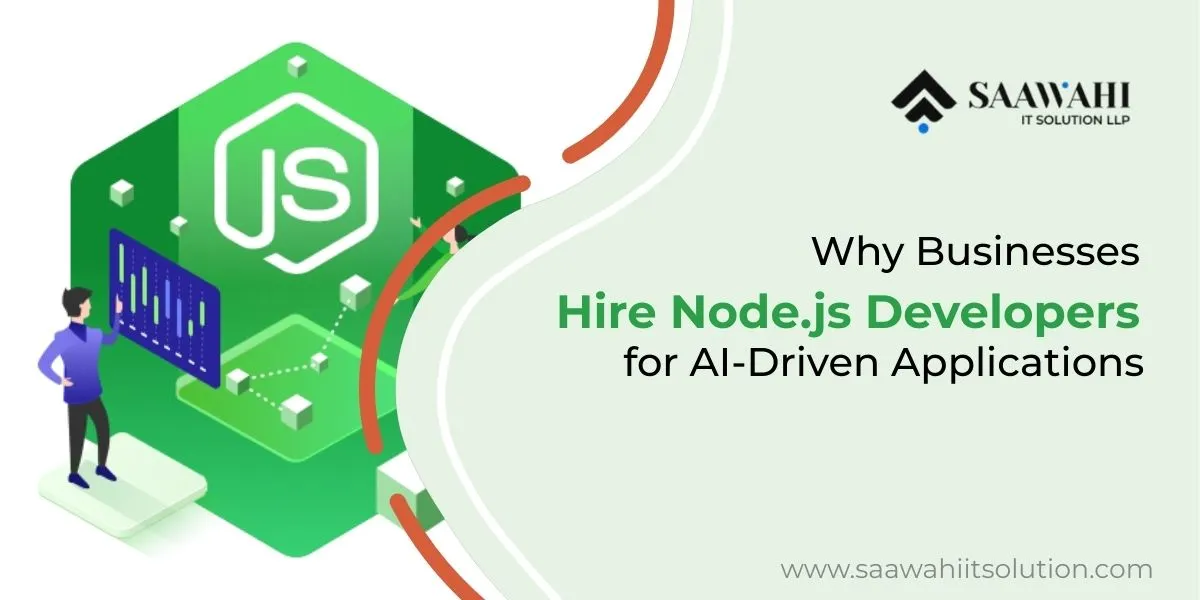
Artificial Intelligence (AI) is no longer a futuristic concept—it is reshaping businesses across industries. From intelligent chatbots and recommendation engines to real-time analytics dashboards and fraud detection systems, AI-driven applications are becoming the norm.
However, powering these applications requires more than just advanced AI models. Backend systems must handle real-time requests, scale efficiently, integrate with multiple services, and maintain high performance under heavy loads.
This is where Node.js has emerged as a critical technology. Its asynchronous, event-driven architecture and lightweight runtime make it ideal for AI-driven applications. As a result, many organizations are actively choosing to hire Node.js developers to build scalable, high-performance AI platforms.
In this article, we explore why businesses are increasingly hiring Node.js developers, how Node.js supports AI-driven applications, and what trends are shaping the future of AI development.
Not every application that uses AI is “AI-driven.” True AI-driven applications go beyond static model predictions—they continuously analyze data, make decisions, and adapt in real time.
Key characteristics include:
Continuous data processing: AI applications ingest data from multiple sources in real-time.
Adaptive decision-making: Responses are dynamic, based on model predictions and user interactions.
Integration with multiple AI services: Applications may combine natural language processing, computer vision, recommendation engines, or predictive analytics.
Scalability: Systems must handle thousands of concurrent users and requests simultaneously.
Reliability and low latency: AI applications need to respond instantly or near-instantly to user actions.
Backend systems that cannot meet these requirements will slow down AI performance, leading to poor user experiences. Node.js addresses these challenges with its non-blocking I/O model and efficient event-driven architecture.
Node.js was originally designed for web applications, but its architecture aligns exceptionally well with AI-driven workloads.
AI applications often involve multiple external operations, such as calling inference APIs, querying databases, or processing data pipelines. Node.js handles these asynchronously, ensuring that requests do not block the server, which keeps applications responsive.
Node.js can handle thousands of simultaneous connections without spawning new threads for each request. This is ideal for AI-driven applications like chatbots, recommendation systems, and real-time dashboards where multiple users interact concurrently.
Node.js allows developers to use JavaScript across both frontend and backend. This reduces context switching, speeds up development, and allows businesses to hire Node.js developers who can work across the full stack.
Most AI services are exposed as APIs. Node.js excels at consuming and orchestrating APIs, enabling seamless integration between AI models and application frontends.
Real-time responsiveness is crucial in AI-driven systems. Node.js powers applications where immediate feedback is required.
Examples include:
By managing WebSockets, event streams, and asynchronous API calls efficiently, Node.js ensures AI applications are both fast and reliable.
Modern AI systems are rarely monolithic—they are typically built using microservices. Each microservice handles a specific function, such as data ingestion, preprocessing, inference, or reporting.
Node.js serves as a lightweight orchestration layer, coordinating these services efficiently:
This orchestration ensures AI systems are modular, resilient, and easier to scale. For complex projects, businesses often hire Node.js developers with expertise in microservices and event-driven architecture.
While Python is dominant for training AI models, production environments require reliability, scalability, and integration. Node.js enables:
This separation allows data science teams and backend teams to work independently while maintaining a seamless production workflow.
The majority of AI applications today are deployed in cloud or serverless environments. Node.js offers several advantages here:
Businesses that want scalable cloud AI solutions often hire Node.js developers to ensure best practices in deployment and architecture.
AI applications frequently process sensitive data, making security a priority. Node.js developers focus on:
Experienced developers ensure that AI systems remain both secure and performant, especially in enterprise-grade deployments.
Companies choose to hire Node.js developers for AI-driven projects for several reasons:
Whether hiring freelancers or collaborating with a Node.js development company, businesses benefit from specialized skills that align with AI production requirements.
The future of Node.js in AI development is shaped by:
These trends indicate that Node.js will remain central to AI infrastructure for years to come.
Node.js is the right choice for AI projects when:
In these cases, hiring Node.js developers or partnering with a Node.js development company ensures scalable, reliable, and maintainable AI applications.
Businesses hire Node.js developers to build scalable, real-time AI applications. Skilled developers integrate AI services, manage backend performance, and ensure reliable production deployment, enabling companies to deliver high-performance, intelligent systems efficiently.
Yes. Node.js’s asynchronous, event-driven architecture allows AI applications to handle thousands of concurrent requests. This makes it ideal for chatbots, recommendation engines, live dashboards, and other real-time AI systems.
Absolutely. Node.js developers are skilled in deploying AI applications in cloud and serverless environments, ensuring fast startup times, scalable infrastructure, and cost-efficient AI processing.
They wrap AI models as APIs, manage authentication, normalize outputs, and coordinate multiple models through microservices. This allows AI applications to function reliably and deliver accurate predictions to end users.
AI-driven applications demand high-performance, scalable, and reliable backends. Node.js has proven to be a versatile and efficient technology that addresses these needs.
Businesses are increasingly choosing to hire Node.js developers to implement real-time integrations, orchestrate AI workflows, and build future-ready AI platforms.
Investing in Node.js expertise is not just a technical decision—it is a strategic choice that ensures AI applications perform optimally, scale effectively, and remain reliable over time.

Wama Sompura is the CEO of Saawahi IT Solution, leading innovations in AI, automation, and digital solutions that help businesses drive efficiency and growth.
© Copyright 2025 All Rights Reserved. Saawahi IT Solution LLP.