Mobile App Development Services: Build Scalable Android, iOS & Cross-Platform Apps
Date - 03/09/2026
Mobile App Development | 5th October
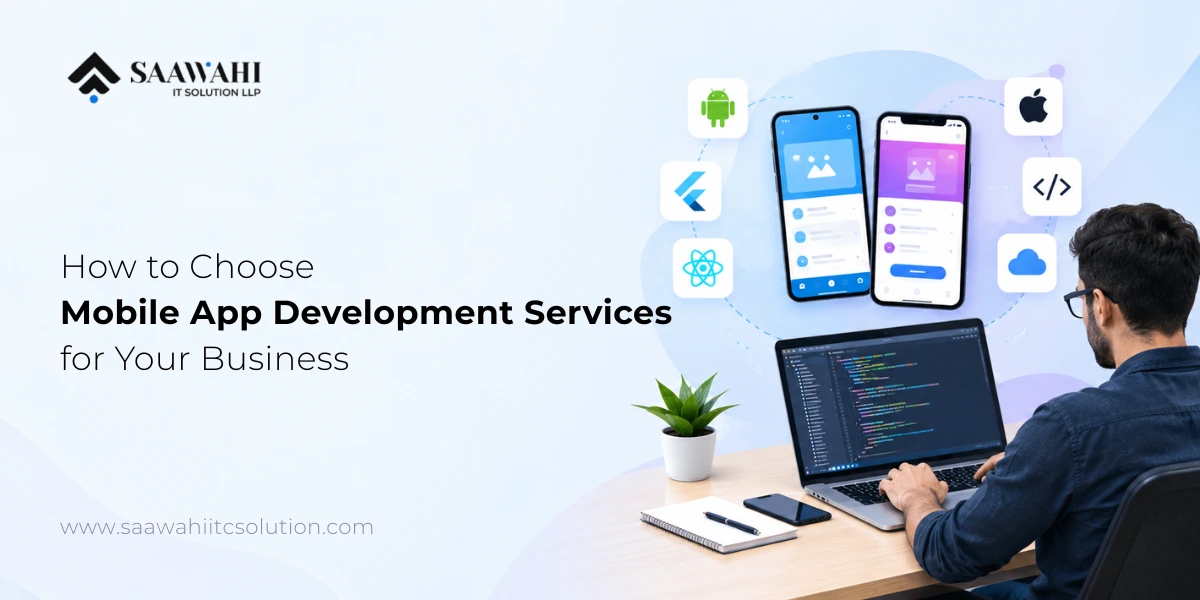
Choosing the right mobile app development partner can have a major impact on your product’s cost, quality, launch timeline, and long-term growth. A development company may have strong technical skills, but that does not automatically mean it is the right fit for your business.
The right choice starts with understanding what you need to build, which platform makes sense for your users, what development approach fits your goals, and how well a potential partner can support the product after launch.
This guide explains how to evaluate mobile app development services, compare development teams, assess Android and iPhone capabilities, understand pricing, and avoid common mistakes before signing a contract.
The right mobile app development service provider should be evaluated based on your business requirements, target platforms, technical expertise, relevant portfolio, development process, security, pricing transparency, ownership terms, and post-launch support. The best provider is not necessarily the cheapest or largest company, but the one whose capabilities and development approach match your product’s needs.
Mobile app development services usually cover much more than writing application code. A reliable development partner should be able to support the product through multiple stages of its lifecycle.
Depending on the project, services may include:
Before comparing companies, clarify which of these services your project actually requires. Some businesses need a complete product team, while others may already have designers, backend engineers, or product managers and only need mobile development expertise.
The first step in choosing mobile app development services is not comparing companies. It is defining the product.
Start by answering a few practical questions:
An app designed to increase online purchases will have different requirements from an employee-management application, healthcare platform, logistics application, or SaaS product.
Identify your primary users, their locations, devices, technical expectations, and the situations in which they will use the application.
Separate must-have features from features that can be introduced later. This can help you create a realistic MVP instead of trying to launch everything at once.
Consider payment gateways, CRM systems, ERP software, databases, authentication systems, analytics platforms, APIs, or other third-party services.
Define measurable goals such as user acquisition, transactions, customer retention, operational efficiency, or subscription growth.
Having these answers makes it much easier to evaluate whether a development company understands your business rather than simply responding to a list of technical requirements.
One of the most important decisions is whether to build a native application for each platform or use a cross-platform approach.
Native applications are built specifically for a particular operating system. Android applications can be developed using technologies such as Kotlin, while iOS applications commonly use Swift.
Native development can be a strong option when your application requires:
The main consideration is that separate development may be required for Android and iOS, potentially increasing development effort.
Cross-platform frameworks allow businesses to develop applications for multiple platforms from a shared codebase.
This approach can be useful when:
However, cross-platform development is not automatically the best choice. The right approach depends on the application’s functionality, performance requirements, target users, and long-term product strategy.
Do not choose a technology simply because a development company specializes in it.
Instead, ask the provider to explain why the recommended approach is suitable for your specific product.
A good development partner should be able to explain the trade-offs involving performance, development time, cost, scalability, maintenance, and future requirements.
If Android represents an important part of your target market, evaluate a company’s Android capabilities separately rather than assuming general mobile experience is enough.
Look for experience with:
Android’s broad device ecosystem also means that testing strategy matters. Ask potential providers how they handle compatibility testing across different devices, operating-system versions, and screen sizes.
The right android app development services provider should be able to explain not only how it builds an application but also how it plans to maintain quality as the product and Android ecosystem evolve.
You may want to hire Android app developers when your business has a significant Android user base or when your product requires dedicated Android expertise.
Hiring dedicated Android specialists can make sense when:
When evaluating developers, look beyond years of experience. Ask about applications they have actually delivered, their role in those projects, testing practices, code ownership, communication, and availability for ongoing support.
iPhone users can have different expectations around application quality, performance, design consistency, and platform behavior.
When evaluating iphone app development services, look for experience with:
Ask the development partner how it handles testing before App Store submission and how it manages future iOS updates.
A strong iOS development team should also understand that creating an application that technically works is different from creating one that delivers a polished experience within the Apple ecosystem.
Businesses should consider whether they need to hire iPhone app developers based on their audience and product requirements.
Dedicated iOS developers can be particularly valuable when:
As with Android developers, evaluate practical experience rather than relying only on a technology list.
Ask to see relevant applications, understand what the developer contributed, and determine whether the team can support the application beyond its initial release.
A portfolio is useful, but simply seeing screenshots is not enough.
When evaluating a mobile app development company, investigate the projects behind the portfolio.
Ask:
A company does not necessarily need experience in your exact industry. More important is whether it has solved problems similar to the ones your product will face.
For example, a company with experience building secure payment systems may be a better fit for a fintech application than a company that has only created simple informational apps.
Find out who will actually work on your project.
Depending on the application, the team may include:
Do not assume that the people shown during the sales process will be the same people assigned to development.
Ask for the proposed team structure and understand each person’s responsibility.
You should also find out how communication will work. Determine who handles requirements, progress updates, technical decisions, approvals, and issue escalation.
A clear development process reduces misunderstandings and helps keep the project under control.
A typical process may look like:
Discovery → Planning → UI/UX Design → Development → Testing → Deployment → Maintenance
During discovery, the team should understand the business problem and requirements.
During design, the user experience and interface are planned.
Development turns the approved designs and requirements into a working application.
Testing identifies functional, usability, security, performance, and compatibility issues.
Deployment prepares the application for distribution through the relevant app stores.
After launch, maintenance handles bug fixes, updates, performance improvements, security changes, and future features.
Before signing a contract, ask how requirements are documented, how changes are handled, how progress is reported, and how approvals work.
Price is important, but the cheapest proposal is not necessarily the most economical option.
A mobile application can involve costs beyond initial development, including:
Instead of comparing only the initial quotation, consider the total cost of ownership.
A lower initial price can become expensive if the application has poor architecture, limited documentation, weak testing, or expensive maintenance requirements.
Ask every potential provider to clearly explain what is included in the quoted price and what would be charged separately.
Technical quality is only one part of vendor selection. You also need to understand what happens to your application, data, and intellectual property.
Before signing, clarify:
Your development partner should not become a permanent gatekeeper for your own product.
Clear ownership and transition terms can protect your business if you later decide to bring development in-house or move to another provider.
Before selecting a provider, ask questions that reveal how they actually work.
The quality of the answers can tell you as much about a company as its portfolio.
Be careful if a provider:
A professional development partner should be willing to discuss limitations and trade-offs instead of promising that everything will be simple.
There is no single best development model for every business.
| Option | Best suited for | Main consideration |
| Development company | Businesses needing a complete product team | Higher coordination and service cost |
| Freelancer | Smaller projects or specific development tasks | Limited team capacity |
| In-house team | Businesses building a long-term internal product capability | Higher hiring and management overhead |
Your choice should depend on project complexity, internal expertise, budget, timeline, and long-term plans.
For a complex application requiring design, mobile development, backend engineering, QA, and ongoing support, a development company can provide a broader team without requiring the business to hire every role internally.
When several companies appear suitable, use a consistent evaluation method instead of choosing based on the sales presentation alone.
You can score providers across areas such as:
| Evaluation area | Suggested weight |
| Relevant experience | 15% |
| Technical expertise | 15% |
| Portfolio and case studies | 10% |
| Development process | 10% |
| Team quality | 10% |
| Security | 10% |
| Pricing transparency | 10% |
| Communication | 5% |
| Ownership and IP terms | 5% |
| Post-launch support | 10% |
Give each provider a score for every category and compare the total.
The exact weights can change depending on your project. For a highly regulated application, security may deserve greater importance. For a startup validating an MVP, speed and cost may carry more weight.
The purpose is not to create a perfect mathematical ranking. It is to make the decision more objective.
Choosing the right provider becomes easier when you evaluate the complete picture rather than one factor.
Start with your business requirements.
Then determine the appropriate platform and development approach.
Next, evaluate the provider’s relevant experience, technical expertise, team, and development process.
After that, compare pricing, security, ownership, communication, and post-launch support.
Finally, use a scorecard to compare the strongest candidates.
The right mobile app development partner should not simply tell you what technology it wants to use. It should understand your business goals, explain its recommendations, identify potential risks, and show how the proposed solution can evolve as your product grows.
Look for relevant experience, technical expertise, a capable development team, a transparent process, strong testing practices, security, clear ownership terms, transparent pricing, and reliable post-launch support.
Start by defining your requirements, then compare companies based on relevant portfolio experience, team capabilities, technology recommendations, development process, pricing, communication, ownership, and support.
It depends on your product. Native development can be preferable for applications requiring maximum platform-specific performance or functionality. Cross-platform development can be useful when launching on multiple platforms with a shared codebase is a priority.
Consider hiring Android app developers when Android is an important target platform, your application requires native Android functionality, or you need dedicated expertise for ongoing Android development and maintenance.
Hire iPhone app developers when iOS is a key platform for your audience, your application requires native Apple functionality, or you need dedicated expertise for building and maintaining an iOS product.
The cost depends on factors such as application complexity, features, platforms, UI/UX requirements, integrations, backend infrastructure, testing, security, and ongoing maintenance. Comparing the total cost of ownership is more useful than comparing initial development quotes alone.
The timeline depends on the application’s scope and complexity. A relatively simple MVP can be developed faster than a feature-rich application involving multiple integrations, complex workflows, advanced security, or extensive testing.
Ask about relevant projects, the proposed team, recommended technology, development process, testing, communication, pricing, source-code ownership, intellectual property, documentation, security, and post-launch support.
Choosing mobile app development services is ultimately a business decision, not just a technology decision.
The best partner is the one that can connect your business objectives with the right technology, development approach, team, budget, and long-term product strategy.
Before making the final decision, compare providers on experience, technology, team, process, cost, security, ownership, and support. A structured evaluation today can help you avoid expensive technical and vendor problems later.

Wama Sompura is the CEO of Saawahi IT Solution, leading innovations in AI, automation, and digital solutions that help businesses drive efficiency and growth.
© Copyright 2025 All Rights Reserved. Saawahi IT Solution LLP.