How AI Agents Are Reshaping Decision-Making in Modern Systems
Date - 24/02/2026
AI | 28th January
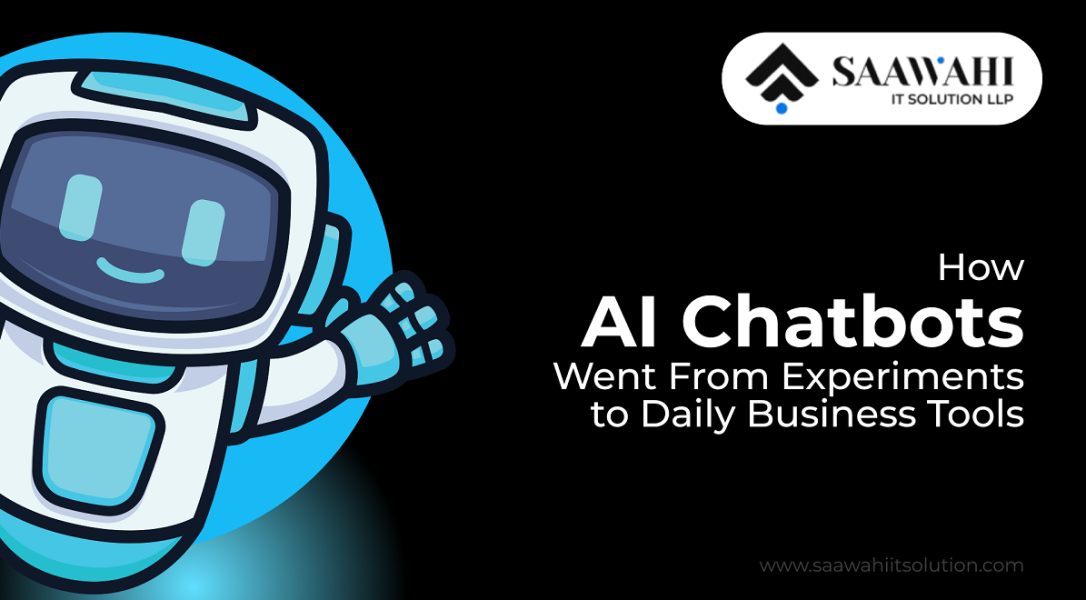
AI chatbots have quietly evolved from simple text-based programs into intelligent digital assistants capable of handling complex conversations, automating customer service, and driving business growth. Today, businesses across industries rely on AI chatbot development to improve customer experience, reduce operational costs, and enable 24/7 engagement. However, this rapid adoption did not happen overnight.
This article explores everything about AI chatbots—from their historical origins and technological evolution to their current role in customer service and enterprise automation. Whether you are a business owner, marketer, or decision-maker evaluating AI chatbot development services, this in-depth guide will help you understand where chatbots came from, how they work today, and why they matter.
An AI chatbot is a software application designed to simulate human-like conversations using artificial intelligence technologies such as Natural Language Processing (NLP), Machine Learning (ML), and, more recently, Large Language Models (LLMs). Unlike traditional rule-based chatbots that respond only to predefined commands, AI chatbots can understand intent, learn from interactions, and improve responses over time.
Modern AI chatbots are used for:
The concept of chatbots dates back to 1966, when Joseph Weizenbaum, a computer scientist at MIT, developed ELIZA. ELIZA was the first chatbot capable of mimicking human conversation using simple pattern matching. Although it lacked true intelligence, ELIZA demonstrated that machines could simulate dialogue, marking the beginning of conversational computing.
Following ELIZA, researchers developed experimental chatbots such as PARRY in 1972, which attempted to simulate a patient with schizophrenia. During this period, chatbots remained largely within academic and research environments. They had no commercial application and relied heavily on scripted responses.
Chatbots began appearing on business websites in the early 2000s. These early implementations were rule-based systems used mainly for answering FAQs and providing basic customer assistance. While limited in intelligence, they represented the first real market adoption of chatbot technology.
By the late 2000s, it became clear that rule-based chatbots were no longer sufficient for growing digital businesses. Users expected faster, smarter, and more human-like interactions—expectations that traditional scripted bots simply could not meet. This gap between user demand and technological capability set the stage for the rise of AI-powered chatbots.
What truly changed during this phase was not just better technology, but a fundamental shift in how businesses viewed conversational interfaces. Chatbots were no longer seen as optional add-ons or experimental tools; they started becoming a core part of digital customer experience strategies.
The launch of Apple’s Siri in 2011 marked a turning point in chatbot evolution. For the first time, millions of users interacted daily with an AI-powered conversational system. Siri, followed by Google Now and Microsoft Cortana, introduced advanced Natural Language Processing (NLP) and voice-based interaction, allowing machines to understand user intent rather than just keywords.
This era demonstrated an important insight: users were willing to talk to machines—provided those machines could understand context and respond naturally. As a result, businesses began exploring AI chatbot development beyond simple FAQ automation.
The next wave came when messaging platforms such as Facebook Messenger, Slack, and WhatsApp opened their ecosystems to chatbots. This dramatically lowered adoption barriers for businesses.
During this phase, organizations started using AI chatbots for:
More importantly, businesses realized that chatbots could handle repetitive, high-volume interactions while human agents focused on complex queries. This realization fueled demand for professional AI chatbot development services, as companies needed scalable and reliable chatbot solutions tailored to their workflows.
Despite widespread adoption, early AI chatbots still struggled with context retention, nuanced conversations, and long-form responses. These limitations were largely overcome with the emergence of generative AI and large language models (LLMs).
Modern AI-powered chatbots can now:
Understand multi-turn conversations
Generate human-like, contextual responses
Adapt tone and language dynamically
Integrate deeply with business systems
This breakthrough transformed chatbots from simple conversational tools into intelligent digital agents. As a result, AI chatbot development has shifted from basic automation toward building autonomous, decision-support systems that actively drive customer engagement and business growth.
At this point in their evolution, chatbots are no longer just responding to users—they are shaping how businesses communicate, support, and scale.
| Market Entry Year | Chatbot Type | Delivery Method | Commercial Purpose |
| 1992 | Dr. Sbaitso | Sound Card Bundle | Showcasing hardware/voice synthesis |
| 2001 | SmarterChild | Instant Messenger | Information utility & Brand ads |
| 2011 | Siri | Built-in OS | Personal Assistant / Ecosystem Lock-in |
| 2016 | Messenger Bots | API / Social Media | Customer Support & E-commerce |
| 2022 | ChatGPT | Web/Mobile App | Productivity, Coding, & Content |
At this stage, many readers understand what AI chatbots are—but the real question becomes how they are actually built. This is where interest often drops if the explanation feels too technical or generic. Instead of viewing AI chatbot development as a black box, it helps to see it as a structured journey that transforms a business problem into an intelligent conversational experience.
Every successful AI chatbot begins with clarity. Before a single model is trained, development teams work to understand:
For example, an AI chatbot for customer service may focus on reducing ticket volume, while a sales chatbot prioritizes lead qualification. This step ensures the chatbot is designed with purpose, not just automation.
Unlike traditional software, chatbots communicate through conversation. This makes conversation design a critical phase. Developers and UX specialists map out realistic dialogue flows, fallback scenarios, and escalation paths.
At this point, businesses often realize that chatbot quality is less about “AI hype” and more about thoughtful interaction design. Poorly designed conversations lead to frustration, regardless of how advanced the AI model is.
AI chatbots learn from data. Historical chat logs, customer queries, FAQs, and domain-specific content are collected to train the model. The quality of this data directly impacts chatbot accuracy.
This is also where many early chatbot implementations failed—insufficient or biased data led to irrelevant or confusing responses. Modern AI chatbot development emphasizes continuous data refinement rather than one-time training.
Using Natural Language Processing (NLP), the chatbot learns to:
This capability allows the chatbot to move beyond single-question responses and handle real conversations. For users, this is the moment when the chatbot starts to feel genuinely helpful rather than robotic.
Depending on the use case, developers choose between:
The goal is not maximum complexity, but optimal intelligence. An experienced AI chatbot development company selects models based on reliability, scalability, and cost-efficiency.
A chatbot becomes truly valuable when it connects with existing business systems. Integration with CRM tools, ticketing platforms, databases, and third-party APIs allows the chatbot to fetch real-time information and trigger actions.
At this stage, chatbots evolve from conversational tools into operational assets that actively support business workflows.
Before launch, chatbots undergo extensive testing to identify gaps in understanding and edge cases. After deployment, real user interactions provide feedback that helps improve accuracy and performance over time.
This continuous optimization is what separates successful AI chatbots from static, short-lived implementations.
By understanding how AI chatbot development works in practice, businesses gain a clearer picture of why professional AI chatbot development services are essential for building solutions that scale, adapt, and deliver long-term value.
Once readers understand how AI chatbots are built, their mindset shifts from curiosity to evaluation. This is the point where they start asking practical questions: What kind of chatbot do I need? How complex should it be? And who can build it properly?
AI chatbot development services exist to bridge this gap between technology and business outcomes. Instead of offering generic chatbot tools, professional AI chatbot development focuses on creating solutions aligned with real operational needs.
Some businesses require lightweight chatbots to answer repetitive queries, while others need deeply integrated AI systems capable of handling complex customer journeys. Understanding these differences is essential before investing.
Custom AI chatbot development is about building intelligence around your business logic, not forcing your workflows to fit a prebuilt bot. These chatbots are trained on domain-specific data and designed to evolve as the business grows.
Organizations typically choose custom AI chatbots when they need:
This approach ensures the chatbot becomes a long-term asset rather than a short-term experiment.
Customer service is where AI chatbots deliver the fastest and most visible impact. Instead of replacing human agents, AI chatbots act as the first line of interaction, resolving common issues instantly and escalating only when necessary.
Well-designed customer service chatbots can:
This balance between automation and human support is what defines successful AI chatbot deployment.
Modern customers don’t interact through a single platform. They move between websites, mobile apps, messaging platforms, and social media. AI chatbot development services ensure conversations continue seamlessly across channels.
An omnichannel chatbot allows a user to start a conversation on a website and continue it on WhatsApp or a mobile app without repeating information. This continuity significantly improves user experience and engagement.
Continuous Optimization and Performance Monitoring
One of the biggest misconceptions about AI chatbots is that they are “set and forget” solutions. In reality, chatbot success depends on continuous learning, monitoring, and optimization.
Ongoing services include:
This ongoing evolution keeps the chatbot relevant, accurate, and aligned with changing customer behavior.
To truly understand the impact of AI chatbots, imagine a fast-growing SaaS company handling hundreds of support tickets daily. Most queries are repetitive—password resets, billing questions, feature explanations.
An AI chatbot instantly resolves these queries by understanding intent, fetching data from internal systems, and responding in natural language. Customers receive immediate answers, while support agents focus on complex issues that require human judgment.
This real-world application highlights why AI chatbots are no longer optional tools—they are foundational to scalable customer service.
Across industries such as e-commerce, healthcare, banking, and education, AI chatbots are redefining customer expectations by delivering speed, consistency, and availability.
While automation is often the initial motivation, the true value of AI chatbot development goes much deeper.
Key long-term benefits include:
Additionally, chatbots generate valuable insights by analyzing customer conversations, helping businesses refine products, messaging, and support strategies.
Despite growing adoption, many chatbot projects fail to deliver expected results. The reasons are rarely technical alone.
Common challenges include:
Successful AI chatbot development requires a balance between intelligence, usability, and operational control—something that inexperienced implementations often miss.
Choosing an AI chatbot development company is not just a technical decision—it’s a strategic one. The right partner understands both AI capabilities and business realities.
Key evaluation criteria include:
A reliable development company acts as a long-term partner, helping businesses evolve their chatbot strategy as technology and customer expectations change.
Behind every intelligent chatbot is a carefully selected technology stack. While users see only the conversation, the backend combines multiple layers of AI and infrastructure.
Typical components include:
The right technology stack ensures reliability, performance, and future readiness.
AI chatbots are moving beyond text-based interactions toward more immersive and autonomous experiences. The next generation of chatbots will not just respond—they will anticipate, recommend, and act.
As these technologies mature, AI chatbots will become central to how businesses operate and compete.
The journey of AI chatbots—from simple scripted programs to intelligent conversational agents—reflects the broader evolution of artificial intelligence itself. Today, AI chatbot development is not about experimentation; it’s about building scalable, intelligent systems that enhance customer experience and operational efficiency.
Businesses that invest thoughtfully, with the right strategy and development partner, position themselves for long-term success in an increasingly AI-driven world.

Wama Sompura is the CEO of Saawahi IT Solution, leading innovations in AI, automation, and digital solutions that help businesses drive efficiency and growth.
© Copyright 2025 All Rights Reserved. Saawahi IT Solution LLP.