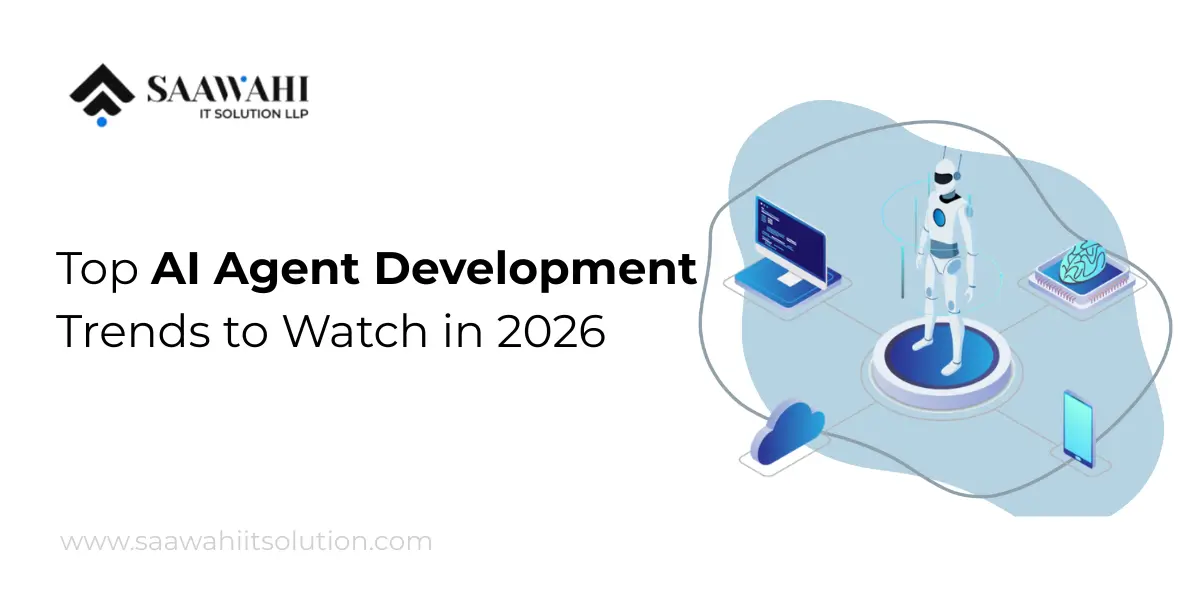
Top AI Agent Development Trends to Watch in 2026
Date - 30/01/2026
AI | 24th February
The year 2026 marks a definitive border in the history of computing. We have moved past the “Chatbot Era”—where AI was a sophisticated interface for information retrieval—into the Agentic Era. In this new landscape, AI is no longer a tool we use; it is a teammate we direct.
The fundamental shift isn’t just about speed or intelligence; it’s about agency. Traditional software follows a script; AI agents follow a goal. This transition is fundamentally rewiring how modern systems—from global supply chains to local energy grids—make choices, manage risks, and evolve.
In 2026, the technological landscape has shifted from generative outputs to autonomous outcomes. This article explores the systemic transition from “Passive AI”—tools that wait for human prompts—to “Agentic AI,” systems capable of independent reasoning, tool usage, and goal execution.
As modern organizations face increasing data density and shrinking reaction windows, the traditional human-centric decision model is hitting a physical limit. AI agents are bridging this gap by utilizing Autonomous OODA Loops (Observe, Orient, Decide, Act) to manage complex infrastructure, supply chains, and financial systems in real-time.
However, this shift introduces a new set of challenges: the Accountability Gap and the risk of Skill Atrophy. This deep dive examines the mechanics of these new systems, the rise of Multi-Agent Ecosystems (MAS), and why the most critical skill for a 2026 leader is no longer “doing” the work, but orchestrating the agents that do.
For decades, software was passive. If you didn’t click a button or write a line of code, the software did nothing. Even the early Generative AI models of the mid-2020s were largely “input-output” machines. You asked a question; it gave an answer.
Today, the Autonomous Margin has shifted. We are seeing the rise of systems that don’t wait for instructions to handle the “how,” only the “what.”
How does an agent actually “decide”? Unlike the rigid “if-then” logic of 20th-century programming, modern agents operate on a cycle of continuous perception and refinement.
To understand agentic decision-making, we must look at the OODA Loop (Observe, Orient, Decide, Act), a framework originally designed for military strategy but now perfected by AI.
One of the most significant breakthroughs in 2026 is the Critique Layer. Before an agent executes a high-stakes decision, it runs a “self-reflection” prompt. It essentially plays devil’s advocate against its own plan, identifying potential hallucinations or logical fallacies. This internal check-and-balance system is what allows us to trust agents with real-world financial and physical infrastructure.
The most immediate impact of AI agents is the destruction of “decision latency.” In traditional corporate structures, a decision often requires a meeting, a memo, a review, and an approval. This creates a bottleneck where the world moves faster than the organization can react.
AI agents don’t get tired, and they don’t have to tackle problems sequentially. A single orchestration agent can deploy a thousand “sub-agents” to analyze different segments of a problem simultaneously.
| Feature | Human-Centric Systems | Agentic Systems |
| Decision Speed | Days/Weeks | Milliseconds/Minutes |
| Scalability | Linear (hire more people) | Exponential (spin up more instances) |
| Data Handling | Curated summaries | Raw, high-frequency telemetry |
| Consistency | High variance (mood/fatigue) | High (governed by guardrails) |
Consider the modern smart city energy grid. In the past, human operators adjusted loads based on historical trends. Today, agentic swarms manage the grid in real-time. If a cloud passes over a solar farm, reducing output, agents instantly negotiate with battery storage systems and industrial consumers to balance the load. The “decision” happens before a human could even read the alert.
As agents take over the “doing,” the role of the human is shifting toward “directing.” We are seeing a move toward Flat Decision Trees.
As we grant AI systems the power to execute, we inevitably encounter the Accountability Gap. In 2026, the question is no longer “Can the AI do it?” but “Who is responsible when it does it wrong?”
Modern systems are moving away from “Black Box” models toward Explainable Agency. When an agent makes a high-stakes decision—such as denying a credit line or rerouting a cargo ship—it must generate a “Decision Trace.” This is a human-readable log of the data points considered, the weights assigned to them, and the logic used to reach the conclusion.
To manage these risks, organizations are implementing Dynamic Sandboxing. Instead of giving an agent full reign, they provide “budgetary and operational envelopes.”
| Risk Category | Manual Management (Old) | Agentic Governance (2026) |
| Financial Leakage | Periodic audits | Real-time threshold alerts & auto-kill switches |
| Hallucination | Human fact-checking | Cross-model verification (Agent A checks Agent B) |
| Security | Firewalls and passwords | Behavioral biometrics and “Proof of Intent” protocols |
The Trust Paradox: We find that humans trust agents more when the agent is programmed to say “I am 70% confident” rather than “I am 100% sure.” Uncertainty is a feature of intelligence, not a bug.
The most sophisticated systems today don’t rely on one “god-model” to do everything. Instead, they utilize Multi-Agent Systems (MAS)—swarms of specialized experts that collaborate to solve complex problems.
We are seeing the rise of internal “agent marketplaces.” For example, a Procurement Agent might negotiate in real-time with a Legal Agent to finalize a contract. These agents speak to each other in high-speed, structured data formats, resolving conflicts in seconds that used to take weeks of back-and-forth emails.
As decision-making becomes an algorithmic process, the human element is undergoing a profound transformation. We are facing a dual reality: Skill Atrophy and Cognitive Augmentation.
There is a legitimate concern that by offloading micro-decisions to agents, humans may lose the “foundational intuition” required to catch systemic errors. If a pilot never flies manually, can they handle an emergency? In the corporate world, if a junior analyst never builds a spreadsheet because an agent does it, can they ever become a senior strategist?
Conversely, the “Value of Human Intent” has never been higher. AI agents are excellent at optimizing for a goal, but they are incapable of defining why a goal matters. In 2026, the most valuable employees are those who can provide “Contextual Oversight”—the ability to see the “Big Picture” that the agent, buried in data, might miss.
The reshaping of decision-making by AI agents is not a distant trend; it is the current operating reality. We have moved from a world where we “use” software to a world where we “direct” intelligence.
The takeaway for modern leaders is clear:
The systems of 2026 are faster, more resilient, and more complex than anything we have seen before. By embracing the agency of AI, we aren’t just automating tasks—we are unlocking a level of systemic intelligence that allows us to solve problems that were previously too fast, too large, or too complex for the human mind alone to navigate.
Is your organization ready to transition from tools to autonomous workflows? Don’t let decision latency hold your growth back. Contact us today to identify where AI agents can accelerate your 2026 roadmap.

Wama Sompura is the CEO of Saawahi IT Solution, leading innovations in AI, automation, and digital solutions that help businesses drive efficiency and growth.
© Copyright 2025 All Rights Reserved. Saawahi IT Solution LLP.