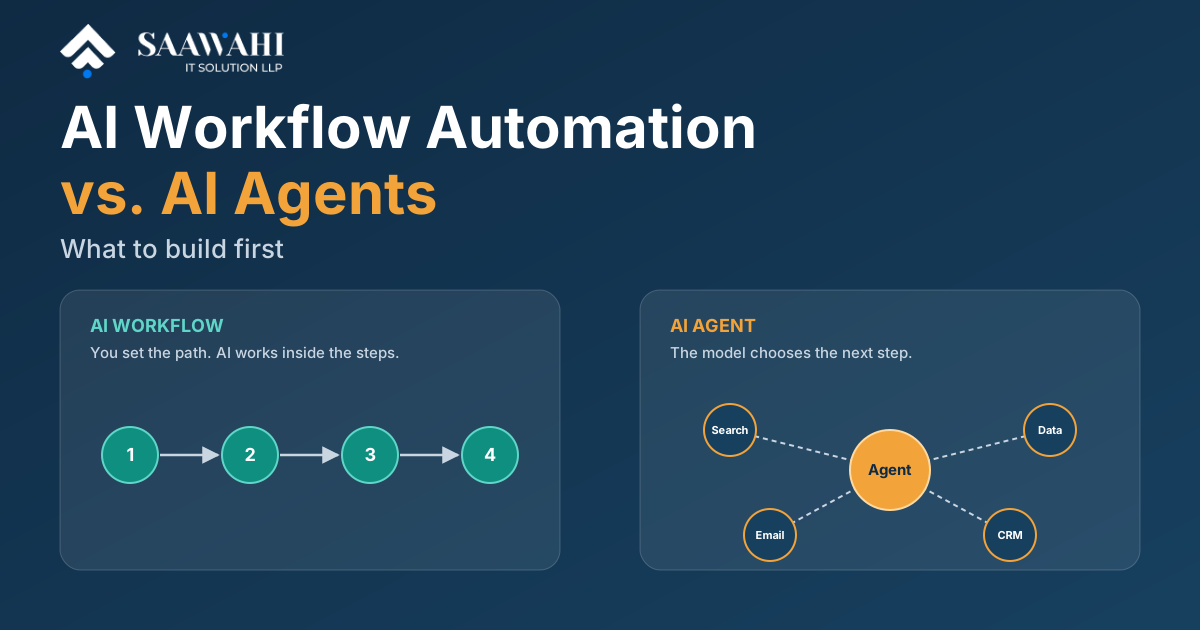
AI Workflow Automation vs. AI Agents: What to Build First
Date - 13/10/2026
AI | 9th June
Most discussions about marketing challenges focus on advertising performance, social media engagement, or search rankings. In practice, those are often symptoms rather than root causes.
The bigger challenge inside modern marketing departments is operational complexity.
Marketing teams are expected to launch campaigns faster, coordinate with more stakeholders, analyze larger volumes of data, personalize customer experiences, and demonstrate measurable business impact. At the same time, budgets remain under scrutiny, teams are often leaner than planned, and technology stacks continue to expand.
The result is a growing gap between strategic objectives and operational capacity.
Many marketing leaders don’t struggle because they lack ideas. They struggle because execution, coordination, reporting, and decision-making become increasingly difficult as the business grows.
This is where artificial intelligence and automation are creating meaningful change—not by replacing marketers, but by reducing operational friction that limits productivity and performance.
A decade ago, marketing teams primarily managed campaigns, events, content, and brand communications.
Today, marketing departments often sit at the center of the customer lifecycle. They interact with:
Every interaction generates information, approvals, requests, and reporting requirements.
As organizations grow, operational complexity grows faster than headcount.
Marketing leaders increasingly find themselves managing workflows, systems, and processes rather than focusing exclusively on strategy and market positioning.
One of the most persistent challenges facing marketing leaders is demonstrating business impact.
Executives want clear answers to questions such as:
Unfortunately, many organizations still rely on fragmented reporting systems.
Campaign performance data may exist in one platform, sales data in another, and customer information in several additional systems.
Without reliable attribution:
AI-powered analytics platforms can consolidate information from multiple sources and identify relationships that would otherwise require extensive manual analysis.
Modern systems can:
Instead of spending hours preparing executive reports, teams can focus on interpreting insights and making decisions.
Marketing and sales share a common objective: generating revenue.
Yet many organizations continue to struggle with alignment between the two functions.
Marketing often measures:
Sales teams focus on:
When definitions differ, friction emerges.
Even strong campaigns can underperform when lead management processes break down.
Potential customers may experience:
Automation helps create structured processes between teams. Many organizations also implement AI chatbot development services to handle initial customer inquiries, collect qualification data, and ensure prospects are routed to the appropriate sales representatives without unnecessary delays.
Examples include:
Rather than relying on manual coordination, teams work from shared processes and standardized data.
Speed has become a competitive advantage.
The ability to launch a campaign, respond to market changes, or support a product release quickly can directly influence business outcomes.
However, execution delays remain common.
| Process Stage | Common Bottleneck |
|---|---|
| Content Creation | Multiple Revision Cycles |
| Legal Review | Approval Queues |
| Design Requests | Resource Limitations |
| Campaign Setup | Manual Configuration |
| Stakeholder Sign-off | Email-based Approvals |
Individually, these delays may seem manageable.
Collectively, they can extend project timelines by weeks.
Slow execution affects:
Modern AI workflow automation services enable organizations to streamline approval processes, reduce manual coordination, and improve visibility across marketing operations. These solutions can:
The objective is not faster work at all costs. It is removing unnecessary waiting time from critical processes.
Most organizations have no shortage of customer data.
The challenge is fragmentation.
Information often exists across:
Each platform contains part of the customer story.
Very few provide the complete picture.
When information is disconnected:
Modern AI systems can aggregate and analyze information across multiple sources.
This enables teams to:
The value comes not from collecting more data, but from making existing data more usable.
Many marketing teams have invested heavily in analytics tools.
Yet a surprising number still struggle to answer straightforward questions such as:
Having data is not the same as having insight.
Large datasets often require:
This creates delays between observation and action.
AI can identify:
Rather than searching through dashboards, marketers receive prioritized insights that require attention.
This shortens the time between discovery and action.
One of the least discussed productivity issues in marketing is administrative overhead.
Marketing managers frequently spend substantial time on:
These activities are necessary, but they rarely create direct customer value.
When administrative work consumes too much time:
Many repetitive activities can be partially automated:
Even small efficiency gains accumulate significantly over a year.
Marketing rarely operates independently.
Successful execution often requires coordination with:
As organizations scale, communication becomes increasingly complex.
AI-powered knowledge systems can help teams locate information quickly without relying on lengthy email chains or internal meetings. Many businesses work with an AI Agent Development Company to build internal assistants capable of retrieving documentation, answering operational questions, and supporting collaboration across departments.
Examples include:
The objective is reducing friction between teams rather than adding additional tools.
Brand consistency becomes more difficult as organizations expand.
Multiple teams may create:
Without governance, inconsistencies emerge.
Inconsistent messaging creates confusion.
Customers may receive different descriptions of:
Trust can erode when messaging varies across channels and departments.
AI systems can assist with:
These capabilities help maintain standards while reducing manual review effort. Organizations are also adopting Generative AI Development Services to assist with content reviews, messaging validation, brand governance, and large-scale content operations while maintaining consistency across customer-facing communications.
Customers increasingly expect relevant experiences.
However, personalization at scale creates operational challenges.
Marketing teams must understand:
Managing these variables manually becomes impossible as audiences grow.
Historically, personalization required:
This limited scalability.
AI systems can dynamically:
The result is more relevant communication without proportionally increasing workload.
Most marketing departments rely on dozens of software platforms.
These may include:
Each tool solves a specific problem.
Collectively, they can create new operational challenges.
Automation increasingly serves as the connective layer between systems.
Instead of replacing existing platforms, organizations are creating integrated workflows that allow tools to communicate automatically.
This reduces manual intervention while preserving existing investments
Organizations that consistently outperform competitors often share several operational characteristics.
They focus on:
Most importantly, they treat operational efficiency as a strategic advantage.
Rather than viewing marketing solely as a creative function, they recognize that execution quality often determines whether great ideas succeed or fail.
The biggest challenges facing marketing teams today are not necessarily creative, strategic, or promotional.
They are operational.
Fragmented data, inefficient workflows, slow approvals, administrative overload, and disconnected systems quietly reduce productivity across organizations every day.
Artificial intelligence and automation are proving valuable because they address these underlying constraints. They help teams move information faster, reduce manual work, improve visibility, and support better decisions.
For marketing leaders, the opportunity is not simply adopting new technology. It is identifying the operational bottlenecks that consume time, create friction, and limit growth—and then applying AI and automation where they deliver measurable business value.
The marketing teams that thrive over the next decade will likely be those that combine human judgment, creativity, and strategy with operational systems designed to scale efficiently.

Wama Sompura is the CEO of Saawahi IT Solution, leading innovations in AI, automation, and digital solutions that help businesses drive efficiency and growth.
© Copyright 2025 All Rights Reserved. Saawahi IT Solution LLP.