AI Workflow Automation vs. AI Agents: What to Build First
Date - 13/10/2026
AI | 26th May
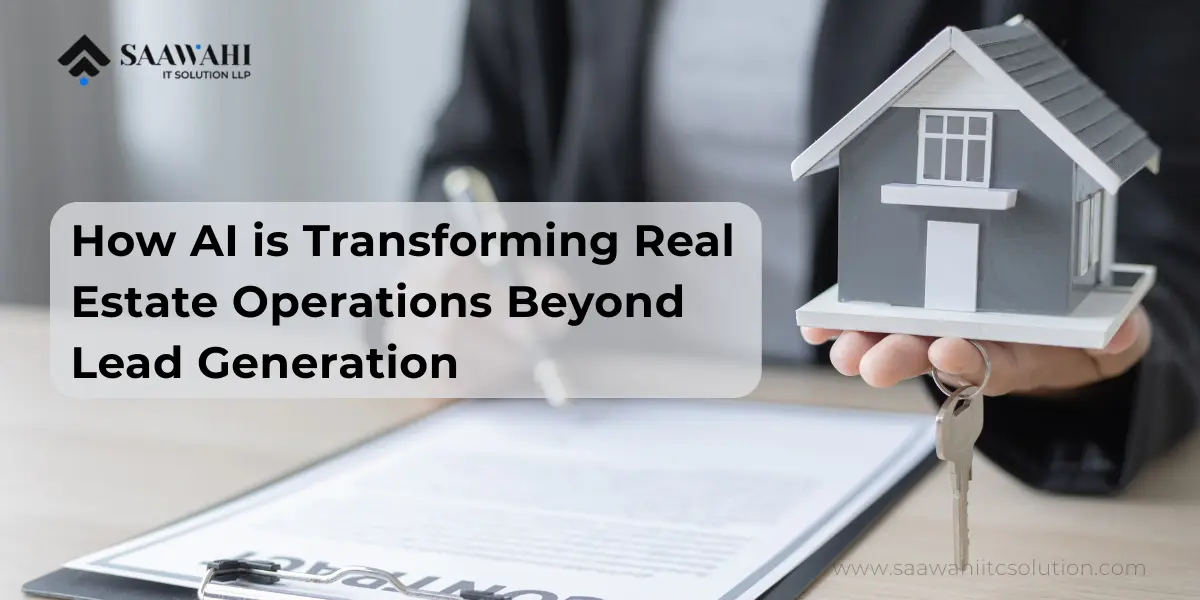
The real estate industry has always been driven by relationships, local networks, property knowledge, and on-ground coordination. For years, most businesses managed operations through phone calls, spreadsheets, WhatsApp chats, paperwork, and manual follow-ups. That system still exists today, but the pressure on real estate businesses has changed significantly. At Saawahi IT Solution, we see this shift every day when real estate teams come to us struggling with rising inquiries, fragmented tools, and growing operational complexity.
Customer expectations are higher, and response time matters more than ever. Managing inquiries across multiple platforms has become difficult, and operational workloads continue to grow as businesses scale. Many agencies and property management firms are now facing a common problem — their operations are becoming harder to manage efficiently through manual processes alone.
While most conversations about AI focus on lead generation and marketing automation, the bigger transformation is happening inside real estate operations themselves.
AI is now helping businesses improve customer communication, automate repetitive tasks, organize operational workflows, streamline tenant management, improve property discovery, and generate smarter business insights. Instead of depending entirely on manual coordination, real estate businesses are slowly moving toward more intelligent and connected operational systems.
Generating leads has always been one of the most expensive and competitive areas in real estate. Businesses spend heavily on advertising campaigns, property portals, social media promotions, and search marketing. Even after investing significant budgets, many agencies still struggle with poor-quality inquiries and inconsistent conversions.
Traditional marketing usually relies on broad targeting and manual campaign optimization. AI-driven marketing changes this approach completely.
Modern AI marketing systems analyze customer behavior, browsing activity, location preferences, engagement patterns, and property interests to identify people who are more likely to convert. Instead of showing the same advertisements to everyone, AI helps businesses personalize campaigns based on customer intent.
For instance, someone actively searching for investment properties may receive content focused on rental returns and appreciation potential, while a family searching for residential apartments may see messaging focused on schools, amenities, and safety.
This creates better targeting and reduces unnecessary advertising spend. More importantly, businesses gain deeper visibility into which campaigns are attracting serious buyers rather than casual inquiries.
One of the biggest operational problems in real estate is delayed communication. Buyers usually contact multiple agencies at the same time. If responses take too long, the inquiries often move to a competitor.
In many businesses, staff members manually manage website inquiries, WhatsApp messages, calls, and social media responses. During busy hours or after office hours, communication delays become unavoidable.
AI chatbots and AI agents for voice assistant help solve this issue by handling initial communication instantly.
When someone submits an inquiry, AI systems can immediately respond with:
Some AI voice agents can even answer incoming calls naturally, collect customer requirements, and transfer important inquiries to the right sales representatives.
Imagine a buyer searching for a 3 BHK apartment late at night. Instead of waiting until the next morning, the AI agent can instantly answer questions, share project details, and schedule a site visit. That level of responsiveness improves customer experience while reducing lead leakage.
Many real estate businesses already use CRM software, but most teams struggle to maintain it properly. Lead records remain incomplete, follow-ups get missed, and customer conversations stay scattered across different platforms.
As businesses grow, this creates operational confusion.
AI Powered development CRM improves how customer data is managed internally. Instead of relying on employees to manually update every interaction, AI systems can automatically:
For example, after a sales call, AI can generate a summary of the discussion, update the customer profile, and schedule the next reminder automatically.
This reduces manual data entry and helps businesses maintain more organized customer records without depending entirely on human coordination.
Property management teams regularly deal with maintenance requests, payment reminders, complaint handling, vendor coordination, and repetitive tenant communication. As the number of properties increases, managing these operations manually becomes difficult.
This is where property management automation creates real operational value.
AI-powered systems can handle tenant requests automatically by categorizing complaints, assigning maintenance vendors, tracking task completion, and updating tenants throughout the process.
For example, if a tenant reports a plumbing issue through WhatsApp, the system can:
This reduces coordination pressure on property management teams while improving tenant experience.
Automated payment reminders and maintenance notifications also help reduce repetitive communication work.
Traditional property search systems mainly depend on filters such as:
However, buyers today expect more personalized recommendations.
AI-powered search and recommendation systems help businesses understand customer intent more effectively. Instead of only matching basic filters, AI analyzes browsing behavior, interaction history, and customer preferences to suggest more relevant properties.
A buyer searching for:
“a family-friendly apartment near schools with future appreciation potential.”
expects smarter recommendations than simple keyword filtering.
AI systems can recommend properties based on:
This creates a more personalized property discovery experience and keeps users engaged for longer periods.
Many property listings sound almost identical. Repetitive descriptions often fail to communicate what makes a property unique. Generic content also affects online visibility and search performance.
AI-generated content systems help businesses create more personalized and scalable property content.
Instead of manually writing every listing, businesses can generate:
The same property can also be positioned differently depending on the audience.
For example:
This improves customer engagement while helping marketing teams create content faster.
As inquiry volumes increase, follow-up management becomes harder to control manually. Sales representatives often juggle multiple conversations, site visits, and internal coordination tasks at the same time.
This leads to:
AI Workflow automation helps businesses maintain structured communication without depending entirely on manual tracking.
AI systems can automatically:
For example, after a property visit, the system can automatically send:
This creates more consistent customer communication and improves internal coordination.
Many real estate businesses struggle to understand which activities actually drive conversions. Without proper operational insights, decision-making becomes reactive instead of strategic.
AI sales intelligence systems help businesses analyze:
This helps identify:
Instead of relying on assumptions, management teams gain access to clearer operational insights that support better decision-making.
Traditional reporting systems mainly focus on past performance. However, growing businesses need forward-looking operational insights.
AI-powered predictive analytics helps businesses forecast:
For example, AI can identify rising maintenance expenses in specific properties or detect declining occupancy trends before they become larger operational problems.
This allows businesses to take proactive action instead of reacting after issues escalate.
The role of AI in real estate is no longer limited to marketing campaigns or automated chat support. Businesses are now using AI to simplify operations, improve internal coordination, reduce repetitive workloads, and create more connected workflows across departments.
The biggest advantage of AI is not replacing people. The real advantage is reducing operational friction so teams can focus more on customer relationships, decision-making, and business growth.
Real estate businesses that continue relying entirely on manual systems may eventually face challenges managing operational complexity efficiently. On the other hand, businesses adopting intelligent automation early are building faster, more scalable, and better-organized operational ecosystems.
If your real estate business is looking to reduce manual workload, improve operational efficiency, and create more streamlined workflows, this is the right time to explore how AI-powered solutions can support long-term business growth and operational transformation. Connect with Saawahi IT Solution, who specialize in building AI agents, virtual assistants, and automated workflows tailored for real estate teams that want to modernize their operations without disrupting day-to-day business.

Wama Sompura is the CEO of Saawahi IT Solution, leading innovations in AI, automation, and digital solutions that help businesses drive efficiency and growth.
© Copyright 2025 All Rights Reserved. Saawahi IT Solution LLP.