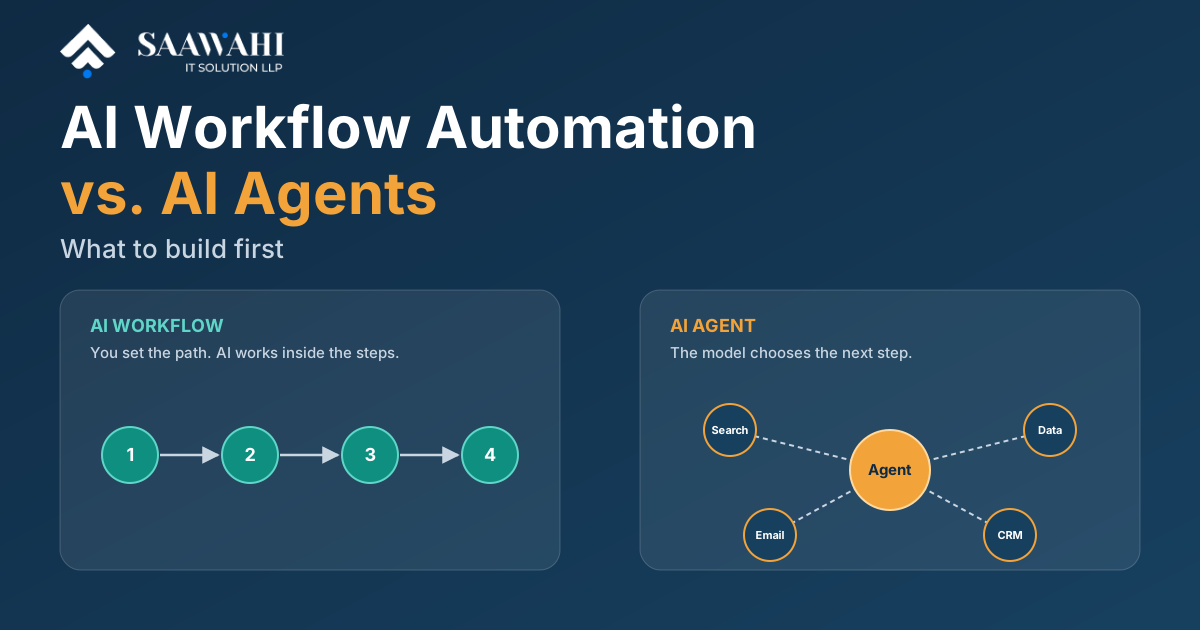
AI Workflow Automation vs. AI Agents: What to Build First
Date - 13/10/2026
AI | 14th May
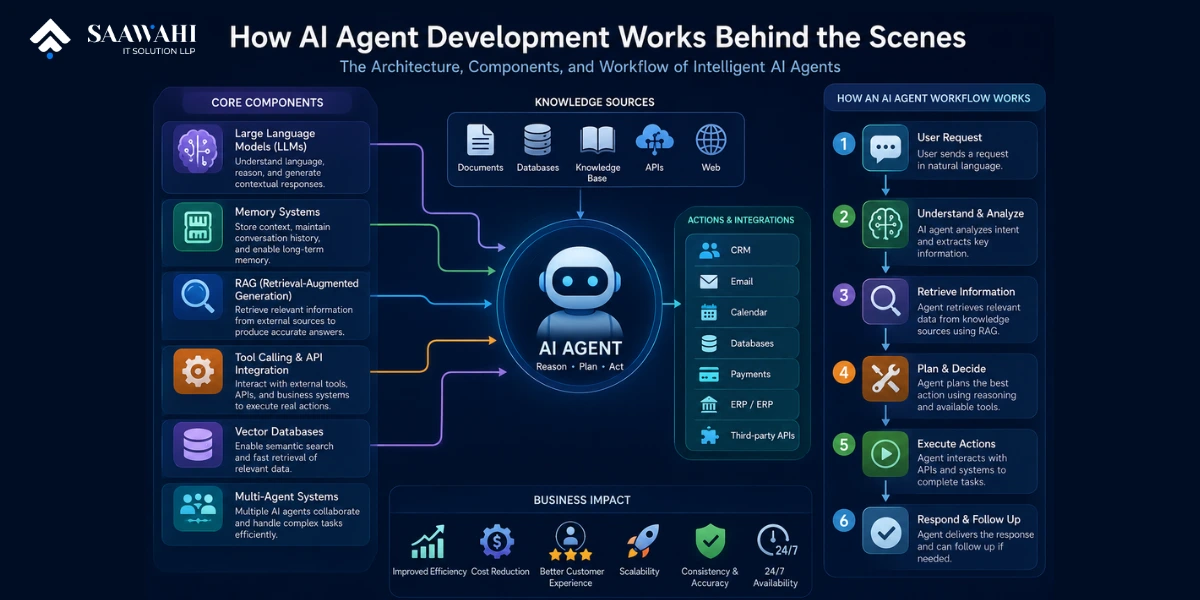
Artificial intelligence has moved far beyond simple chatbots and scripted automation. Modern businesses are now investing in AI agents capable of reasoning, executing tasks, interacting with software systems, and handling complex workflows with minimal human supervision. While many companies are eager to adopt AI-powered development, very few truly understand what happens behind the scenes of AI agent development.
An AI agent is not just a conversational interface connected to a language model. Behind every intelligent AI system is a carefully designed architecture involving memory management, workflow orchestration, API integrations, contextual reasoning, retrieval systems, and decision-making frameworks. These components work together to create systems capable of performing real operational tasks rather than simply generating responses.
As businesses increasingly rely on intelligent automation to improve efficiency and scalability, understanding how AI agent development works has become more important than ever.
For years, businesses relied on rule-based automation systems to reduce repetitive work. These systems followed predefined instructions and operated effectively only when workflows remained predictable. However, traditional automation often struggled when dealing with changing scenarios, unstructured information, or context-based decisions.
This limitation created a major gap between automation and actual operational intelligence.
AI agents emerged as the next evolution of automation because they combine language understanding, reasoning, contextual memory, and software interaction into a single intelligent system. Unlike standard chatbots that only answer questions, AI agents can perform actions, retrieve information, coordinate workflows, and adapt to changing tasks.
For example, a traditional customer support bot may provide scripted responses based on keywords. An AI agent, however, can understand the customer’s issue, retrieve account details, access internal documentation, generate a solution, create a support ticket, and escalate the request if necessary.
This operational capability is what makes AI agents significantly more powerful than older automation technologies.
Modern AI agent systems are built using multiple interconnected components. Each component plays a specific role in helping the agent understand information, maintain context, and execute tasks effectively.
At the center of most AI agents is a large language model. These models are responsible for understanding human language, generating responses, interpreting instructions, and supporting reasoning capabilities.
LLMs allow AI agents to:
Models such as GPT, Claude, Gemini, and open-source alternatives provide the intelligence layer that powers modern AI systems. However, an LLM alone does not create a fully functional AI agent. Without memory, integrations, and workflow systems, the model remains limited to conversation generation.
This is one of the biggest misconceptions businesses have when evaluating AI solutions.
One of the defining characteristics of advanced AI agents is their ability to maintain memory and context across interactions.
Basic chatbots often forget previous conversations or lose track of user intent after a few messages. AI agents solve this problem through structured memory systems.
These memory systems generally include:
Memory allows AI agents to:
For example, an AI sales assistant can remember previous customer preferences, ongoing discussions, product interests, and communication history to deliver more relevant interactions over time.
Without memory management, AI agents cannot operate effectively in real business environments where continuity and context are critical.
One of the most important developments in AI agent architecture is Retrieval-Augmented Generation, commonly known as RAG.
Traditional language models rely mainly on pre-trained knowledge. This creates limitations because business data changes constantly. Companies need AI systems capable of accessing updated information in real time.
RAG solves this challenge by allowing AI agents to retrieve information from external sources before generating responses.
These sources may include:
Instead of relying entirely on static training data, the AI agent retrieves relevant information dynamically and uses it to generate more accurate outputs.
This approach significantly improves:
RAG systems are becoming essential for enterprise-grade AI agents because businesses require reliable access to real-time operational information.
One of the biggest differences between AI chatbots and AI agents is the ability to perform actions using external tools and APIs.
Modern AI agents are designed to interact with business systems rather than simply generating text responses.
This process is commonly known as tool calling.
Through APIs and integrations, AI agents can:
For example, consider an AI-powered customer onboarding workflow.
The AI agent can:
This ability to execute operational tasks transforms AI agents into active business systems rather than passive assistants.
AI agents often need to retrieve large amounts of contextual information quickly. Traditional keyword-based search systems are not always effective because human language is highly contextual.
This is where vector databases become important.
Vector databases store information in numerical representations called embeddings. These embeddings allow AI systems to perform semantic search instead of relying only on exact keywords.
Semantic search helps AI agents:
For example, if a user asks:
“How do I upgrade my enterprise subscription?”
The AI agent can retrieve relevant documentation even if the exact wording does not exist in the stored content.
This improves the quality of AI-generated responses and creates more natural interactions.
One of the most advanced developments in AI agent architecture is the rise of multi-agent systems.
Instead of relying on a single AI agent to handle everything, businesses are increasingly deploying multiple specialized agents that collaborate together.
Each agent may have a dedicated responsibility.
For example:
These agents can communicate with each other to complete larger objectives more efficiently.
Multi-agent systems are especially useful for:
This architecture improves scalability while allowing organizations to create highly specialized AI-driven operations.
Understanding the technical architecture is important, but real value comes from seeing how AI agents operate in practical workflows.
Consider an AI-powered eCommerce support system.
When a customer submits a support request, the workflow may look like this:
This entire workflow can happen within seconds.
The AI agent is not simply answering questions. It is coordinating systems, retrieving information, executing tasks, and managing operational processes simultaneously.
This is why AI agent development requires much more than integrating a chatbot interface into a website.
Modern AI agent development involves a wide range of technologies and frameworks.
Some commonly used tools include:
These technologies help developers:
However, technology alone does not guarantee successful AI implementation. The effectiveness of an AI agent depends heavily on architecture design, workflow planning, data quality, and business alignment.
Despite their capabilities, AI agents also introduce technical and operational challenges.
One major challenge is hallucination, where AI systems generate incorrect or misleading information. Businesses must carefully design validation and retrieval systems to reduce these risks.
Security and privacy are also critical concerns because AI agents often interact with sensitive business data.
Additional challenges include:
Building reliable AI agents requires balancing automation with accountability.
Businesses expecting fully autonomous systems without monitoring often underestimate the complexity involved in production-level AI deployments.
Despite the technical complexity, businesses are rapidly adopting AI agents because the operational benefits are substantial.
AI agents help organizations:
More importantly, AI agents are enabling businesses to move beyond basic automation toward intelligent operational systems capable of adapting to changing business requirements.
This shift is becoming a major competitive advantage across industries.
AI agents are still evolving rapidly. The next generation of systems will likely become more autonomous, collaborative, and workflow-oriented.
Future AI agents may:
Businesses are moving toward ecosystems where multiple AI agents work together as digital operational teams.
Rather than replacing humans entirely, these systems are more likely to augment human capabilities by handling repetitive coordination, information retrieval, and process execution tasks at scale.
AI agent development is far more complex than connecting a language model to a chatbot interface. Behind every intelligent AI system is an architecture involving memory management, retrieval systems, workflow orchestration, semantic search, API integrations, and operational automation.
Modern AI agents are transforming how businesses handle customer support, workflow management, data processing, and operational decision-making. As organizations continue investing in intelligent automation, understanding the technology behind these systems becomes increasingly important.
Businesses that understand how AI agents work behind the scenes are better positioned to build scalable, reliable, and future-ready AI solutions capable of delivering real operational value.

Wama Sompura is the CEO of Saawahi IT Solution, leading innovations in AI, automation, and digital solutions that help businesses drive efficiency and growth.
© Copyright 2025 All Rights Reserved. Saawahi IT Solution LLP.