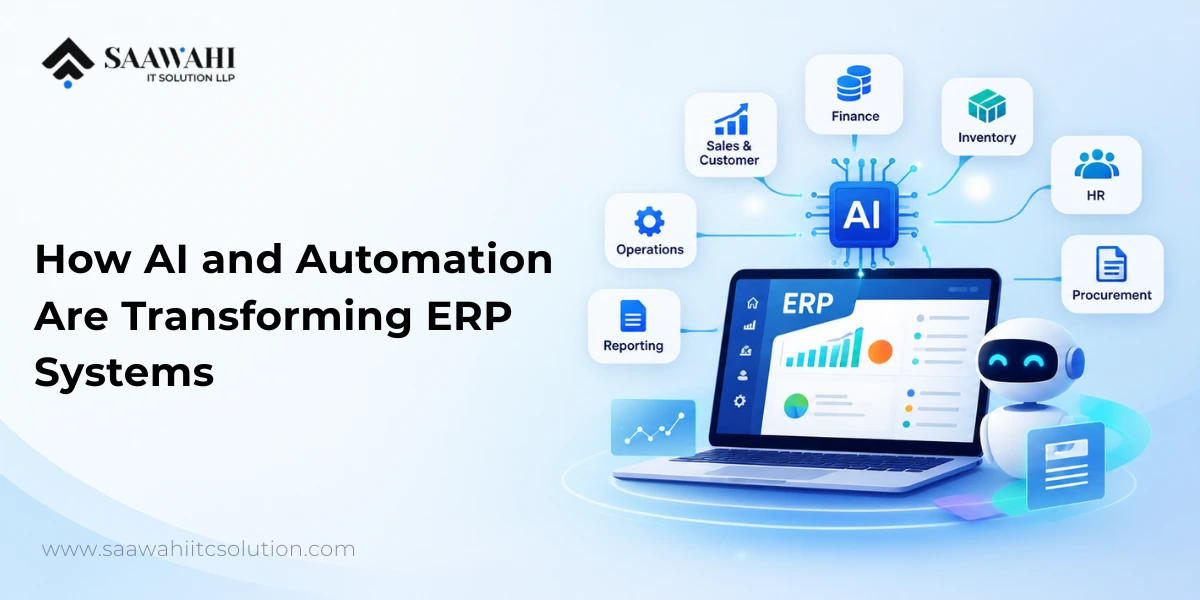
AI-Powered ERP Software: How AI and Automation Are Transforming ERP Systems
Date - 14/09/2026
AI | 22nd January
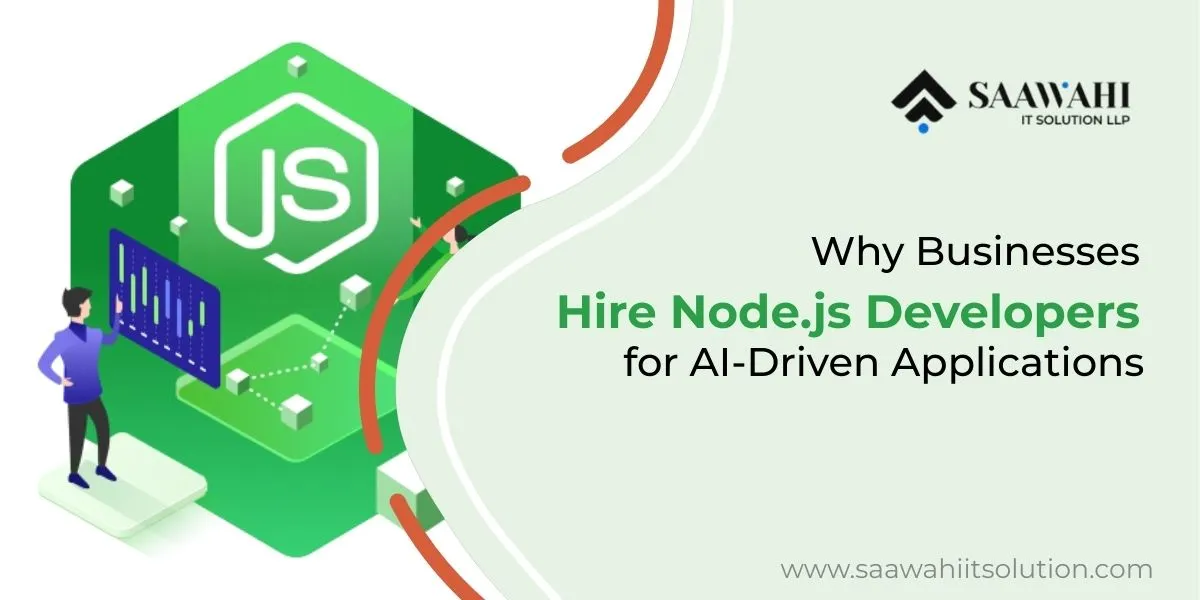
Building an AI-powered application involves much more than connecting an AI model to a user interface. Businesses need reliable APIs, authentication, databases, real-time communication, third-party integrations, workflow orchestration, security, monitoring, and scalable infrastructure around the AI capability.
This is where experienced Node.js developers can play an important role.
Node.js is particularly well suited to the application and backend layer of AI-powered products because it handles asynchronous operations, API communication, real-time interactions, and high-concurrency workloads efficiently. Developers can use it to connect AI models and services with web applications, mobile apps, databases, enterprise systems, and automated workflows.
For businesses planning an AI chatbot, AI SaaS product, AI agent, recommendation system, or generative AI application, hiring the right Node.js developers can help turn an AI capability into a production-ready product.
AI model can generate text, analyze information, classify data, create recommendations, or perform other intelligent tasks. But the model itself is rarely the complete product.
A production AI application may need to:
The backend connects these pieces.
A simplified AI application architecture might look like:
User → Web/Mobile Application → Node.js Backend → AI Model/API → Database → Business Systems
The Node.js layer can act as the coordination layer between the user-facing application, AI services, internal data, and external systems.
This is one of the main reasons businesses hire Node.js developers for AI projects.
An AI-focused Node.js developer is not necessarily training the underlying machine learning model. Instead, their role is often to build the application infrastructure that makes AI usable inside a real product.
Depending on the project, a Node.js developer may be responsible for:
Developers can integrate applications with large language models and other AI services through APIs. They can manage requests, responses, authentication, error handling, usage limits, and application-specific logic.
The developer creates the APIs that connect the frontend with AI services, databases, users, and other business systems.
Applications such as AI chatbots, copilots, voice assistants, and collaborative tools may require streaming responses or real-time communication. Node.js can support these interactive experiences through asynchronous processing and technologies such as WebSockets.
AI applications often need to store conversations, user preferences, documents, application data, logs, and other information. Node.js can connect the application layer with relational and NoSQL databases according to the project’s architecture.
An AI assistant becomes much more useful when it can interact with the systems a business already uses.
Node.js developers can build integrations with:
An AI system may need to perform several steps instead of returning a single response.
For example:
User request → AI interpretation → Retrieve data → Call business API → Process result → Generate response
The backend coordinates these operations and manages failures, permissions, and application logic.
The decision to hire Node.js developers is usually driven by more than the programming language itself. Businesses are looking for developers who can connect AI capabilities with reliable application architecture.
Connecting an AI API can be relatively straightforward. Building a reliable product around it is considerably more involved.
Businesses need developers who can handle authentication, request validation, database operations, retries, rate limits, monitoring, security, and application-specific business logic.
A Node.js developer can build this surrounding infrastructure and integrate AI capabilities into a usable product.
Many modern AI products depend on immediate interaction.
Examples include:
Node.js’s event-driven architecture makes it a strong option for applications that need to manage many concurrent I/O operations and real-time connections.
The value of enterprise AI often comes from what the system can do with business data and applications.
For example, an AI assistant might need to:
The Node.js backend can coordinate these interactions.
AI SaaS applications need to manage users, subscriptions, authentication, APIs, databases, usage limits, dashboards, notifications, and AI services.
Node.js can fit well into this type of architecture, particularly when the product already uses JavaScript or TypeScript across the frontend and backend.
AI agents require more than an LLM response.
An agent may need to understand a task, select a tool, retrieve information, execute an action, evaluate the result, and continue the workflow.
Node.js can provide the backend layer responsible for:
For businesses exploring autonomous workflows, this application layer can be just as important as the AI model itself.
AI applications can generate many simultaneous API requests, database operations, and external service calls.
Node.js’s asynchronous, event-driven model is well suited to I/O-heavy workloads where the application spends significant time communicating with external services rather than performing intensive CPU calculations.
This can make it a practical choice for AI applications with large numbers of concurrent users.
Organizations that already have JavaScript or TypeScript teams may be able to extend their existing technology ecosystem with Node.js rather than introducing an entirely different backend stack.
This can simplify development across:
The result can be a more consistent development workflow.
This is one of the most important decisions for businesses building AI products.
The answer isn’t simply “Node.js or Python.”
They often serve different parts of the same AI system.
| Requirement | Node.js | Python |
|---|---|---|
| AI/ML model training | Limited | Strong |
| Data science | Limited | Strong |
| Machine learning experimentation | Limited | Strong |
| LLM API integration | Strong | Strong |
| AI application backend | Strong | Strong |
| Real-time applications | Strong | Good |
| WebSocket-heavy applications | Strong | Good |
| API orchestration | Strong | Strong |
| AI SaaS development | Strong | Strong |
| JavaScript/TypeScript full-stack development | Strong | Limited |
Python remains widely used for machine learning, data science, experimentation, and model development.
Node.js, meanwhile, can be particularly effective for the application layer that connects AI capabilities with users, business logic, APIs, databases, and external systems.
In larger AI projects, Node.js and Python can work together rather than compete.
For example:
Python → Model development / ML processing
Node.js → APIs / application logic / real-time communication / integrations
The right architecture depends on the product requirements rather than the popularity of either language.
Node.js developers can contribute to a wide range of AI-powered products.
Build conversational applications that connect LLMs with customer data, knowledge bases, business systems, and communication channels.
Develop subscription-based AI products with authentication, billing, user management, dashboards, usage tracking, and AI functionality.
Build intelligent systems that can use tools, access data, execute actions, and complete multi-step workflows.
Connect AI with business processes to automate repetitive tasks such as data processing, document handling, notifications, reporting, and approvals.
Create backend services that collect user activity and connect recommendation logic with the application.
Integrate AI into existing CRM, ERP, HR, e-commerce, finance, education, healthcare, or internal business systems.
Build applications where users expect continuous interaction, live updates, streaming responses, or immediate system feedback.
AI agents are moving beyond simple question-and-answer interfaces toward systems that can take actions.
A simplified agent workflow may look like:
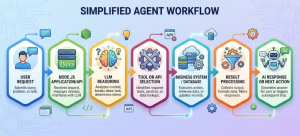
The Node.js layer can manage the communication between these components.
For example, an AI sales agent might receive a request from a salesperson, retrieve customer information from a CRM, check product availability through an API, generate a recommendation, and record the interaction.
This requires application engineering alongside AI capabilities.
For businesses planning these systems, experienced AI and backend developers can help determine where agents should act autonomously and where human approval should remain part of the workflow.
When hiring Node.js developers for AI projects, businesses should look beyond basic Node.js programming.
A developer should understand technologies such as:
Depending on the project, useful experience includes:
Production AI applications may also require knowledge of:
AI applications can process sensitive business and customer information, making security particularly important.
Developers should understand:
The exact skill combination should depend on the application’s architecture.
Hiring Node.js developers makes particular sense when your project requires a strong application and backend layer around AI.
Consider hiring Node.js developers if you are building:
You may also benefit from Node.js expertise when your project requires multiple external APIs, real-time communication, high-concurrency workloads, or complex application workflows.
A reliable AI application needs more than coding. It needs an architecture that connects business requirements with technical implementation.
The development team identifies the business problem, users, data sources, AI capabilities, integrations, and expected outcomes.
The team determines which components should handle the frontend, backend, AI services, databases, integrations, authentication, and infrastructure.
Developers build APIs, business logic, authentication, database connections, and application services.
AI models or external AI services are integrated into the application according to the required workflows.
The application is connected with business systems, APIs, databases, and automation workflows.
The system is tested for functionality, performance, security, reliability, AI response quality, and failure scenarios.
The application is deployed to the appropriate infrastructure and monitored for performance, errors, usage, and operational issues.
AI applications often require ongoing improvements as models, user requirements, business processes, and usage patterns evolve.
Choosing a developer solely because they know Node.js can create problems.
An experienced Node.js developer may not automatically have experience working with LLMs, AI APIs, agents, or AI workflows.
Production AI applications require security, error handling, monitoring, cost management, data handling, and fallback strategies.
A prototype may work with a simple implementation but fail when the number of users, integrations, or AI requests increases.
The right stack depends on the application’s requirements. Node.js, Python, or a combination of technologies may be appropriate.
Fast development is valuable, but production AI systems also need reliability, maintainability, security, and scalability.
Before hiring a Node.js developer or development company for an AI project, evaluate:
The most important question is not simply:
“Can this developer write Node.js?”
It is:
“Can this developer use Node.js to build the application layer required by our AI product?”
That distinction can have a significant impact on the project’s long-term success.
AI applications often require several disciplines to work together: backend engineering, AI integration, cloud infrastructure, automation, databases, and product development.
Saawahi combines AI and software engineering capabilities to build AI-powered applications, SaaS platforms, automation systems, and enterprise software. Its current service portfolio includes AI agents, generative AI, workflow automation, AI chatbots, SaaS development, and Node.js-based web application development.
The company’s AI agent development offering focuses on custom agents, workflow automation, decision-support systems, integrations with CRM/ERP/API environments, and end-to-end deployment and optimization.
For businesses that need both application engineering and AI integration, this combined capability can be useful when moving from an AI concept or prototype toward a production-ready system.
Yes. Node.js is particularly useful for the application and backend layer of AI systems, including API integration, real-time communication, business logic, databases, authentication, and integrations with external systems. It is not generally the first choice for training computationally intensive machine learning models.
Yes. Node.js applications can communicate with LLM providers through APIs and SDKs. Developers can build application logic around model requests, responses, streaming, authentication, error handling, and business workflows.
It depends on the project. Python is generally stronger for machine learning, data science, and model development, while Node.js is highly useful for application backends, APIs, real-time experiences, and integrations. Complex AI products can use both.
Yes. Node.js developers can build the backend and orchestration layer for AI agents, including tool integrations, APIs, authentication, workflow execution, data access, and real-time communication. The overall solution may also involve dedicated AI/ML technologies.
A Node.js developer can build APIs, backend services, authentication, database integrations, AI service integrations, real-time communication, business workflows, third-party integrations, and the infrastructure required to turn AI capabilities into a production application.
Consider hiring Node.js developers when your AI product requires a scalable backend, real-time communication, multiple APIs, business-system integrations, AI workflows, or a JavaScript/TypeScript-based application architecture.
Yes. Node.js can support the backend of AI SaaS products, including authentication, subscriptions, APIs, user management, databases, AI integrations, usage tracking, and application workflows.
Successful AI products require more than a powerful model. They need an application architecture that connects AI capabilities with users, data, business systems, and workflows.
Node.js can be a strong choice for this application layer, particularly when the product requires API-heavy architecture, real-time interactions, external integrations, and scalable backend services.
For businesses planning AI chatbots, AI SaaS platforms, AI agents, generative AI applications, or intelligent workflow automation, the right Node.js development expertise can help turn an AI concept into a reliable production system.
The important decision is not simply whether to use Node.js. It is choosing the right architecture and development expertise for the AI product you want to build.
Planning an AI-powered application? Saawahi can help you evaluate the architecture, AI integration requirements, and development approach before you start building.

Wama Sompura is the CEO of Saawahi IT Solution, leading innovations in AI, automation, and digital solutions that help businesses drive efficiency and growth.
© Copyright 2025 All Rights Reserved. Saawahi IT Solution LLP.