How AI Agents Are Reshaping Decision-Making in Modern Systems
Date - 24/02/2026
AI | 30th January
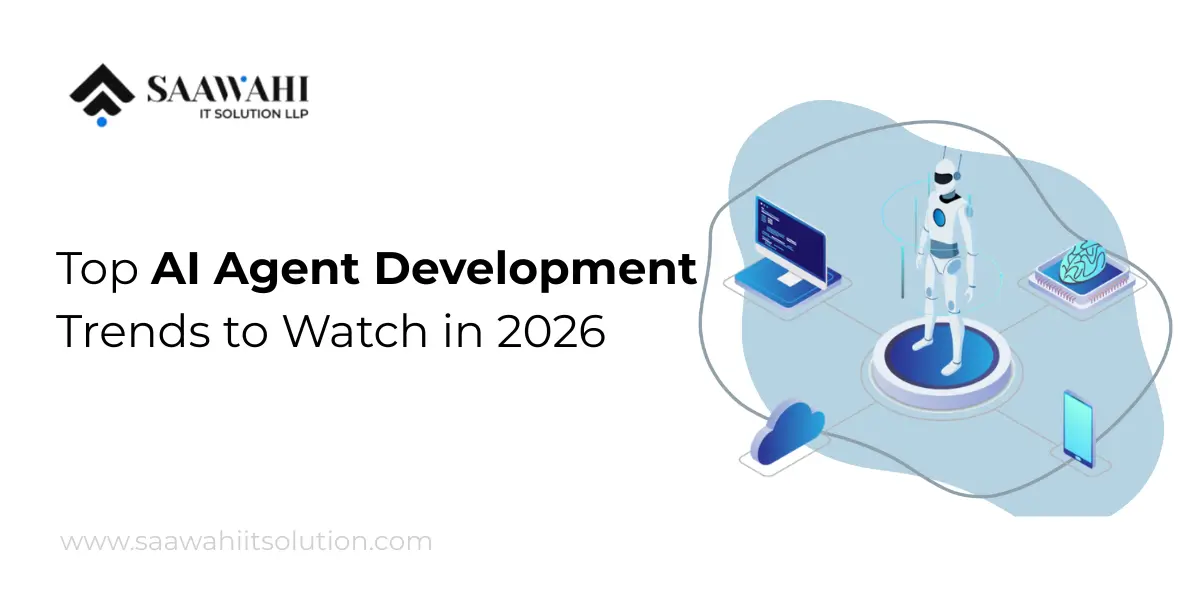
AI agents are no longer experimental tools or chat-based assistants. By 2026, they are becoming autonomous digital workers capable of planning tasks, executing workflows, making decisions, and collaborating with humans and systems in real time.
Businesses are moving beyond traditional automation and rule-based bots toward AI agent development that combines:
This shift is driving massive demand for AI agent development services and specialized AI agent development companies that can build scalable, secure, and business-ready agent ecosystems.
In this article, we explore the top AI agent trends shaping 2026, why they matter, and how organizations can leverage them for competitive advantage.
An AI agent is an intelligent system that can:
Unlike chatbots, AI agents don’t just respond — they act.
Examples:
This evolution is redefining AI agent development from simple conversational AI into enterprise-grade automation architecture.
In 2026, enterprises are shifting from isolated agents to multi-agent architectures, where multiple AI agents collaborate like teams.
How it works:
Why it matters:
This trend is pushing AI agent development companies to design agent ecosystems rather than standalone bots.
Short-term prompts are no longer enough.
Modern AI agents in 2026 use:
Business impact:
This makes AI agent development services critical for designing secure memory layers that comply with data privacy and governance policies.
AI agents are increasingly tool-native, not just language-native.
They can:
Popular tool stacks in 2026:
Why this trend matters for businesses:
AI agents become operational assets, not just interfaces.
Any serious AI agent development company must now focus on tool orchestration and error handling, not just prompt engineering.
One of the fastest-growing use cases in 2026 is AI-powered workflow automation using agents.
AI agents are replacing:
Examples:
This trend is driving demand for custom AI agent development services that integrate deeply with ERP, CRM, and internal systems.
Fully autonomous AI isn’t always ideal.
In 2026, the best AI agent systems follow a human-in-the-loop approach:
Benefits:
This trend aligns with Google’s Helpful Content + Trust signals, making it an important consideration for businesses adopting AI agents responsibly.
Generic agents are losing relevance.
The future belongs to domain-trained AI agents, such as:
These agents:
This is where experienced AI agent development companies outperform DIY solutions.
Static data is outdated.
In 2026, AI agents increasingly operate on:
Use cases:
This trend makes real-time architecture design a core skill in advanced AI agent development services.
As AI agents gain execution power, security becomes non-negotiable.
Key focus areas in 2026:
Businesses are choosing AI agent development partners who prioritize governance-by-design, not afterthoughts.
A major shift in 2026 is the rise of Agent-as-a-Service (AaaS) models.
Instead of hiring staff, companies deploy:
These agents:
This is transforming how organizations evaluate ROI from AI agent development investments.
In earlier years, AI agents were POCs.
In 2026, businesses ask:
Successful AI agent implementations are:
This shift favors professional AI agent development companies over generic AI tools.
Building AI agents isn’t just about models — it requires:
A trusted AI agent development company helps organizations:
Look for:
Avoid one-size-fits-all solutions — AI agents must be tailored to your business logic.
AI agent development is moving beyond innovation hype and entering a phase of operational dependency. Beyond 2026, AI agents will no longer be viewed as optional productivity tools—they will function as core digital infrastructure, embedded directly into business processes, decision systems, and customer experiences.
The next evolution will not be about more intelligent models, but about better-orchestrated agent ecosystems—where multiple AI agents collaborate, self-correct, and operate within clearly defined governance frameworks. Businesses that treat AI agents as long-term assets—rather than short-term experiments—will gain sustained advantages in speed, cost efficiency, and scalability.
From a commercial standpoint, organizations that invest early in custom AI agent development services will be able to:
However, success will depend heavily on how these agents are built. Generic tools and plug-and-play solutions will struggle to meet enterprise requirements around security, compliance, and reliability. This is why partnering with an experienced AI agent development company becomes critical—one that understands not just AI models, but business logic, system integration, and long-term governance.
Looking ahead, AI agents will increasingly act as digital employees, collaborating with human teams, learning continuously, and driving outcomes autonomously. Companies that design their AI agent strategy today are not just adopting new technology—they are redefining how work gets done in the decade ahead.
The question is no longer if AI agents will transform your business—but who will build them, how well they will be governed, and how fast they will deliver measurable ROI.

Wama Sompura is the CEO of Saawahi IT Solution, leading innovations in AI, automation, and digital solutions that help businesses drive efficiency and growth.
© Copyright 2025 All Rights Reserved. Saawahi IT Solution LLP.